Salvator Rosa’s “Democritus in Meditation”: A Portrait of Philosophical Doubt
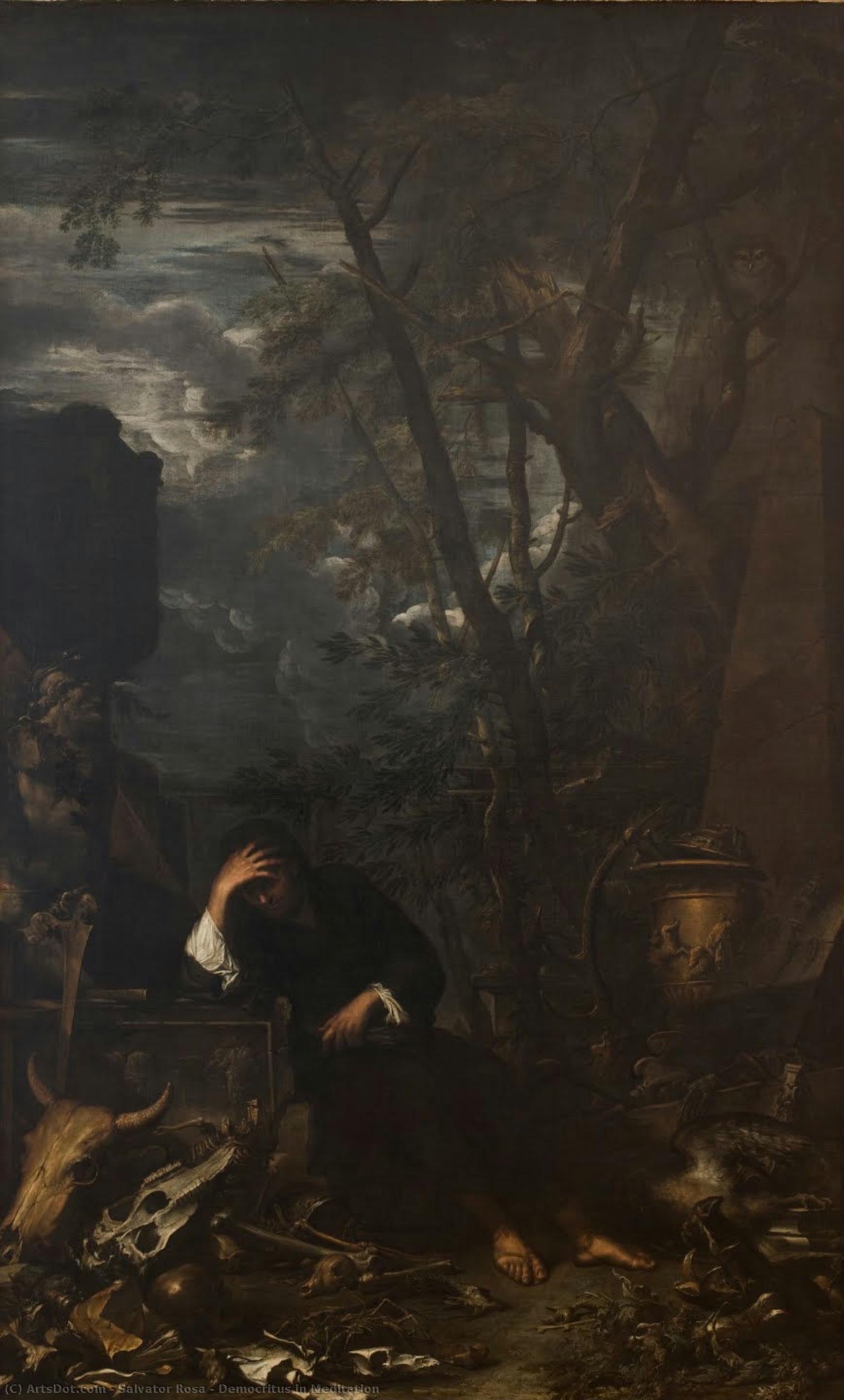
Salvator Rosa's "Democritus in Meditation," painted around 1650-1651, is more than just a portrait; it’s a profound meditation on the nature of existence itself. This captivating work, now housed within the Metropolitan Museum of Art, offers a rare glimpse into the mind of the ancient Greek philosopher Democritus, rendered with Rosa's signature blend of dramatic realism and brooding introspection. The painting immediately draws the viewer in with its stark setting – a desolate landscape dominated by weathered stone, skeletal remains, and the looming presence of death. Democritus, seated upon a simple block, embodies a quiet despair, his head bowed as if wrestling with the fundamental questions of life and mortality. He’s not engaged in lively debate or philosophical discourse, but rather lost in solitary contemplation, a visual representation of the philosopher's core belief: that all things are ultimately composed of atoms moving randomly through an empty void.
A Masterpiece of Baroque Drama and Technique
Rosa’s masterful technique is evident throughout “Democritus in Meditation.” The artist employs a rich, dark palette—deep browns, grays, and blacks—to create a sense of somberness and decay. The lighting is dramatic, casting long shadows that emphasize the figure's isolation and vulnerability. Notice the meticulous detail with which Rosa renders the textures of the stone, the folds of Democritus’ cloak, and even the scattered bones – each element contributing to the painting’s overall sense of realism and weight. The use of etching with drypoint adds a subtle textural quality, enhancing the feeling of age and decay. Rosa's skill in capturing both the physical form and the psychological state of his subject is truly remarkable.
Symbolism and Philosophical Resonance
The painting’s symbolism is layered and deeply resonant. The setting itself—a graveyard or a desolate landscape—represents the inevitable passage of time and the fragility of human existence, directly reflecting Democritus' atomistic philosophy. The scattered bones serve as a stark reminder of mortality, while the discarded helmet and books suggest the futility of worldly pursuits. Even the bird soaring above Democritus can be interpreted symbolically – perhaps representing freedom from earthly concerns or simply an indifferent observer of human suffering. Rosa deliberately chose this subject matter to explore themes of skepticism, materialism, and the limitations of human knowledge—ideas central to Democritus’ thought.
Context within Rosa's Artistic World
“Democritus in Meditation” is part of a larger body of work by Salvator Rosa that often explored themes of moral philosophy, skepticism, and the relationship between humanity and nature. Rosa was known for his unconventional approach to art, frequently incorporating elements of satire, allegory, and even melodrama into his paintings. He deliberately challenged conventional artistic norms, rejecting the idealized beauty favored by many of his contemporaries. This painting is particularly interesting in relation to Rosa’s other works depicting Diogenes throwing away his bowl – a seemingly contradictory image that highlights the artist's complex relationship with both worldly success and philosophical detachment. Rosa himself was a man of contradictions—a flamboyant personality who often engaged in scandalous behavior, yet also possessed a deep sense of moral seriousness.
Today, “Democritus in Meditation” continues to captivate viewers with its powerful depiction of human doubt and the enduring questions of philosophy. It’s a testament to Rosa's artistic genius and his ability to infuse his paintings with profound psychological depth. ArtsDot offers high-quality reproductions that allow you to experience this iconic work of art in your own home or office, bringing a touch of philosophical contemplation to any space.