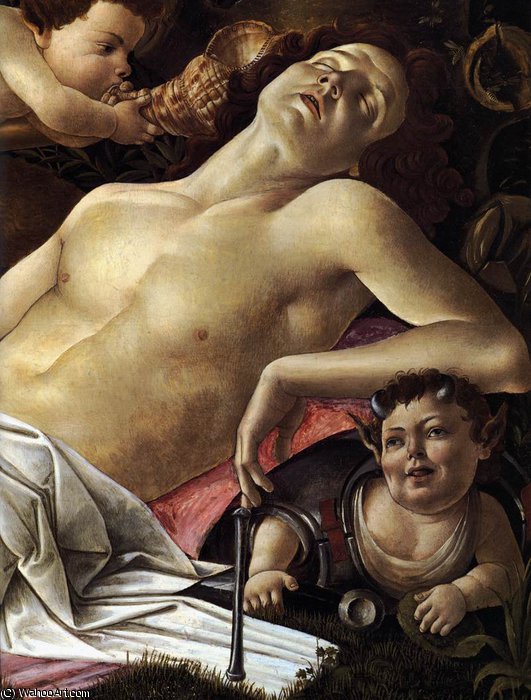
Botticelli’s serene Venus and Mars portrays exquisite grace amidst mythological symbolism—a captivating glimpse into Renaissance Florence. Admire the delicate depiction of love and power by this celebrated artist.
Discover Sandro Botticelli (1445-1510), Renaissance master of 'Birth of Venus' & 'Primavera'. Explore his elegant style, mythological themes, and lasting influence on art history!
A Serene Reconciliation of Cosmic Forces
In the heart of a lush, verdant forest, Sandro Botticelli captures a moment of profound stillness that transcends the boundaries of time. This exquisite detail from Venus and Mars presents a scene where the chaotic energies of conflict are surrendered to the gentle embrace of peace. The goddess Venus, an emblem of love and fertility, reclines with an effortless grace, cradling a sleeping infant whose innocence serves as a silent testament to divine grace. Beside her, the formidable Mars, god of war, appears uncharacteristically subdued, his usual martial strength humbled by the tranquil presence of the feminine. This visual dialogue between the conqueror and the nurturer creates a captivating atmosphere of serenity amidst potential conflict, making it an ideal centerpiece for any space seeking to evoke contemplative calm.
The Ethereal Language of Line and Light
Botticelli’s technical mastery is on full display through his signature use of tempera on wood panel, a medium that allows for a luminous quality rarely matched in the annals of the Renaissance. Each stroke is part of a larger, flowing contour, where the artist employs a masterful use of line to create drapery that seems to move with a life of its own. The meticulous layering of pigments produces subtle gradations and vibrant colors that breathe life into the forest backdrop, lending a sense of depth and atmospheric weight to the scene. For the discerning collector, the ethereal delicacy of this work offers more than just visual beauty; it provides a window into the refined elegance of the Florentine school, where every detail—from the soft skin of the infant to the resting violin on the forest floor—is rendered with breathtaking precision.
A Timeless Allegory for the Modern Interior
Beyond its aesthetic splendor, this artwork serves as a profound philosophical meditation on the duality of human existence. It embodies the Renaissance humanist ideal: the reconciliation of opposing forces, such as passion and reason, or strength and vulnerability. The presence of the violin, resting quietly in the shadows, suggests that even amidst the complexities of life, harmony can be found through art and nature. Integrating a high-quality reproduction of this masterpiece into an interior design scheme offers more than mere decoration; it introduces a narrative of moral virtue and spiritual growth. Whether placed in a grand salon or a quiet study, the painting acts as a focal point for reflection, inviting viewers to find their own moment of peace within the eternal dance of the cosmos.