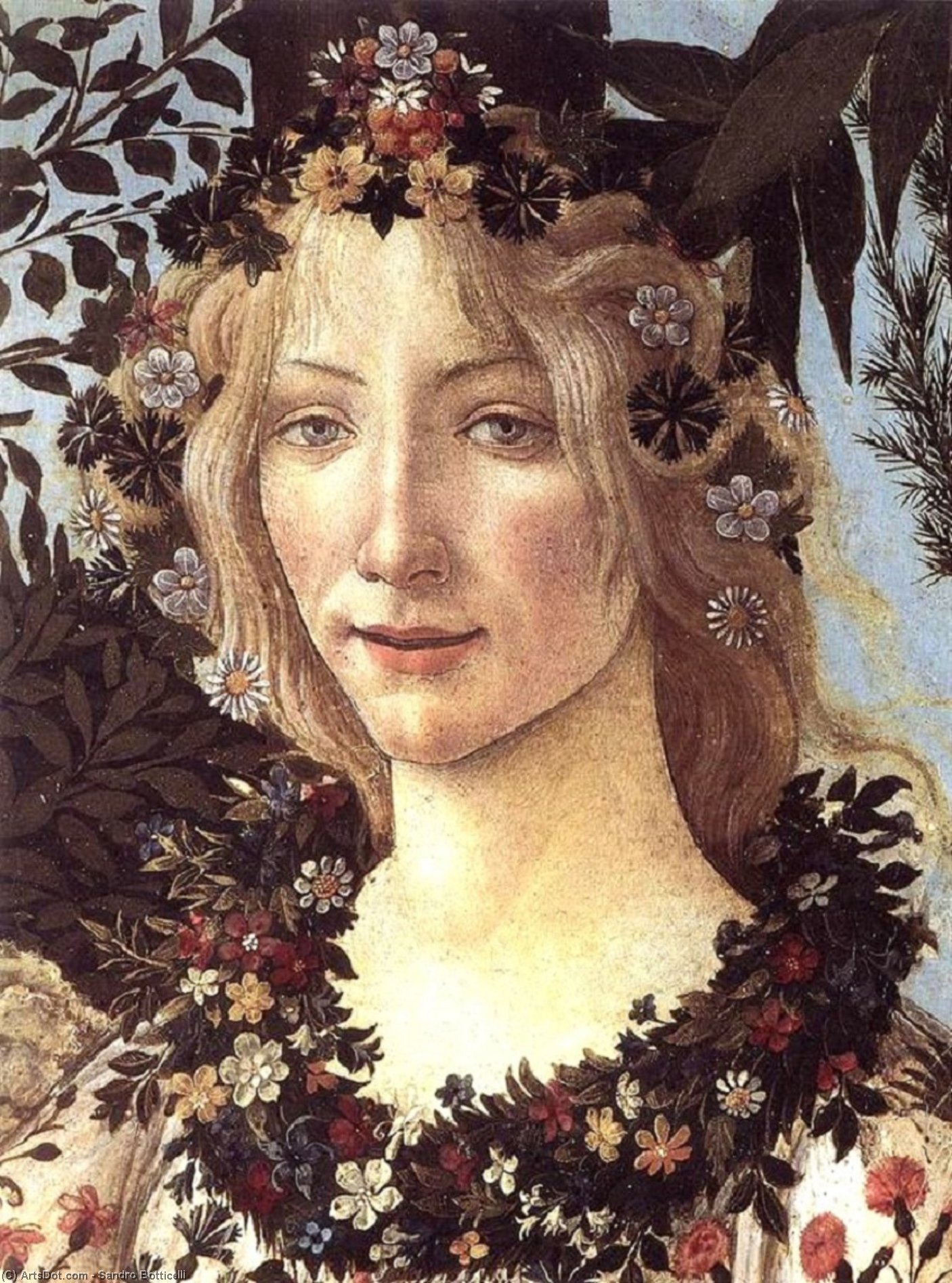
Botticelli’s ‘Primavera’ detail: A serene Renaissance portrait of a young woman in an opulent floral wreath. Explore this iconic 1482 masterpiece's beauty & symbolism.
Discover Sandro Botticelli (1445-1510), Renaissance master of 'Birth of Venus' & 'Primavera'. Explore his elegant style, mythological themes, and lasting influence on art history!
Step into the Renaissance heart of Florence at the Uffizi Gallery! Explore masterpieces by Botticelli, Leonardo da Vinci & Michelangelo – an unforgettable art experience.
A Vision of Spring: Botticelli’s *Primavera* (Detail)
This exquisite detail from Sandro Botticelli's monumental masterpiece, *Primavera*, painted around 1482, offers a captivating glimpse into the heart of Florentine Renaissance ideals. More than just a portrait, it is a fragment of a complex allegorical garden – a celebration of love, beauty, and renewal.
Subject & Composition
The focus rests upon a young woman, her face radiating serene grace. She is enveloped by an opulent wreath of meticulously rendered flowers, which isn’t merely decorative but integral to the artwork's meaning. Botticelli masterfully centers the composition on her visage and upper torso, allowing the abundant foliage to frame her like a blossoming halo. The shallow depth of field draws the viewer intimately close, emphasizing the delicate features and ethereal quality of the subject.
Style & Technique
Botticelli’s style is instantly recognizable – an elegant linearity that gracefully bridges the gap between the late Gothic period and the burgeoning Renaissance. He employs oil paint on panel with remarkable skill, achieving a smoothness and richness in color saturation characteristic of the era. Notice the delicate brushstrokes used to define each petal and leaf, creating a tactile quality that invites close inspection. The artist’s attention to detail is astounding; from the subtle modeling of the face to the intricate patterns within the floral arrangement, every element is rendered with precision and care.
Historical Context & Symbolism
Created during the height of the Medici patronage in Florence, *Primavera* reflects the humanist philosophies prevalent at the time – a renewed interest in classical mythology and a celebration of earthly beauty. The flowers themselves are laden with symbolic meaning. While specific interpretations vary, they often represent virtues such as fidelity, love, and fertility. The overall scene is believed to be an allegory of Spring’s arrival and the blossoming of love, potentially linked to themes of Neoplatonic philosophy popular within Lorenzo de' Medici’s court. Botticelli was commissioned by the Medici family, powerful patrons who shaped the artistic landscape of Florence.
Emotional Impact & Legacy
This detail evokes a profound sense of tranquility and grace. The soft, diffused lighting contributes to an atmosphere of ethereal beauty, while the subject's serene expression invites contemplation. Botticelli’s *Primavera*, even in this fragment, is a testament to his ability to capture not just physical likeness but also the inner spirit of his subjects. His work was initially somewhat overshadowed after his death, but experienced a dramatic revival in the 19th century thanks to the Pre-Raphaelites who championed its beauty and symbolic depth. Today, Botticelli is celebrated as one of the most important artists of the Italian Renaissance, and *Primavera* remains an iconic masterpiece.
For Collectors & Designers
A reproduction of this detail would be a stunning addition to any collection or interior space. Its delicate beauty and rich symbolism lend themselves well to both traditional and contemporary settings. The warm earth tones and highlights of pink and red offer versatility in color schemes, creating a focal point that exudes elegance and sophistication. Consider pairing it with complementary floral arrangements or within a gallery wall showcasing Renaissance art.