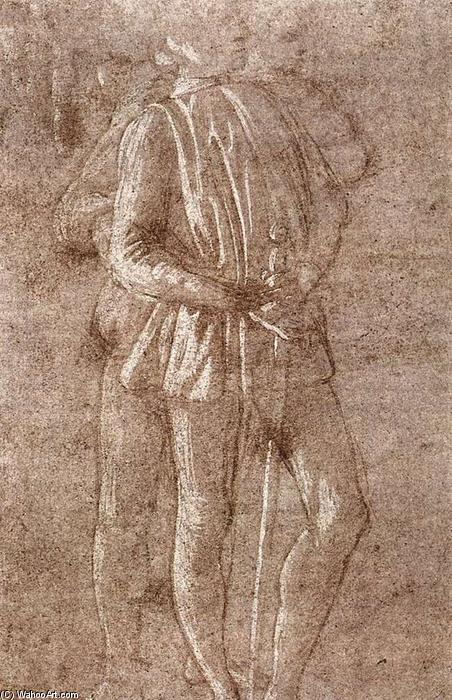
Explore Sandro Botticelli’s ‘Study of Two Standing Figures,’ a captivating 1475 charcoal drawing showcasing Renaissance elegance & intimate emotion. A rare study, perfect for art lovers!
Discover Sandro Botticelli (1445-1510), Renaissance master of 'Birth of Venus' & 'Primavera'. Explore his elegant style, mythological themes, and lasting influence on art history!
A Moment of Intimate Connection: Botticelli’s Study of Two Standing Figures
This captivating charcoal drawing by Sandro Botticelli, created around 1475, offers a rare and intimate glimpse into the artist's preparatory process. Far from a finished composition, this *Study of Two Standing Figures* is a powerful exploration of form, gesture, and human connection – a testament to Botticelli’s mastery of line and his deep understanding of the human anatomy.
Subject & Composition
The artwork depicts two figures locked in a close embrace. The vertical orientation emphasizes the height and closeness of the subjects, drawing the viewer's eye upwards along their intertwined forms. It is not a narrative scene but rather an investigation into the *feeling* of connection – a study of how bodies relate to one another in a moment of shared intimacy or perhaps protection. The lack of background detail focuses all attention on the figures themselves and the emotional weight of their interaction.
Style & Technique
Botticelli’s style here is distinctly Renaissance, showcasing his dedication to anatomical accuracy alongside an expressive use of line. He employs hatching and cross-hatching techniques with remarkable skill, building up tonal variations that suggest volume and texture without relying on color. The lines are loose and fluid, indicative of a preparatory sketch, yet they possess a grace and elegance characteristic of Botticelli’s work. This is dry media – likely charcoal or graphite – applied to paper, creating a textured surface that adds depth and visual interest.
Historical Context & Artistic Lineage
Created during the Early Renaissance in Florence, this study reflects the period's renewed interest in classical art and humanism. Botticelli, born Alessandro di Mariano di Vanni Filipepi, bridged the gap between the late Italian Gothic style and the emerging Renaissance aesthetic. While celebrated for his mythological paintings like *The Birth of Venus* and *Primavera*, works such as this reveal a foundational skill in figure drawing – essential to all his compositions. His training likely began in goldsmithing before transitioning to painting, influencing his precise linework.
Symbolism & Emotional Resonance
While the specific meaning remains open to interpretation, the embrace inherently symbolizes intimacy, affection, and perhaps even solace or protection. The figures’ closeness suggests a deep emotional bond. In the context of Renaissance art, such studies could have been preliminary sketches for larger religious or mythological works, where human interaction played a crucial role in conveying narrative and emotion.
Impact & Interior Design Considerations
The monochromatic palette and understated elegance of this drawing make it incredibly versatile for interior design. A reproduction would lend a sophisticated, timeless quality to any space – from a classic study or library to a modern living room. The artwork’s quiet contemplation and emotional resonance create a focal point that invites viewers to pause and reflect. Its large size (165 x 100 cm) ensures it commands attention without overwhelming the surrounding décor. This piece is ideal for those seeking art that speaks to the universal themes of human connection and emotion. Its subtle beauty offers a refined touch, perfect for collectors and design enthusiasts alike.