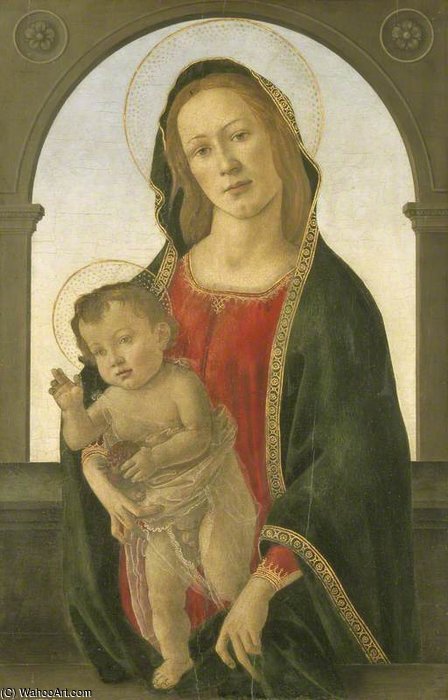
A Celestial Encounter in Florentine Gold
In the heart of the Italian Renaissance, where the light of humanism began to illuminate the shadows of the Middle Ages, Sandro Botticelli captured a moment of profound tenderness that continues to resonate across centuries. The Virgin and Child with a Pomegranate is not merely a religious icon; it is a breathtaking window into the soul of Florence during its golden age. As one gazes upon this masterpiece, the viewer is immediately drawn into an intimate circle of devotion, where the boundaries between the earthly and the divine seem to dissolve. The composition, famously executed in a tondo—a circular format that focuses the eye inward—creates a sense of cosmic harmony, pulling the observer into a private, sacred space shared only by the Madonna, her Christ Child, and the celestial attendants who surround them.
The technical mastery displayed in this work reflects the pinnacle of Botticelli’s skill with tempera on panel. Through the delicate application of tempera grassa, the artist achieved a luminous, almost pearlescent quality that breathes life into the skin of the Virgin and the soft features of the infant Jesus. There is a rhythmic grace to the lines, a hallmark of Botticelli’s hand, which guides the eye through a landscape of flowing drapery and ethereal faces. He employs a subtle sfumato to soften the contours of the figures, allowing them to emerge from the background with a naturalistic warmth that avoids the rigidity of earlier eras. For the discerning collector or interior designer, this painting offers a rare balance of structural strength and atmospheric lightness, making it a centerpiece capable of anchoring a room with both elegance and historical weight.
Symbolism and the Language of Devotion
Beyond its surface beauty, every element within this circular frame serves as a silent sermon, rich with the theological and humanist allegories prevalent in the Medici era. The most striking symbol is, of course, the pomegranate held within the scene. To the Renaissance mind, this fruit was far more than a seasonal offering; its bursting seeds represented the unity of the Church and the promise of eternal life through Christ’s resurrection. The deep, rubied hues of the fruit act as a poignant foreshadowing of the Passion, adding a layer of bittersweet gravity to the otherwise serene maternal embrace. This interplay between the sweetness of infancy and the inevitability of sacrifice creates an emotional complexity that elevates the work from a simple portrait to a profound meditation on mortality and grace.
The setting itself—a softly illuminated window—acts as a visual metaphor for divine revelation. Light pours into the composition, not as a harsh glare, but as a gentle, sanctifying presence that highlights the purity of the subjects. This use of light suggests that the figures are not merely sitting in a room, but are bathed in the radiance of God’s favor. For those seeking to bring inspiration into a living space, this artwork provides more than just decoration; it offers a sense of tranquility and spiritual depth. Whether placed in a sunlit gallery or a quiet study, the Madonna of the Pomegranate serves as a timeless reminder of the beauty found in protection, nurturing, and the enduring promise of renewal.