A Glimpse Through the Lens of Luminism
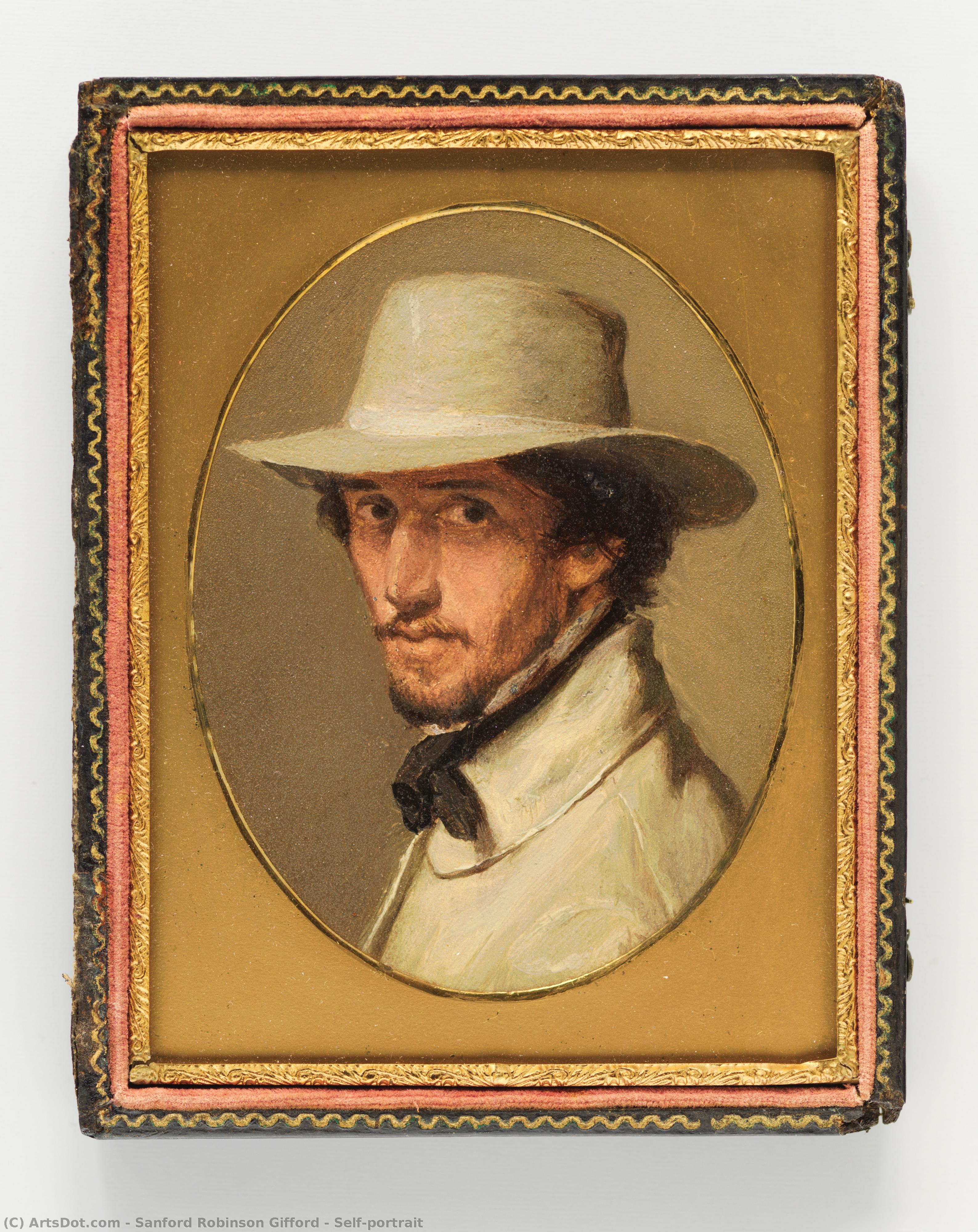
In the intimate confines of an oval frame, reminiscent of a precious daguerreotype, Sanford Robinson Gifford invites us into a private moment of self-reflection. His 1853 Self-Portrait is far more than a mere record of his physical likeness; it is a profound window into the soul of a rising master of the Hudson River School. Painted when the artist was just thirty years old, this delicate work captures Gifford at a pivotal moment in his career, standing on the precipice of becoming a pioneer of Luminism. The composition, executed with an exquisite sensitivity to light and atmosphere, presents the artist not as a distant figure of prestige, but as a working craftsman, deeply connected to the natural world he so famously celebrated.
The subject is presented in his functional attire—a broad-brimmed hat designed to shield his eyes from the sun and an off-white smock accented by a dark kerchief. This choice of clothing serves as a subtle nod to his identity as a plein-air painter, someone whose life was dictated by the shifting qualities of daylight. As he turns to confront the viewer with a gaze that is both bold and contemplative, there is an undeniable sense of quiet confidence. The painting captures a tension between the artist's internal world and his external observation, a duality that would define much of his later, more expansive landscapes.
Mastery of Light and Delicate Technique
Technically, this portrait showcases the early brilliance of Gifford’s hand. Eschewing the heavy, dramatic impasto often associated with larger-scale historical paintings, he employs small, delicate brushstrokes that lend the piece a soft, ethereal quality. The palette is remarkably subtle, relying on nuanced shifts in tone rather than jarring colors to create depth and form. This mastery of light—the very essence of the Luminist style—is already evident here; even within this small-scale work, there is a sense of diffused radiance that seems to emanated from within the canvas itself.
For collectors and interior designers, this piece offers a unique opportunity to possess a fragment of American art history. The miniature scale and the oval format lend it an air of intimacy and elegance, making it an ideal centerpiece for a curated gallery wall or a sophisticated study. As a reproduction, this work brings the quiet dignity of the 19th-century Hudson River School into the modern home, providing a focal point that encourages slow looking and deep emotional resonance. It is a testament to the idea that true artistic power does not require grand proportions, but rather an unerring ability to capture the fleeting beauty of a single, luminous moment.