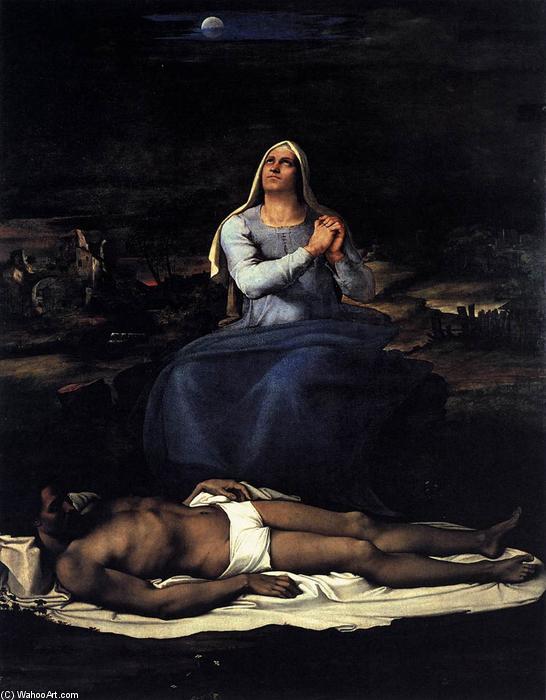
Sebastiano del Piombo (1485-1547) was a Venetian-Roman Renaissance painter known for his unique blend of Venetian colorism and Roman grandeur. His masterful works, including "Pietà" and "Raising of Lazarus," showcase Mannerist style and significant artistic innovation.
Discover Viterbo’s history at Museo Civico! Explore Etruscan & Roman artifacts, plus an art gallery featuring works by Sebastiano del Piombo. Located in the beautiful Santa Maria della Verità complex.
Pietà by Sebastiano Del Piombo: A Renaissance Echo of Sorrow
The Pietà, executed in 1516 by Sebastiano del Piombo and housed at the Museo Civico in Viterbo, Italy, stands as a monumental testament to the artistic fervor of the High Renaissance. More than just a depiction of grief—the Virgin Mary cradling the lifeless body of Jesus Christ—it embodies profound theological contemplation and masterful execution, cementing its place among the most iconic images of Christian iconography.
Del Piombo’s genius lay in his ability to synthesize Venetian colorism with Roman grandeur. Trained under Giovanni Bellini and Giorgione, he absorbed the luminous palettes and atmospheric perspective characteristic of Venice while simultaneously embracing the monumental scale and sculptural dynamism favored by Rome’s artistic elite. This dual influence is immediately apparent in “Pietà,” where a rich tapestry of blues and whites dominates the composition—a deliberate nod to Venetian tradition—yet simultaneously conveys an overwhelming sense of solemnity.
Composition and Technique: Mastering Light and Form
- Central Figure: Mary’s serene posture exudes compassion as she gently supports Jesus's limp torso. Her drapery is rendered with meticulous detail, showcasing the artist’s command of fabric folds and shading—a technique honed during his formative years in Venice.
- Jesus Christ: The depiction of Jesus embodies Roman sculptural ideals. His body lies supine, draped in a pristine white cloth that contrasts sharply against the dark background, emphasizing vulnerability and highlighting Del Piombo's understanding of anatomy.
- Landscape Background: A stylized landscape beneath a night sky serves as an evocative backdrop, adding depth to the scene and subtly suggesting a spiritual realm beyond earthly concerns. The artist skillfully employs chiaroscuro—the dramatic interplay of light and dark—to sculpt volume and create a palpable atmosphere of mourning.
Historical Context: Michelangelo’s Influence and Venetian Legacy
The Pietà represents a pivotal collaboration between Del Piombo and Michelangelo Buonarroti, marking the zenith of Renaissance artistic innovation. Michelangelo provided the cartoon for the painting—a preparatory sketch that meticulously outlined the figures and their poses—demonstrating his unwavering commitment to capturing human emotion with unparalleled accuracy. This partnership underscores the interconnectedness of artistic circles during the period and exemplifies the shared pursuit of sublime beauty.
Furthermore, “Pietà” embodies the Venetian legacy of expressive colorism, a stylistic approach championed by Giorgione and Bellini that prioritized emotional resonance over strict realism. Del Piombo’s masterful use of pigment—particularly blues and whites—captures the essence of sorrow and reverence—a testament to his artistic vision and enduring influence on subsequent generations of painters.
Symbolism: Grief, Redemption, and Divine Compassion
The Pietà transcends mere visual representation; it speaks to fundamental theological concepts. Mary’s grief symbolizes divine compassion and maternal love—the embodiment of Christian virtues—while Jesus's lifeless body represents sacrifice and redemption. The painting invites contemplation on themes of mortality and immortality, prompting viewers to grapple with questions of faith and spirituality.
Its placement in the Museo Civico Viterbo ensures that this masterpiece continues to inspire awe and admiration, offering a timeless glimpse into the artistic brilliance of the Renaissance—a period defined by its profound engagement with human emotion and spiritual aspiration.