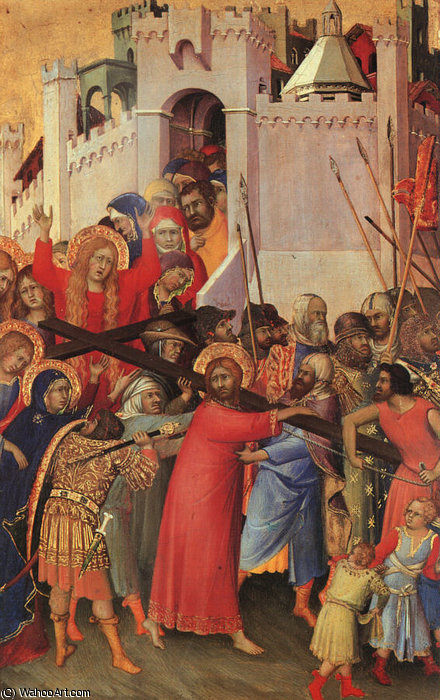
Explore Simone Martini’s Orsini Polyptych – a masterpiece of Late Gothic art featuring poignant depictions of the Passion and embodying Florentine elegance. Admire its intricate detail and radiant gold leaf at KMSKA.
Discover Simone Martini, the Sienese master of elegance and grace! His International Gothic paintings—like 'Maestà'—blend religious themes with courtly refinement & exquisite detail.
Simone Martini’s Orsini Polyptych: A Window Into Medieval Devotion
The Orsini Polyptych, created around 1326-34 by Simone Martini for Cardinal Napoleone Orsini, stands as a remarkable testament to the artistic fervor of Siena during its zenith. More than just a decorative object, it’s a profound meditation on faith and mortality—a microcosm of medieval piety rendered with breathtaking skill and luminous color. Its current location is split between the Louvre in Paris, the Royal Museum of Fine Arts in Antwerp and the Gemäldegalerie Berlin, ensuring that this masterpiece continues to inspire awe and scholarly debate centuries after its creation.
A Synthesis of Gothic Elegance
Martini’s style firmly establishes itself within the International Gothic tradition—a movement characterized by a delicate balance between Byzantine grandeur and Northern European realism. Unlike Giotto’s earlier frescoes, Martini eschewed harsh lines and emphasized graceful contours, prioritizing expressive detail and nuanced coloration. The artist skillfully employed tempera paint on wooden panels, layering thin glazes of pigment to achieve astonishing luminosity and depth – techniques that would foreshadow the burgeoning Renaissance aesthetic. This meticulous approach is evident in every brushstroke, creating an atmosphere of serene contemplation.
Narrative Drama Within Miniature Dimensions
The polyptych’s narrative unfolds across four interconnected scenes: “The Carrying of the Cross,” “The Lance Thrust,” “The Descent from the Cross” and “The Entombment.” Martini meticulously depicts Christ’s suffering—the agonizing weight of the cross, the piercing lance wound, the solemn procession of mourners—with palpable emotion. The figures are rendered with astonishing realism, conveying psychological complexity through subtle gestures and facial expressions. Notably, Martini's depiction of Mary Magdalene kneeling before Christ’s corpse embodies compassion and sorrow – a poignant reminder of humanity’s vulnerability in the face of divine judgment.
Symbolism Rooted in Medieval Theology
Beyond its visual beauty, the Orsini Polyptych is laden with symbolic significance reflecting the dominant theological preoccupations of the era. The inclusion of Longinus' lance—said to have pierced Christ’s side and restored his sight—represents redemption through sacrifice. Similarly, the skull at the base of “The Descent from the Cross” symbolizes Adam’s mortality and the universality of human suffering – a visual echo of Augustine’s theological framework. Furthermore, the Orsini family coat-of-arms prominently displayed on the panels underscores the patron's piety and reinforces the artwork’s devotional purpose.
A Legacy of Artistic Influence
The Orsini Polyptych profoundly impacted subsequent artists, particularly those working in France during the late Medieval period. Its innovative use of color and its expressive portrayal of human emotion served as a catalyst for stylistic developments that would ultimately propel Europe into the Renaissance. Studying Martini’s masterpiece offers invaluable insight into the artistic sensibilities of a pivotal moment in Western art history—a testament to the enduring power of beauty and faith communicated through masterful technique.