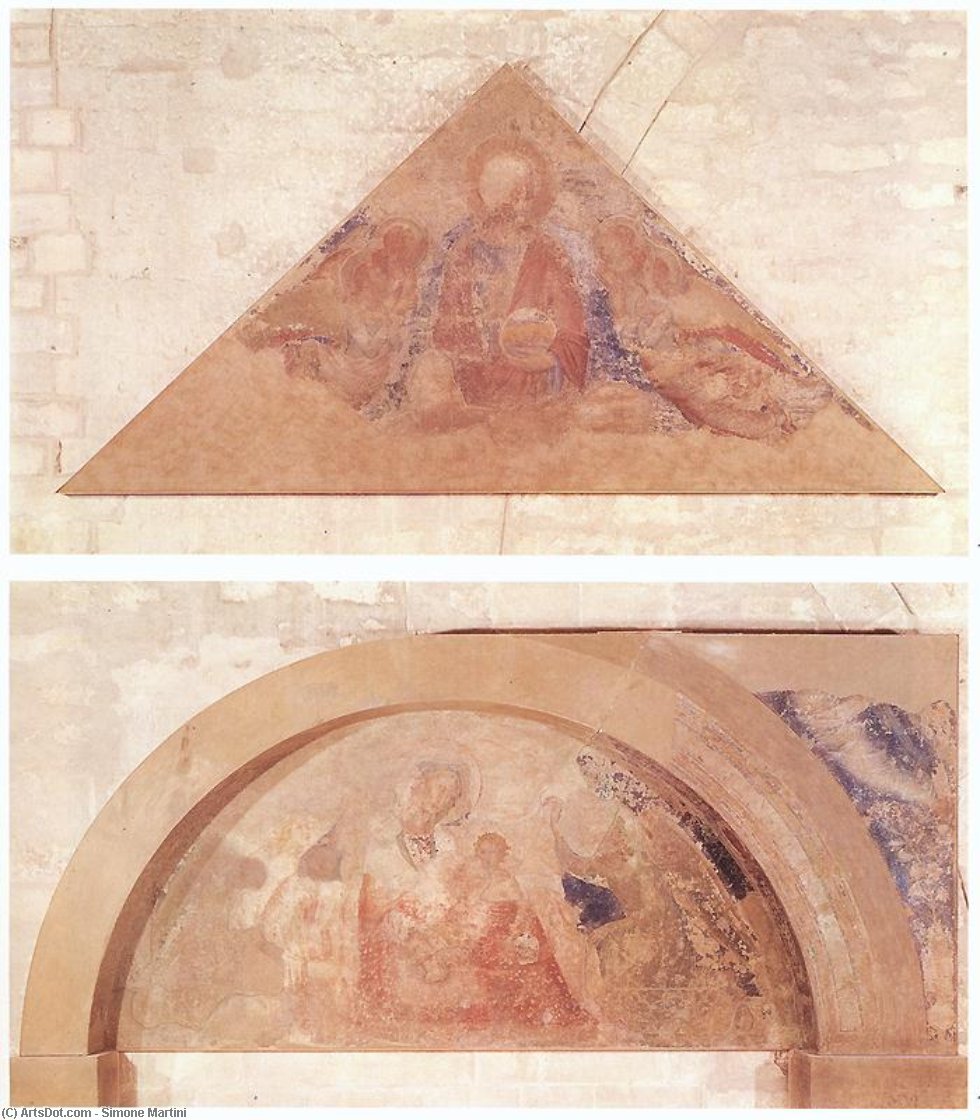
Marvel at Simone Martini's 'Saviour Blessing & Madonna of Humility,' a stunning 1341 masterpiece from Siena’s Palazzo Pubblico. Witness intricate detail and courtly elegance in this iconic Gothic tympanum and lunette.
Discover Simone Martini, the Sienese master of elegance and grace! His International Gothic paintings—like 'Maestà'—blend religious themes with courtly refinement & exquisite detail.
Explore Avignon Cathedral (Notre-Dame des Doms)! Discover Gothic & Romanesque art, Pope John XXII's mausoleum, panoramic views & UNESCO history in Provence.
A Vision of Divine Grace: Simone Martini’s ‘Saviour Blessing’
Simone Martini's “Saviour Blessing (Tympanum) and Madonna of Humility (Lunette),” painted in 1341, stands as a breathtaking testament to the burgeoning artistic brilliance of early Renaissance Italy. Created for the Avignon Cathedral, this monumental work—a composite of a tympanum depicting Christ’s blessing and a lunette showcasing the Virgin Mary and Child – offers a profound glimpse into the religious fervor and sophisticated aesthetic sensibilities of its time. More than just a depiction of biblical scenes, it's a carefully constructed visual poem, brimming with symbolism and executed with an unparalleled level of detail and elegance that firmly establishes Martini as a master of the International Gothic style. The piece’s enduring appeal lies not only in its technical mastery but also in its ability to evoke a sense of serene spirituality and courtly refinement—qualities deeply rooted in the cultural landscape of Siena, where Martini spent his formative years.
The Symphony of Line and Color
Martini's distinctive style is immediately apparent in the work’s meticulous attention to line and color. The figures are rendered with an exquisite delicacy, their forms flowing and sinuous, imbued with a sense of movement and grace. He employs a vibrant palette—rich blues, reds, golds, and greens—that not only captures the luminosity of the religious subjects but also contributes significantly to the overall atmosphere of opulence and reverence. Notice particularly the use of gold leaf, lavishly applied to highlight key elements such as the garments of Christ and the Virgin Mary, drawing the viewer’s eye and emphasizing their divine status. The background is rendered with a subtle, almost hazy effect, creating depth and suggesting an ethereal realm beyond the earthly confines of the scene. Martini's mastery of perspective—a relatively new development in art at this time—is skillfully employed to create a sense of spatial realism within the stylized framework of the International Gothic style.
Symbolism Woven into Every Detail
“Saviour Blessing” is a rich tapestry of symbolic meaning, reflecting the theological and philosophical currents of the 14th century. The central scene of Christ blessing—a gesture of grace and benediction—is immediately recognizable, yet Martini imbues it with his own unique interpretation. The figures surrounding Christ are not merely decorative; each element carries significant weight. The presence of the Virgin Mary, holding the infant Jesus, symbolizes humility, purity, and divine motherhood. The angels flanking Christ represent heavenly messengers and guardians. Even the architectural details—the arches, columns, and windows—are laden with symbolism, alluding to biblical narratives and theological concepts. The inclusion of a small child in the scene, often interpreted as representing faith or innocence, further reinforces the work’s message of hope and redemption. The very composition itself, with its balanced arrangement of figures and elements, speaks to an underlying harmony and order—a reflection of God's perfect creation.
A Window into Avignon and the Papal Court
The commission for “Saviour Blessing” marked a pivotal moment in Simone Martini’s career. He was summoned to Avignon by Cardinal Jacopo Stefaneschi, one of the Italian Cardinals serving at the Papal court during the period when Avignon had become the seat of the papacy. This move brought Martini into contact with a vibrant and cosmopolitan environment, exposing him to new artistic influences and providing him with opportunities to collaborate with other prominent artists. The work itself offers valuable insights into the visual culture of Avignon—a city renowned for its stunning architecture, elaborate religious ceremonies, and luxurious lifestyle. It’s believed that Martini brought his Sienese aesthetic sensibilities to bear on the project, creating a unique synthesis of Italian and French artistic traditions. The painting's presence within the cathedral served as a powerful visual statement about the authority and grandeur of the Papal court.
A Legacy of Elegance
“Saviour Blessing (Tympanum) and Madonna of Humility (Lunette)” remains one of Simone Martini’s most celebrated works, exemplifying his extraordinary talent and artistic vision. Its exquisite detail, harmonious composition, and profound symbolism continue to captivate viewers centuries after its creation. Reproductions of this masterpiece offer a remarkable opportunity to experience the beauty and spiritual depth of this iconic work of art—a window into the heart of 14th-century Italy and a testament to the enduring legacy of one of its greatest artistic figures. ArtsDot’s hand-painted reproductions strive to capture not only the visual splendor but also the emotional resonance of Martini's original, ensuring that this timeless treasure can be appreciated by generations to come.