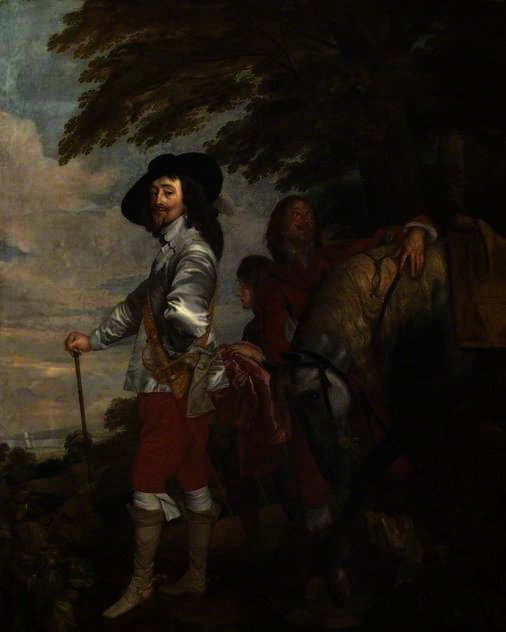
Charles I - (47) by Anthony van Dyck: A Portrait of Power and Nobility
- Artist: Anthony van Dyck
- Date: Unknown
- Style: Baroque
A Grand Display of Royal Status
This striking artwork presents a portrait of Charles I, accompanied by two other men and their horses, set against a backdrop of trees and a distant landscape. The composition immediately conveys an air of formality and nobility, characteristic of the Baroque period's emphasis on grandeur and power. Charles I is positioned slightly off-center, exuding confidence as he holds a walking stick and gazes towards his left. Two other figures flank him: one expertly guides a horse, while the other looks away, adding depth to the scene. The horses themselves are not mere accessories; they are integral to the composition, contributing dynamism and symbolizing strength and control – qualities highly valued in a monarch.
Baroque Technique and Dramatic Lighting
Anthony van Dyck masterfully employs Baroque techniques to create a visually arresting image. The color palette is rich and warm, dominated by reds, grays, and browns, punctuated by accents of white and touches of green within the foliage. Van Dyck’s attention to detail is evident in the rendering of textures – the sheen of fabrics, the roughness of bark, and the glossiness of the horses' coats are all skillfully depicted through precise brushstrokes. The use of chiaroscuro—the dramatic contrast between light and shadow—is particularly effective. A strong light source illuminates Charles I from the front, highlighting his face and clothing while leaving other areas in shadow, enhancing the sense of depth and volume. Perspective is achieved through diminishing size as objects recede into the background and atmospheric haze suggesting distance.
Symbolism and Historical Context
Beyond its aesthetic appeal, this portrait is rich in symbolism reflecting the political climate of the Caroline era (1625-1649). The sword carried by one of the men likely represents authority and military power. The horses, as mentioned earlier, symbolize strength and control, essential attributes for a ruler. Charles I commissioned portraits like these to project an image of regal authority during a period marked by increasing political tensions that would ultimately lead to the English Civil War. Van Dyck’s role as Principal Painter in Ordinary to Charles I underscores the importance of art as a tool for royal propaganda and self-representation.
Emotional Impact and Artistic Legacy
The overall emotional tone of the portrait is dignified, somewhat aloof, and undeniably powerful. It reflects the formality and grandeur associated with Baroque courtly life. Van Dyck’s skill in capturing not only physical likeness but also a sense of character elevates this work beyond a mere representation; it becomes an enduring testament to Charles I's ambition and the artistic mastery of Anthony van Dyck, one of the most celebrated portraitists of his time. This piece exemplifies Van Dyck’s influence on English art and continues to inspire awe in viewers today.