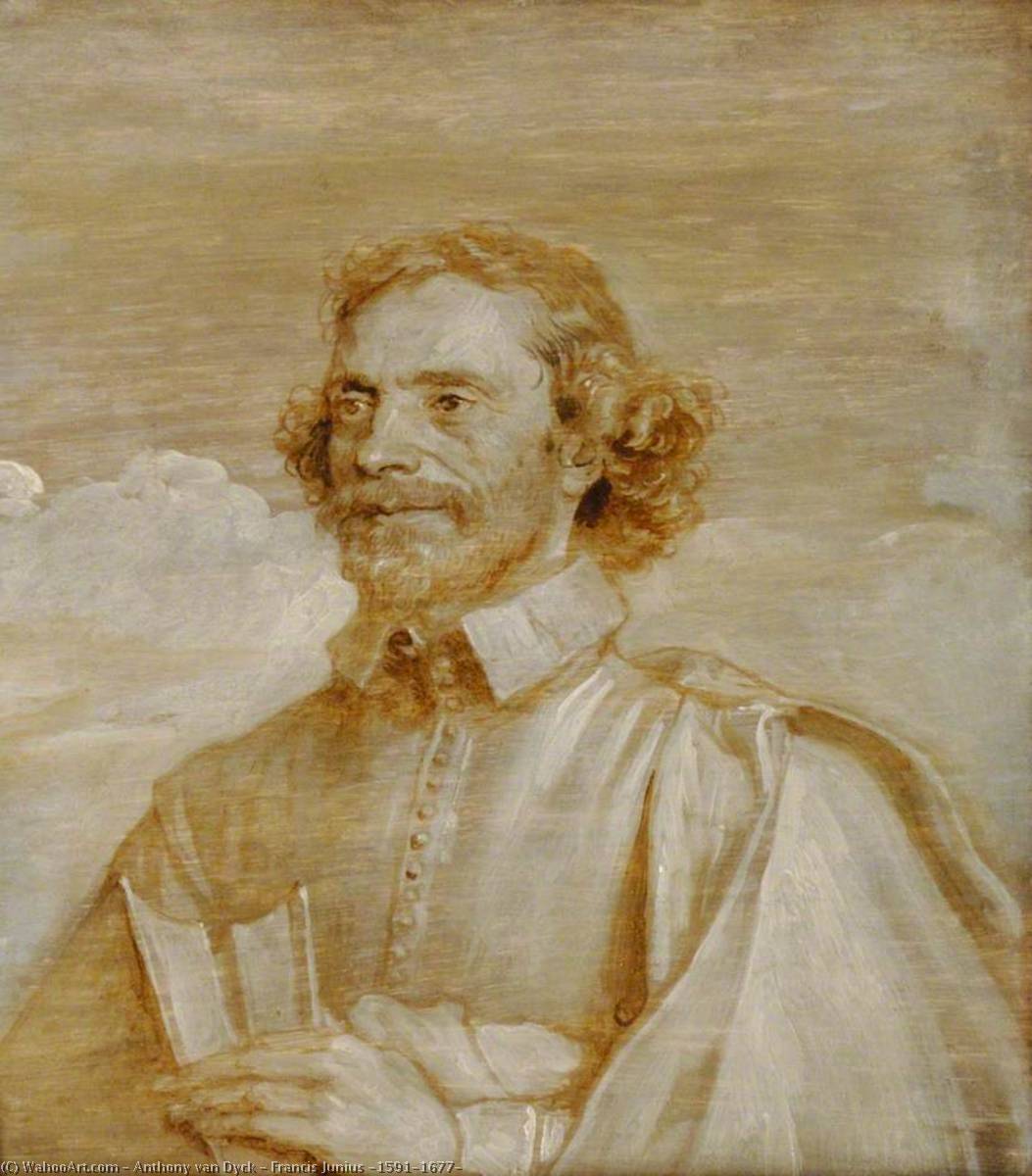
A Portrait of Contemplation: Francis Junius by Sir Anthony van Dyck
Sir Anthony van Dyck’s “Francis Junius (1591–1677)” is more than just a portrait; it's a carefully constructed tableau of intellect, serenity, and the quiet dignity of scholarly life. Painted in 1640, during his influential years at the English court, this work offers a rare glimpse into the mind of a man deeply engaged with the classical world – Francis Junius, a pioneering German philologist whose meticulous study of ancient texts laid the groundwork for modern linguistic scholarship. Van Dyck, already establishing himself as a master of aristocratic portraiture, here demonstrates his remarkable ability to capture not just physical likeness but also the very essence of character.
The painting immediately draws the eye to Junius’s face – a study in thoughtful repose. His long hair, meticulously rendered with a subtle blend of light and shadow, frames a countenance marked by seriousness and perhaps even a hint of melancholy. The beard, equally detailed, adds to his air of learned wisdom. Van Dyck's mastery of chiaroscuro is evident here; the soft illumination highlights Junius’s features while subtly receding into the background, creating a sense of depth and drawing the viewer into his gaze. His hands, clasped together in front of him, speak volumes – not of grand gestures or outward expression, but of inner contemplation, suggesting a man lost in thought, absorbed in the complexities of language and history.
The Setting: A Window to Knowledge
Beyond Junius’s figure lies a carefully orchestrated backdrop that reinforces his intellectual pursuits. An open window reveals a sky – not a dramatic, tempestuous one, but a muted, atmospheric vista. This isn't merely decorative; it subtly symbolizes the vastness of knowledge and the connection between the individual scholar and the wider world of ideas. The inclusion of two books—one positioned near the bottom left corner, the other towards the top right—is particularly significant. These aren’t simply props; they are emblems of Junius’s profession – a testament to his dedication to textual analysis and historical research. The placement suggests a deliberate act of engagement with these works, a constant dialogue between the scholar and his subject.
Van Dyck's choice of composition is deliberately restrained. The figures are positioned centrally within the frame, creating a sense of balance and formality. The lack of excessive ornamentation—no elaborate clothing or opulent furnishings—further emphasizes Junius’s intellectual stature. The overall effect is one of understated elegance and quiet sophistication – hallmarks of Van Dyck's style.
A Master at Work: Van Dyck’s Technique and Context
“Francis Junius” exemplifies van Dyck’s evolving artistic approach during his time in England. While he continued to employ the rich, velvety textures characteristic of his earlier Flemish work, there is a noticeable shift towards greater naturalism and a more nuanced understanding of human expression. His brushwork becomes looser, allowing for subtle gradations of tone and color – a departure from the smoother, more polished surfaces favored by some of his contemporaries. This reflects a growing interest in capturing not just the appearance but also the inner life of his subjects.
Painted in 1640, this portrait emerges during a period of significant cultural exchange between England and continental Europe. Van Dyck’s presence at the English court was instrumental in shaping the development of portraiture in Britain, introducing new techniques and stylistic influences. Junius himself represents a vital link between classical scholarship and the burgeoning intellectual landscape of the 17th century. His work, particularly his editions of ancient texts, profoundly impacted the study of language and literature, establishing him as a towering figure in the history of philology.
A Timeless Reflection: Reproduction and Artistic Legacy
ArtsDot is proud to offer a meticulously hand-painted reproduction of “Francis Junius” by Sir Anthony van Dyck. Our artists recreate the painting’s subtle nuances, capturing the depth of its emotional resonance and the exquisite detail of Van Dyck's technique. This reproduction serves not only as a beautiful work of art but also as a window into a fascinating period of intellectual history – a testament to the enduring power of scholarship and the artistry of one of Europe’s greatest portraitists.
Whether displayed in a study, a library, or a sophisticated interior space, “Francis Junius” will undoubtedly serve as a captivating focal point, inviting contemplation and sparking conversation. It's an investment in both artistic beauty and intellectual heritage – a piece that speaks to the enduring value of knowledge, wisdom, and the human spirit.