A Vision of Aristocratic Grace
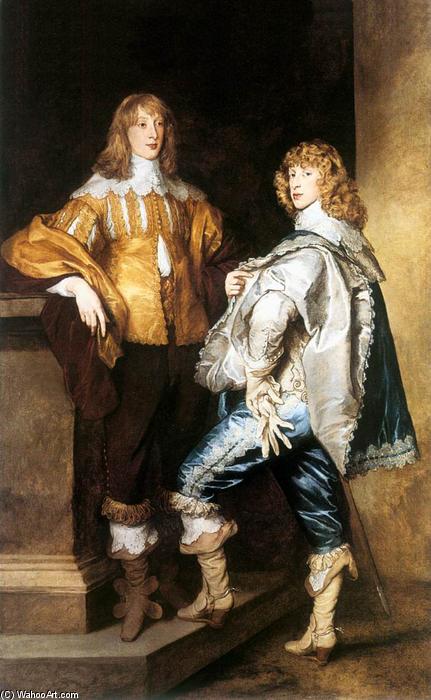
In the grand tapestry of the Baroque era, few portraits capture the essence of noble poise as exquisitely as Sir Anthony van Dyck’s Lord John and Lord Bernard Stuart. Painted around 1638, this masterpiece serves as a window into the opulent world of the seventeenth-century English court, where lineage and presentation were paramount. The painting presents two young men, the sons of Esmé Stewart, the 3rd Duke of Lennox, poised with a quiet, dignified confidence that transcends their youth. As they stand side by side, there is an unmistakable air of aristocratic majesty, a carefully curated tableau designed to project both their high social standing and their inherent character to posterity.
Van Dyck, a Flemish master who became the preeminent portraitist for the English monarchy, possessed a unique ability to blend the monumental energy of his mentor, Peter Paul Rubens, with a refined, lyrical elegance. In this double portrait, we see the artist at the height of his powers, moving away from flamboyant exuberance toward a more subtle, sophisticated grandeur. The composition is balanced yet dynamic, drawing the viewer’s eye across the vibrant interplay of color and texture that defines the subjects' attire.
The Mastery of Light and Texture
To behold this work is to witness a masterclass in the use of oil on canvas. Van Dyck employs a sophisticated technique of layering pigments and utilizing glazes to create a surface that seems to breathe with life. The tactile richness of the painting is profound; one can almost feel the weight of the heavy fabrics and the delicate softness of the lace. On the left, the striking yellow jacket of Lord John provides a brilliant focal point, its folds sculpted by light and shadow to suggest depth and substance. This is contrasted beautifully by the deep, regal blues of Lord Bernard’s attire on the right.
The artist’s brushwork is both meticulous and fluid, particularly evident in the way he captures the subtle nuances of skin tones and the intricate details of the lace collars. Through the masterful manipulation of chiaroscuro—the dramatic contrast between light and dark—Van Dyck imbues the figures with an ethereal glow, making them appear to emerge from the shadows of history into the present moment. This technical brilliance ensures that the painting is not merely a record of faces, but a celebration of material splendor and atmospheric depth.
An Enduring Legacy for the Modern Collector
Beyond its historical significance, Lord John and Lord Bernard Stuart offers a profound emotional resonance that continues to captivate contemporary audiences. There is a certain poignant tension in the gaze of these young men—a sense of being caught between the innocence of youth and the heavy responsibilities of their noble bloodline. For the art lover, it is a piece of profound historical storytelling; for the interior designer, it is a statement of timeless sophistication.
Integrating a high-quality reproduction of this Van Dyck masterpiece into a curated space can transform an environment, adding layers of history, warmth, and classical elegance. Whether placed in a formal study, a grand dining room, or a contemporary gallery setting, the painting’s rich palette and commanding presence serve as an anchor of prestige. It is more than a decoration; it is an invitation to contemplate the enduring beauty of the Baroque spirit and the timeless allure of aristocratic dignity.