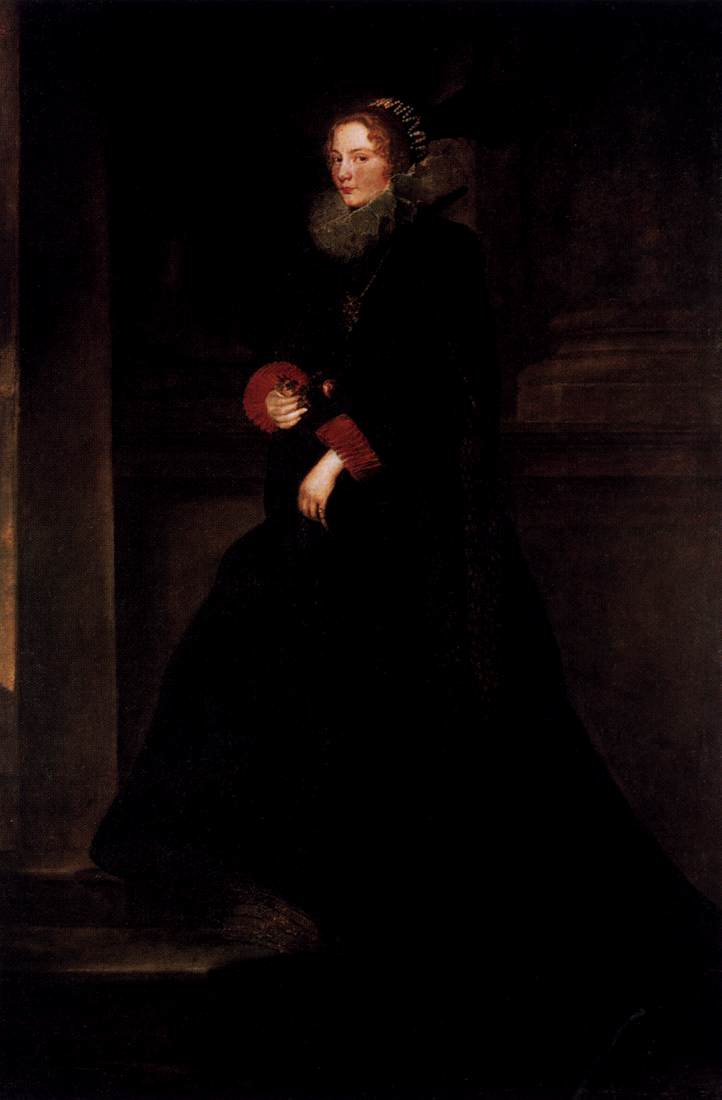
A Portrait of Dignified Grace: Exploring Anthony van Dyck’s Marchesa Geronima Spinola
Sir Anthony van Dyck, born in Antwerp in 1599, stands as a titan amongst Baroque portraitists—a figure whose influence reverberates through centuries of artistic endeavor. His tragically premature death at forty-two robbed the world of a prodigious talent, yet his brief but brilliant career cemented his legacy as one of the era’s foremost masters, propelling him from Flemish workshops to the opulent courts of Italy and ultimately establishing him as a beloved artist within the English monarchy. From humble beginnings under Hendrick van Balen's tutelage, Van Dyck rapidly absorbed the stylistic currents shaping Northern Europe, particularly Rubens’ dynamic compositions and masterful manipulation of light—a formative experience that instilled in him an unwavering commitment to realism combined with theatrical grandeur.
- Subject Matter & Context: Marchesa Geronima Spinola embodies the quintessential Baroque ideal – a noblewoman rendered with meticulous detail against a backdrop designed to elevate her status and convey profound emotion. Painted in 1624, this portrait reflects the burgeoning humanist spirit of the period, prioritizing psychological insight alongside formal beauty. Commissioned by influential patrons, it exemplifies the artistic patronage prevalent during Van Dyck’s time, showcasing the wealth and sophistication of aristocratic society.
- Style & Technique: Van Dyck's approach distinguishes itself through a deliberate layering of thin glazes—a technique honed under Rubens—that achieves luminous effects and subtle gradations in color. This painstaking process imbues the canvas with an ethereal quality, capturing not merely likeness but also conveying an aura of aristocratic dignity. Brushwork is generally smooth, though areas reveal textural nuances that hint at the artist’s tactile engagement with his medium.
- Composition & Visual Elements: The artwork's central focus rests upon Marchesa Spinola herself, positioned in a three-quarter pose against a dark architectural setting—a doorway or archway—that serves to frame her figure and subtly reinforce her importance. Diagonal lines within the architecture intersect with vertical lines emanating from the woman’s posture, creating visual dynamism while maintaining compositional control. The inclusion of a sphere symbolizes power and wealth.
- Color Palette & Lighting: Dominated by deep blacks and browns, punctuated by splashes of crimson—particularly in her gown—the palette underscores the painting's dramatic mood. Crucially, Van Dyck employs chiaroscuro – the masterful manipulation of light and shadow – to sculpt Marchesa Spinola’s face and upper torso, highlighting her features and amplifying the emotional impact of the portrait. This technique elevates the image beyond mere representation, transforming it into a theatrical tableau.
- Symbolism & Emotional Resonance: Beyond its formal beauty, Marchesa Geronima Spinola speaks to themes of nobility, grace, and perhaps even melancholy. The solemn expression conveyed by Van Dyck—coupled with the subdued color scheme—suggests an inner contemplation that transcends mere visual spectacle. The architectural setting serves as a reminder of lineage and heritage, anchoring the portrait within its historical context and enriching its symbolic significance.
This exquisite reproduction captures the essence of Baroque artistry, allowing you to appreciate Van Dyck’s unparalleled skill in portraying human emotion and elevating portraiture to an art form of profound psychological depth.