A Portrait of Status and Loyalty: Sir Anthony van Dyck’s Philippe Le Roy
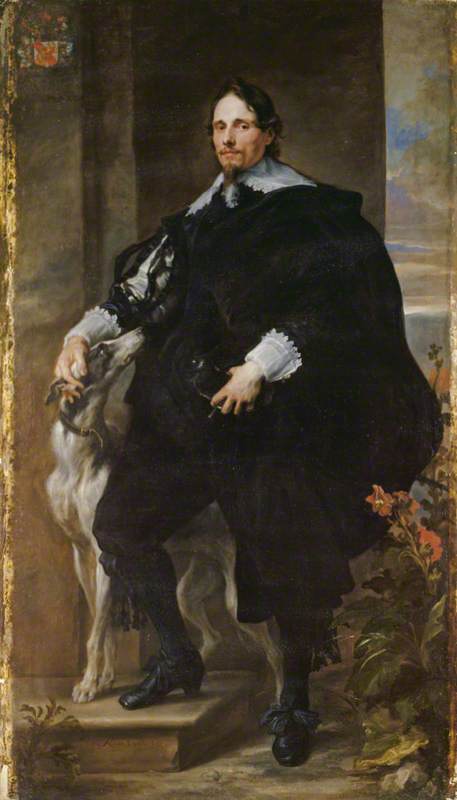
Sir Anthony van Dyck's "Philippe Le Roy," painted in 1630/40, is more than simply a portrait; it’s a meticulously crafted tableau of wealth, power, and the enduring bonds of companionship. This arresting image, now available as a stunning hand-painted reproduction from ArtsDot.com, offers a captivating glimpse into the Dutch Golden Age and the refined sensibilities of its most celebrated court painter. The painting immediately commands attention with its dramatic lighting – a strong light source originating from the left illuminates the subject’s face and upper body, casting deep shadows that lend an incredible sense of volume and realism to the figure. This masterful use of chiaroscuro, reminiscent of Caravaggio but imbued with van Dyck's signature elegance, is central to the work’s emotional impact.
Subject and Composition: A Study in Formal Portraiture
The subject himself, Philippe Le Roy, is presented as a man of considerable standing. Dressed in a rich black cloak and doublet adorned with a ruffled collar – details indicative of his social status – he embodies the ideals of Renaissance portraiture. The choice of dark colors against a deep background amplifies the figure’s presence, creating an immediate sense of formality and gravitas. Notably, Le Roy holds a small white dog in his left hand; this seemingly simple gesture is laden with symbolic weight. Dogs throughout history have represented loyalty, fidelity, and even nobility, suggesting that Le Roy possesses these virtues – qualities highly valued within the aristocratic circles of the time. The composition itself is vertically oriented, emphasizing the subject’s stature and projecting an image of authority and dignity.
Technique and Artistic Detail: Van Dyck's Signature Style
Van Dyck’s technical prowess is immediately apparent in every brushstroke. The painting demonstrates a remarkable command of oil paint, utilizing layering and blending to achieve smooth transitions and incredibly realistic textures. The cloak, in particular, showcases his masterful impasto technique – the thick application of paint creates a tactile quality, mimicking the weight and texture of the fabric. Similarly, the dog’s fur is rendered with exquisite detail, capturing its individual strands and creating a sense of softness and warmth. The use of linear perspective, converging towards an unseen horizon line, adds to the illusion of depth, while subtle atmospheric effects further enhance the three-dimensional quality of the scene. The artist's attention to anatomical accuracy, combined with his ability to capture fleeting expressions, is truly exceptional.
Historical Context and Symbolism: Echoes of the Dutch Golden Age
"Philippe Le Roy" firmly situates itself within the context of the Dutch Golden Age, a period marked by unprecedented artistic flourishing. Van Dyck’s work reflects the era's fascination with realism, detail, and the celebration of human achievement – particularly within the realm of portraiture. Beyond its aesthetic merits, the painting offers insights into the social values of 17th-century Europe. The emphasis on status, loyalty, and the importance of personal connections speaks to a society deeply invested in maintaining appearances and upholding traditional hierarchies. Considering that van Dyck was working at the courts of Europe, including England, this piece exemplifies the artistic trends prevalent across these influential centers of culture. The inclusion of red flowers within the foliage provides a delicate counterpoint to the predominantly dark palette, suggesting a fleeting beauty amidst the formality of the scene – a subtle reminder of life’s ephemeral nature.
A hand-painted reproduction from ArtsDot.com allows you to bring this exquisite masterpiece into your home or office, capturing not only its visual splendor but also the rich historical and artistic context that surrounds it. Explore the details, appreciate the artistry, and let “Philippe Le Roy” become a timeless addition to your collection.