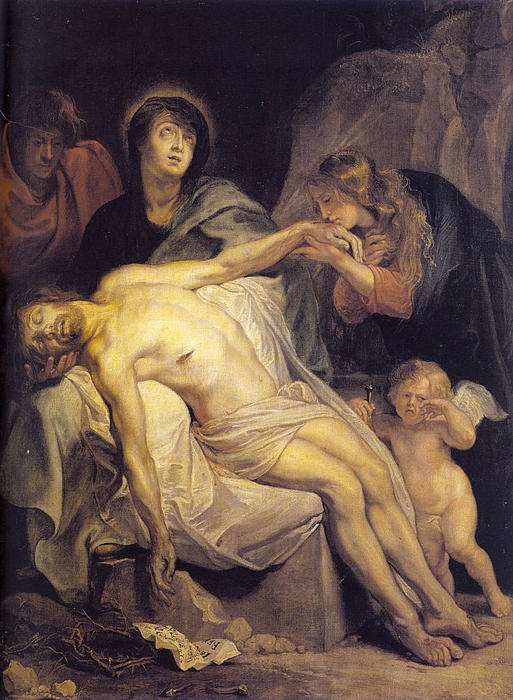
Explore 'The Lamentation' by Anthony van Dyck! A Baroque masterpiece depicting Christ’s sorrow, rich detail & dramatic lighting. Admire this iconic 1620 painting – a timeless work of art.
Sir Anthony van Dyck (1599-1641): Master Flemish Baroque painter renowned for elegant portraits of European aristocracy & Charles I's court. Influential in English art, known for religious scenes & innovative style.
Explore Vienna's artistic soul at the Kunsthistorisches Museum! Discover masterpieces by Raphael, Rembrandt, Vermeer & ancient treasures from Egypt to Rome.
A Moment of Profound Sorrow: Examining Anthony van Dyck’s ‘The Lamentation’
Sir Anthony van Dyck's “The Lamentation,” completed in 1620 during his formative years in Italy, stands as a cornerstone of Baroque religious painting—a testament to Rubensian influence and Van Dyck’s burgeoning mastery of dramatic visual storytelling. This monumental canvas depicts the Virgin Mary, Saint John the Evangelist, Nicodemus, Joseph of Arimathea, and Mary Magdalene gathered around the lifeless body of Jesus Christ following his crucifixion, capturing a scene steeped in grief and divine compassion.
Composition and Style: Baroque Realism Elevated
The painting’s composition is strikingly deliberate—a pyramidal structure anchored by Mary's figure draws the viewer’s eye upwards, emphasizing her sorrowful gaze and conveying a sense of solemn grandeur. Van Dyck skillfully employs overlapping planes to create depth and spatial complexity, mirroring the theatrical conventions prevalent in Baroque art. The style embodies Baroque realism, prioritizing meticulous detail and expressive emotion over idealized beauty. Like Rubens before him, Van Dyck utilizes dynamic poses and intense facial expressions—particularly Mary’s – to communicate profound psychological states. Furthermore, the dramatic lighting—characterized by stark contrasts between light and shadow—highlights the faces of the mourners, intensifying their emotional impact and reinforcing the scene's theatrical quality.
Technique: Brushstrokes That Speak Volumes
Van Dyck’s technique is characterized by loose, expressive brushstrokes that imbue the drapery and rock formations with palpable texture. These visible marks contribute to the painting’s overall sense of immediacy and convey a feeling of movement despite the stillness of the figures. The muted color palette—dominated by browns, reds, and golds—creates an atmosphere of somber contemplation, reflecting the solemnity of the subject matter. Careful attention is paid to anatomical accuracy, demonstrating Van Dyck's commitment to portraying human form with realism and sensitivity.
Historical Context: Rubensian Influence and Artistic Innovation
“The Lamentation” emerged from a period marked by significant artistic innovation—the Baroque era—and reflects the influence of Peter Paul Rubens, whom Van Dyck had studied extensively during his time in Antwerp. Rubens’s emphasis on dynamism and emotional intensity served as a crucial catalyst for Van Dyck's own stylistic development. However, unlike Rubens’s flamboyant grandeur, Van Dyck’s rendition prioritizes restraint and psychological nuance—a hallmark of his distinctive artistic vision. The painting was commissioned by Cardinal Maurizio Fabrizi Farnese, reflecting the patronage system that fueled artistic creativity during the Renaissance and Baroque periods in Italy.
Symbolism: Grief, Faith, and Divine Sorrow
The symbolism embedded within “The Lamentation” is rich and multilayered. The draped cloth covering Christ’s body symbolizes his burial shroud—a poignant reminder of mortality and sacrifice. Angels flanking Mary convey divine sorrow and underscore the universality of grief experienced by humanity in the face of suffering. These visual cues invite contemplation on themes of faith, compassion, and the profound emotional impact of Jesus's death—themes central to Christian iconography throughout history.
Emotional Impact: A Window into Human Suffering
Ultimately, “The Lamentation” transcends mere depiction; it strives to evoke empathy and convey a visceral understanding of human sorrow. The painting’s masterful composition, expressive technique, and evocative color palette combine to create an unforgettable experience for the viewer—a timeless masterpiece that continues to resonate with audiences centuries after its creation. Its enduring power lies in its ability to capture the essence of grief and faith, cementing Van Dyck's place as one of the most poignant voices of his era.