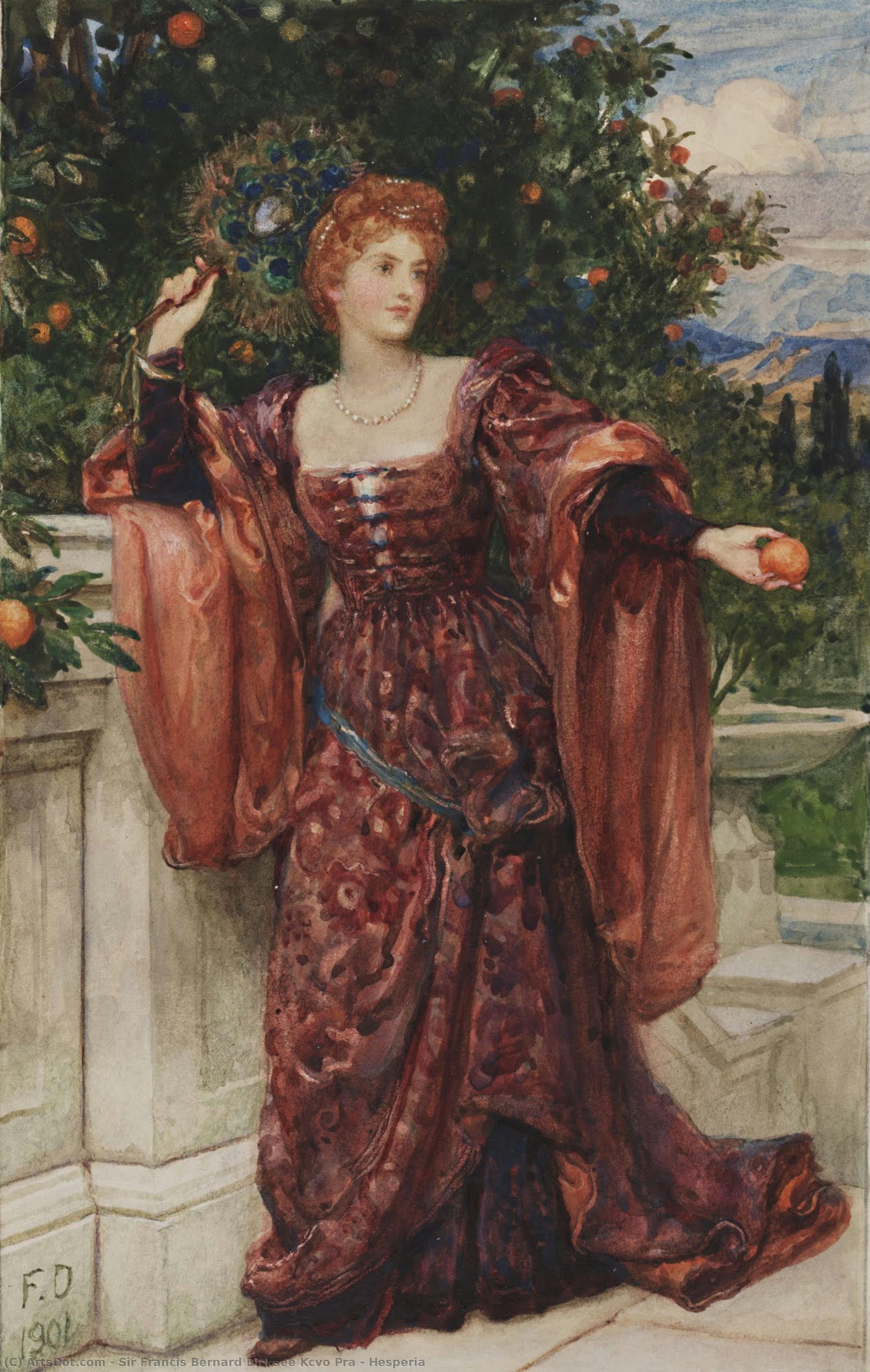
Hesperia - A Reverie of Golden Apples
Frank Dicksee’s “Hesperia” stands as a testament to the Pre-Raphaelite movement's fascination with mythology and idealized beauty, capturing a moment frozen in time—a serene tableau imbued with profound symbolism. Painted in 1887, this watercolour delicately portrays a woman seated on a ledge overlooking a landscape dominated by towering trees and distant mountains, her arms outstretched as if embracing the tranquility of the scene.
Dicksee’s artistic training under Lord Leighton and Sir John Everett Millais instilled in him a meticulous attention to detail and a masterful command of tonal harmony. He skillfully employed layering techniques—a hallmark of Pre-Raphaelite painting—to achieve remarkable luminosity and depth, capturing the ethereal quality characteristic of this influential style.
- Subject Matter: The artwork depicts Hesperia, the nymph from Greek mythology who guarded the golden apples of Elysium. This reference speaks to themes of immortality, paradise, and feminine grace—concepts central to Victorian Romanticism.
- Style: Dicksee’s style aligns perfectly with the Pre-Raphaelite aesthetic, prioritizing lyrical beauty over mere realism. The composition is deliberately balanced, emphasizing stillness and contemplation.
- Technique: Watercolor was chosen for its ability to produce subtle gradations of color and luminosity—essential for conveying the mood and atmosphere of the landscape. Dicksee’s meticulous brushwork contributes to the painting's textural richness.
- Historical Context: “Hesperia” emerged during a period of intense artistic experimentation, challenging academic conventions and reviving interest in medieval art and literature. It reflects Victorian society’s yearning for idealized visions of nature and spirituality.
- Symbolism: The woman's outstretched arms symbolize receptiveness to divine grace and the embrace of eternal beauty. The landscape itself represents Edenic paradise—a realm untouched by corruption and brimming with vitality.
Dicksee’s masterful rendering captures not only visual splendor but also an emotional resonance that lingers long after viewing. “Hesperia” invites contemplation on themes of serenity, aspiration, and the enduring allure of mythic narratives—making it a captivating piece for collectors and interior designers alike.