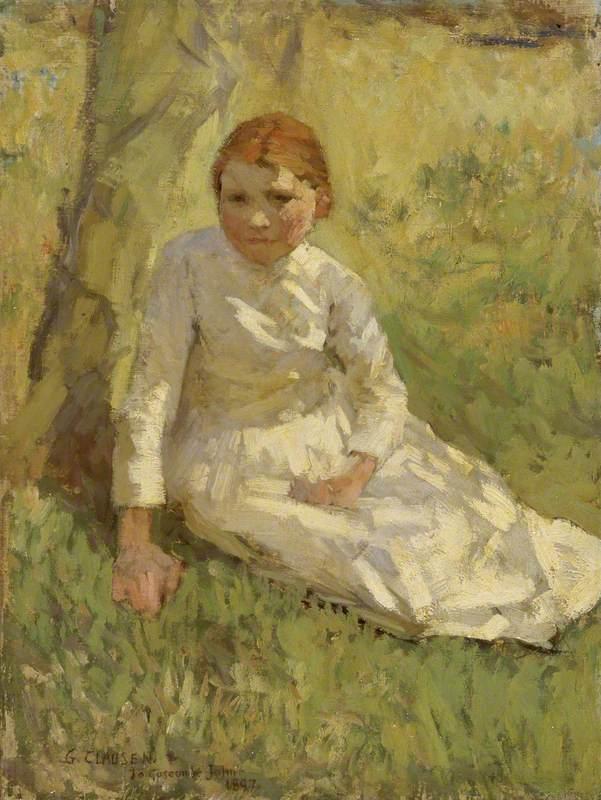
Immerse yourself in Sir George Clausen’s ‘Girl in a Field,’ an Impressionistic masterpiece capturing tranquil childhood amidst vibrant greens and yellows. This 1900 painting evokes nostalgia with its loose brushstrokes and focus on light, offering a timeless portrait of innocence.
A Portrait of Tranquility Amidst Change: Exploring Sir George Clausen’s “Girl in a Field”
The painting "Girl in a Field," executed by Sir George Clausen in 1900, stands as a testament to the Impressionist movement's ability to capture not just visual appearances but also the intangible essence of experience. More than simply depicting a young girl seated amongst wildflowers—though that idyllic scene is undeniably present—the artwork embodies a deeper contemplation on childhood innocence and the enduring connection between humanity and the natural world, themes particularly resonant during the turbulent period leading up to World War I. Clausen’s artistic vision wasn't merely about replicating what he saw; it was about distilling it into something emotionally profound.
- Subject Matter & Context: Clausen’s subject matter—a solitary girl absorbed in observation—reflects the burgeoning interest in psychology and introspection that characterized the era. Painted against the backdrop of a vibrant English meadow, the scene speaks to a yearning for simplicity and escape from the anxieties of industrialization and urban life. The year 1900 marks a pivotal moment in British history, witnessing significant advancements in science and technology alongside growing social unrest—a context that informs Clausen’s artistic sensibility.
- Style & Technique: Clausen skillfully employed Impressionistic techniques to convey his vision. Loose brushstrokes dominate the canvas, prioritizing the fleeting effects of light and color over precise detail. The artist eschewed academic conventions, favoring instead a vibrant palette dominated by greens and yellows—colors that evoke the freshness and vitality of springtime. Visible texture is achieved through layering paint in short strokes, mimicking the roughness of grass blades and leaves, creating an immersive sensory experience.
- Color Palette: The artist’s masterful use of color contributes significantly to the painting's emotional impact. White—representing purity and innocence—contrasts sharply with the verdant hues of the meadow, highlighting the girl’s figure as a beacon of tranquility amidst the surrounding landscape.
- Lighting & Perspective: Soft, diffused light illuminates the scene, suggesting an overcast day or indirect sunlight – a deliberate choice that enhances the painting's atmosphere and reinforces its contemplative mood. Clausen employs perspective to create depth, diminishing the size of distant trees and foliage, drawing the viewer’s eye inwards towards the central figure.
Symbolism & Emotional Resonance: The girl’s gaze—directed outwards with quiet thoughtfulness—suggests a connection to something larger than herself – perhaps an awareness of the beauty and fragility of nature, or simply a moment of serene contemplation. Clausen's work speaks to a universal desire for peace and harmony, capturing a timeless image of childhood innocence untouched by worldly concerns. It’s a painting that invites viewers to pause and appreciate the simple joys of existence.
Concluding Thoughts: “Girl in a Field” exemplifies Clausen’s commitment to portraying human experience with sensitivity and nuance. Its Impressionistic style—characterized by its embrace of light, color, and texture—continues to inspire artists and collectors alike. More than just a depiction of a pastoral scene, it's an emblem of a bygone era – one defined by optimism, artistic experimentation, and a profound appreciation for the natural world. Clausen’s legacy resides not only in his masterful technique but also in his ability to distill complex emotions into a single, unforgettable image.