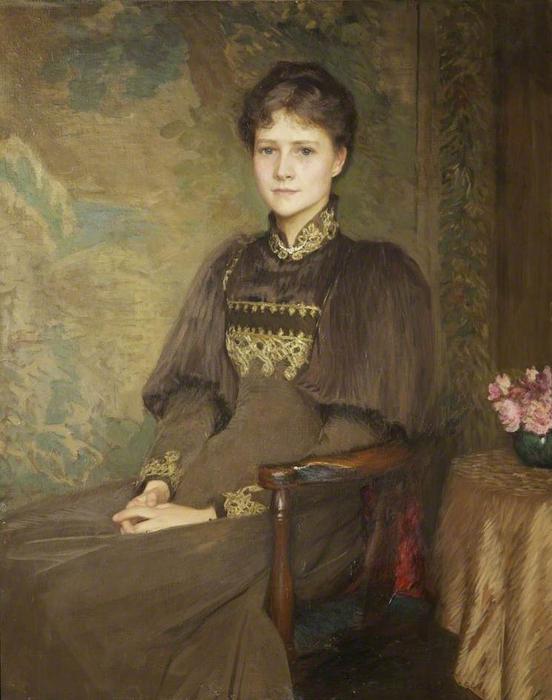
Admire Sir George Clausen's 'Mrs. Herbert Roberts,' a captivating portrait of a woman in elegant attire, showcasing his signature Impressionistic style and capturing Edwardian life.
Sir George Clausen (1852-1944): British Impressionist painter of luminous rural scenes & poignant war art, including 'Youth Mourning.' Founder of the New English Art Club.
Home to one of the world's finest Pre-Raphaelite collections, Liverpool's Walker Art Gallery offers an unmissable journey through Renaissance masters and British modernism that invites you to explore its timeless beauty.
A Portrait of Quiet Dignity: Sir George Clausen’s Mrs. Herbert Roberts
Sir George Clausen's "Mrs. Herbert Roberts," painted in 1894, is more than just a portrait; it’s a carefully constructed tableau of Edwardian society and the subtle language of domestic life. The canvas captures a woman of considerable presence – Lady Clwyd – seated with an air of serene composure within a richly appointed interior. Clausen, a key figure in British Impressionism, masterfully employs light and color to evoke not just a likeness but also a sense of mood and character, firmly establishing himself as one of the most important landscape painters of his time. The painting’s enduring appeal lies in its ability to simultaneously convey formality and intimacy, offering a glimpse into the world of the upper-middle class while hinting at the complexities beneath the surface.
A Study in Light and Texture: Clausen's Impressionistic Technique
Clausen’s approach is distinctly Impressionist, yet he avoids the fleeting effects often associated with the movement. He meticulously builds up layers of paint – visible brushstrokes create a textured surface that captures the play of light on fabrics and objects. Notice how he uses broken color to suggest the sheen of the velvet upholstery, the delicate folds of the lace collar, and the subtle highlights on Mrs. Roberts’ dress. The diffused light filtering through the window is rendered with remarkable sensitivity, creating an atmosphere of warmth and tranquility. Unlike purely atmospheric Impressionists, Clausen retains a degree of solidity in his forms, grounding the scene in a tangible reality. This balance between observation and interpretation is what gives his work its lasting power.
Symbolism and Social Context: The Portrait as Statement
“Mrs. Herbert Roberts” offers a fascinating window into the social conventions of late Victorian and Edwardian England. The setting itself – a comfortable, well-furnished room – speaks to the wealth and status of the family. The presence of two vases with flowers is a common motif in portraits of this era, signifying beauty, refinement, and domestic harmony. Mrs. Roberts’ posture—seated upright, hands folded gracefully—reflects the expected demeanor of a respectable lady. However, there's also an underlying sense of quiet contemplation in her gaze, suggesting a depth beyond mere social grace. Interestingly, research reveals that Ray Roberts, the subject of the portrait, was a prominent politician who served as a member of Congress and later as Chairman of the Committee on Veterans’ Affairs. This detail adds another layer to the painting's interpretation – is it a celebration of domesticity or a subtle commentary on the role of women in society?
A Legacy of Light: The Enduring Appeal of Clausen’s Vision
The painting’s influence extends far beyond its immediate historical context. Clausen's ability to capture the essence of light and atmosphere, combined with his empathetic portrayal of human subjects, has resonated with viewers for over a century. His work is frequently compared to that of John Constable and J.M.W. Turner, both masters of capturing the beauty of the English countryside. Today, reproductions of “Mrs. Herbert Roberts” continue to be appreciated for their exquisite detail, evocative atmosphere, and timeless elegance. It’s a testament to Clausen's skill that this portrait, painted over 120 years ago, still manages to evoke a powerful sense of connection and quiet contemplation—a reminder of the enduring beauty found in everyday life.