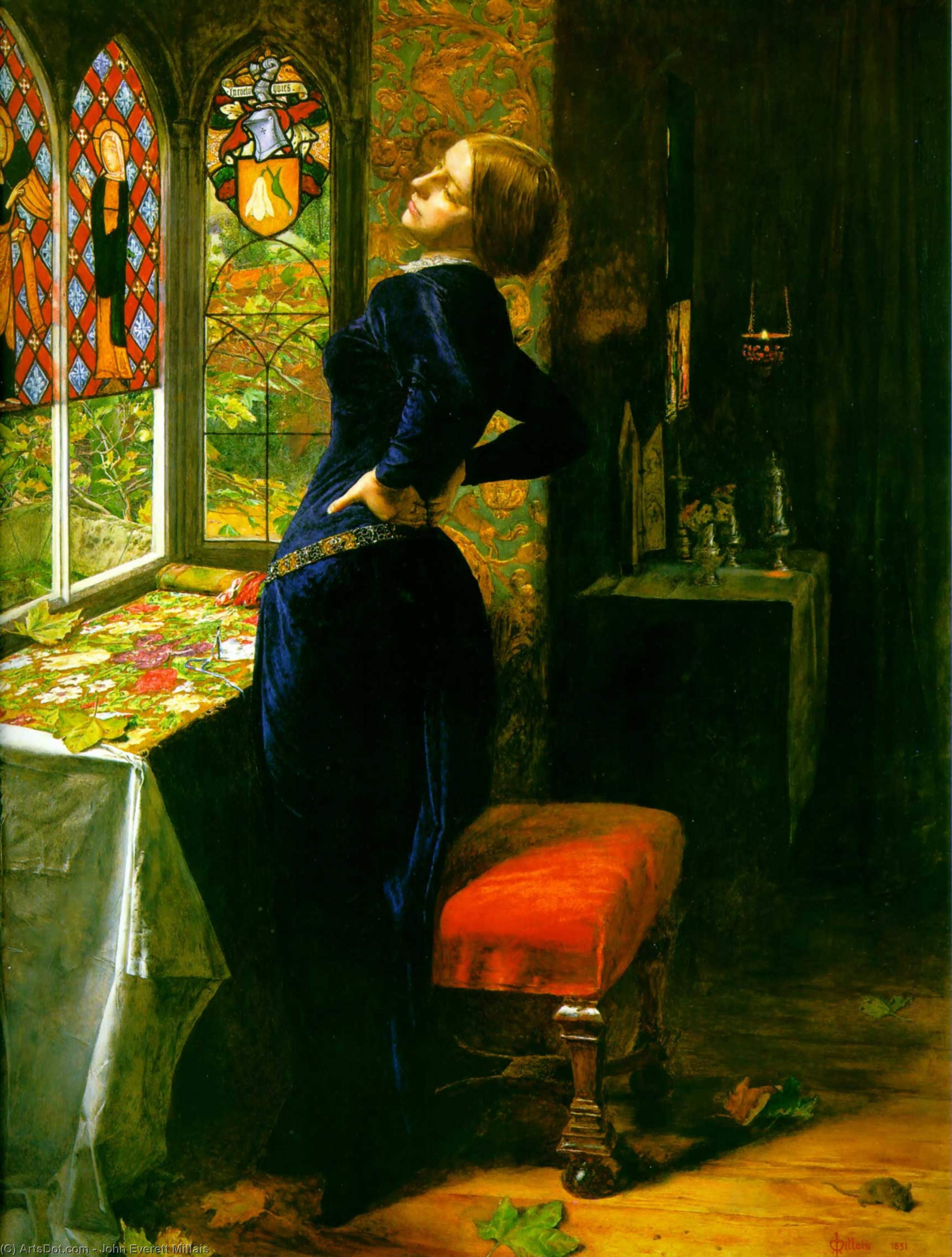
Millais' 'Mariana in the Moated Grange' captures Victorian melancholy & longing. Explore Tennyson’s poem brought to life with Pre-Raphaelite detail – a must-see masterpiece!
Explore the art of Sir John Everett Millais (1829-1896), a Pre-Raphaelite founder. Discover his detailed realism, iconic paintings like Ophelia & Christ in the House of His Parents, and lasting Victorian impact.
Tate Gallery
(London, United Kingdom)
Discover British & international art at Tate Britain! Explore centuries of masterpieces, from Turner to modern icons – free entry awaits in London’s riverside gallery.
Mariana in the Moated Grange: A Pre-Raphaelite Portrait of Longing
Sir John Everett Millais's "Mariana in the Moated Grange," created in 1851, is a cornerstone of the Pre-Raphaelite movement and a poignant exploration of isolation and unrequited love. This oil on panel painting, now residing at the Tate Gallery in London, captures a moment of profound introspection inspired by Alfred, Lord Tennyson's poem of the same name. The artwork depicts Mariana, a woman abandoned and awaiting her lover’s return, trapped within the confines of a decaying estate. Millais masterfully translates Tennyson's melancholic verse into a visually arresting scene that resonates with viewers even today.
Composition, Setting, and Narrative
The painting presents a contemplative Mariana standing near a window in a richly appointed room. Her posture—hand resting on her hip, gaze directed outward—conveys a sense of quiet resignation and longing. The interior is meticulously detailed: a dining table set for two with wine glasses and a vase suggests a life interrupted, a promise unfulfilled. The room’s opulence contrasts sharply with Mariana's evident sadness, highlighting the disparity between her expectations and reality. The window itself acts as a symbolic portal, framing a view of overgrown foliage and hinting at an external world from which she is separated. The scene draws directly from Tennyson’s poem, where Mariana languishes in a desolate moated grange, endlessly awaiting a lover who never arrives. Millais's composition isn't merely illustrative; it amplifies the poem's emotional core, allowing viewers to experience Mariana's solitude viscerally.
Pre-Raphaelite Techniques and Artistic Influences
Millais was renowned for his dedication to realism and detail, a hallmark of the Pre-Raphaelite Brotherhood. In "Mariana," this is evident in the precise rendering of fabrics—the rich velvet of her dress, the intricate patterns of the wallpaper—and the accurate depiction of natural elements like the fallen leaves scattered on the floor. He skillfully employs chiaroscuro (the use of strong contrasts between light and dark) to create depth and atmosphere, drawing attention to Mariana's figure while subtly obscuring the background details. Sfumato, a technique that softens edges and creates a hazy effect, further enhances the painting’s dreamlike quality. The Pre-Raphaelite emphasis on beauty, detail, and emotional expression is fully realized in this work, showcasing Millais's ability to blend technical mastery with profound human understanding. The influence of early Italian Renaissance art, which the Pre-Raphaelites sought to emulate, can be seen in the painting’s meticulous attention to detail and its focus on narrative storytelling.
Symbolism and Emotional Impact
Beyond its aesthetic beauty, "Mariana in the Moated Grange" is rich in symbolism. The window represents both hope and confinement—a gateway to a potential future but also a barrier separating Mariana from it. The decaying grandeur of the room speaks to lost opportunities and fading dreams. The fallen leaves symbolize the passage of time and the slow erosion of hope. Even seemingly minor details, like the mouse scurrying across the floor, contribute to the painting's overall sense of melancholy and isolation. Millais’s masterful use of color—the somber blues and greens dominating the palette—further reinforces the painting’s emotional weight. The artwork evokes a powerful sense of longing, loneliness, and the enduring human capacity for hope in the face of despair. It is this ability to convey complex emotions through visual means that makes "Mariana in the Moated Grange" such an enduring masterpiece.
Millais' Legacy and Other Notable Works
Sir John Everett Millais was a prolific artist whose contributions extended beyond “Mariana.” He is also celebrated for works like "Mrs. Bischoffsheim," both housed at the Tate Gallery, which demonstrate his versatility in portraiture. His ability to capture human emotion and detail made him a leading figure in the Victorian art scene. "Mariana in the Moated Grange" remains one of his most iconic pieces, admired for its technical brilliance and profound emotional resonance—a testament to Millais’s enduring legacy as a master painter.