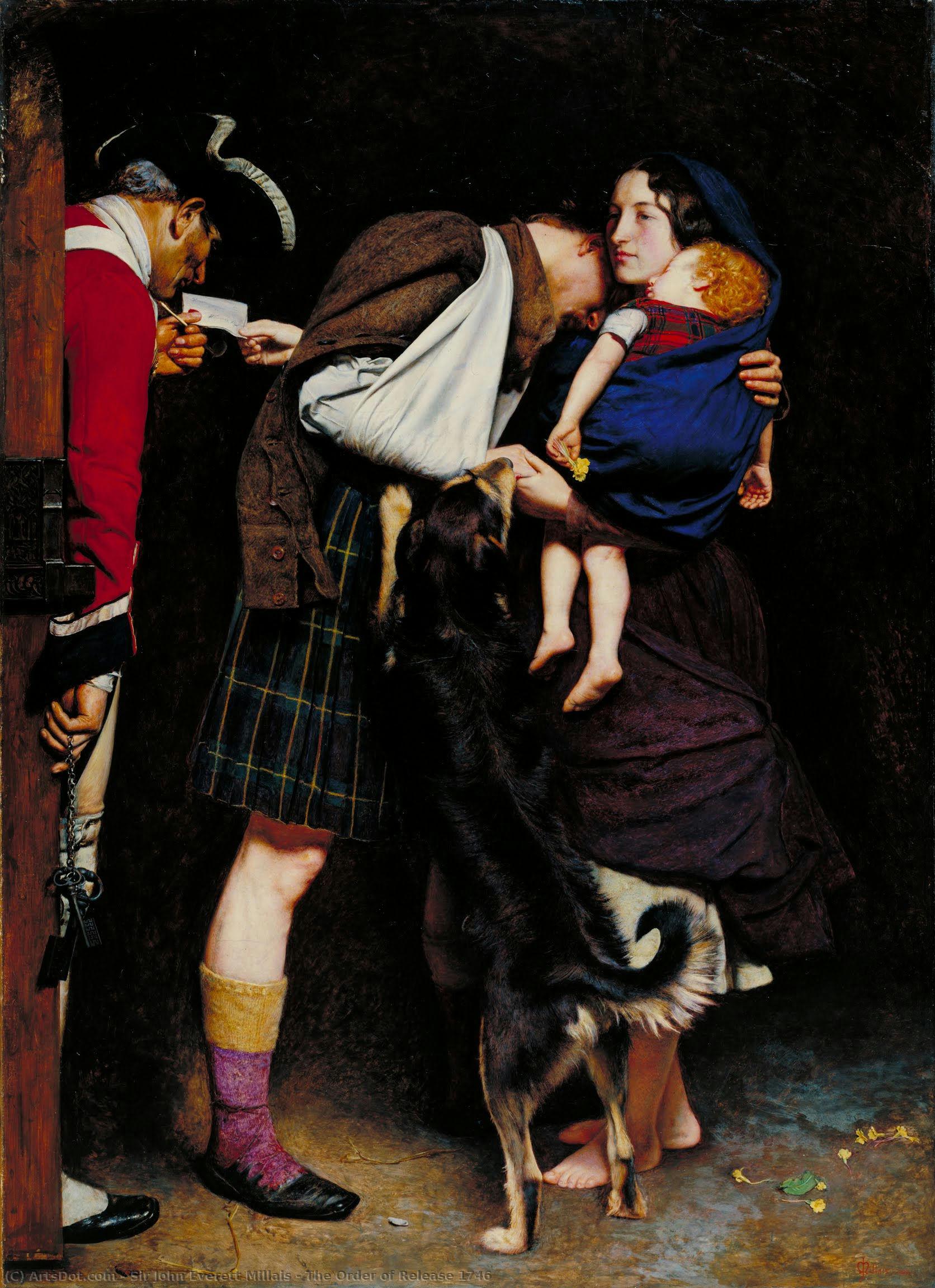
Sir John Everett Millais’s "The Order of Release 1746" captures Victorian realism with a poignant family portrait of a Jacobite soldier's release, showcasing meticulous detail and emotional depth characteristic of the Pre-Raphaelite movement – discover this exquisite hand-painted reproduction.
Explore the art of Sir John Everett Millais (1829-1896), a Pre-Raphaelite founder. Discover his detailed realism, iconic paintings like Ophelia & Christ in the House of His Parents, and lasting Victorian impact.
Tate Britain
(London, United Kingdom)
Discover modern & contemporary art at Tate Britain! Explore British masterpieces from medieval times to today, amidst stunning architecture and engaging exhibitions. Free admission!
A poignant tableau of remembrance: Sir John Everett Millais’s ‘The Order of Release 1746’
Sir John Everett Millais's “The Order of Release 1746” is more than a simple depiction of a family; it’s a meticulously crafted meditation on memory, loss, and the enduring weight of history. Painted in 1852, this intimate scene captures a moment of profound significance – the release of a Jacobite soldier after years of imprisonment following the failed rebellion led by Bonnie Prince Charlie. Measuring 73 x 102 cm, the painting’s scale invites us into its quiet drama, drawing us close to the faces and emotions of those involved.
The Pre-Raphaelite Vision: Detail and Emotional Resonance
- Technical Mastery: Millais, a key figure in the Pre-Raphaelite Brotherhood, employed his signature style – an almost obsessive attention to detail and a commitment to realism that bordered on photographic. The rendering of fabric textures, particularly the worn clothing of the family, is remarkably tactile, inviting the viewer to almost feel the rough wool against their skin.
- Color Palette: The muted color palette—dominated by earthy browns, greens, and grays—contributes significantly to the painting’s somber mood. These restrained tones heighten the sense of melancholy and reinforce the historical context of hardship and confinement.
- Compositional Precision: The carefully arranged composition guides our eye through the scene. The central figures – the mother holding her child, the released soldier, and the two dogs – are positioned with deliberate intent, creating a dynamic yet controlled narrative flow.
Historical Context and Symbolic Weight
“The Order of Release 1746” is deeply rooted in the tumultuous political landscape of early 19th-century Britain. The Jacobite uprisings, attempts to restore the Stuart monarchy, were a persistent source of unrest and conflict. This painting isn’t merely a historical record; it's an exploration of the human cost of rebellion and the enduring impact of political upheaval on ordinary families. The inclusion of the dogs adds another layer of symbolism – loyalty, companionship, and perhaps even a connection to the natural world amidst the chaos of war.
Emotional Impact and Artistic Legacy
Millais’s ability to evoke emotion through seemingly simple details is what elevates “The Order of Release 1746” beyond a mere portrait. The mother's expression, a mixture of relief, sorrow, and perhaps even lingering fear, speaks volumes about the sacrifices made during times of conflict. This painting exemplifies Millais’s profound understanding of human psychology and his ability to translate complex emotions onto canvas. It remains a powerful testament to the Pre-Raphaelite movement’s commitment to capturing not just appearances but also the very soul of its subjects. This hand-painted reproduction offers an unparalleled opportunity to experience the beauty and emotional depth of this iconic work firsthand.