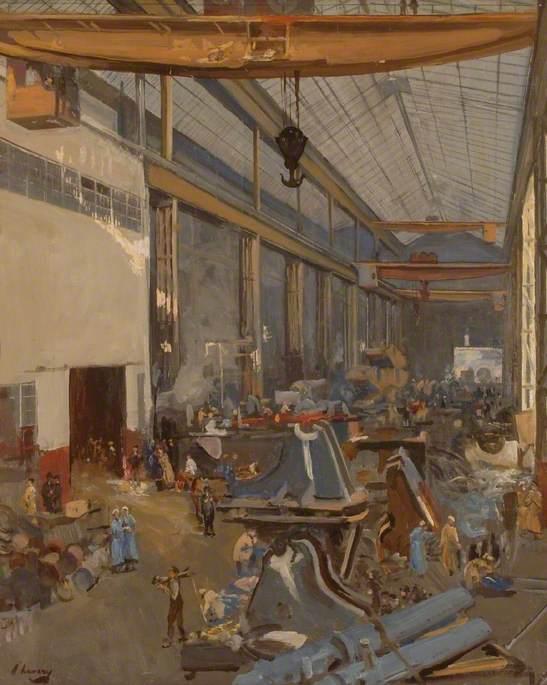
Sir John Lavery's "Munitions, Newcastle" (1917) captures the industrial heart of wartime Britain – a bustling munitions factory scene brimming with activity and raw determination.
Sir John Lavery (1856-1941): Celebrated Irish painter of Edwardian society, wartime scenes & portraits. Influenced by Whistler, a key figure in British art.
Explore modern war & conflict at Imperial War Museums (IWM) in London! Discover powerful exhibits, aircraft at Duxford, HMS Belfast & Churchill War Rooms. Real stories from WW1 to today.
A Chronicle of Industry and Resilience: Lavery’s “Munitions, Newcastle”
Sir John Lavery's "Munitions, Newcastle," painted in 1917, is far more than a depiction of a factory floor; it’s a poignant snapshot of Britain’s wartime spirit, a testament to the tireless efforts of its workforce, and a masterful example of the artist’s evolving Impressionistic style. The painting immediately draws the eye into a vast, echoing space – an industrial heart beating with the rhythm of production during World War I. Lavery doesn't shy away from the gritty reality of the scene; instead, he embraces it, capturing the scale and intensity of the munitions factory in Newcastle with remarkable detail and emotional resonance. The composition is deliberately powerful, utilizing a strong horizontal axis defined by the towering overhead cranes that dominate the upper portion of the canvas. These aren’t merely mechanical structures; they become symbols of industry's relentless drive, reaching upwards towards an unseen goal – fueling the war effort.
Impressionistic Detail and Atmospheric Depth
Lavery’s brushwork is immediately striking, a hallmark of his Impressionistic approach. Loose, visible strokes create a sense of movement and immediacy, as if we are standing within this bustling factory ourselves. The artist skillfully employs light and shadow to build depth and atmosphere, bathing the scene in a warm, artificial glow emanating from the furnaces and strategically placed lamps. This isn’t a romanticized view; it's a deliberately realistic portrayal of an industrial environment, yet Lavery imbues it with a remarkable sense of drama. The muted palette – dominated by browns, grays, and ochres – reflects the utilitarian nature of the setting, while subtle hints of blue and white punctuate the scene, drawing attention to machinery and equipment, adding visual interest without overwhelming the overall mood. The figures themselves are rendered with sensitivity, capturing their focused expressions and purposeful movements as they navigate the complex network of operations.
A Window into Wartime Britain
“Munitions, Newcastle” offers a crucial glimpse into the lives of ordinary Britons during World War I. The painting’s creation coincided with a period of immense national mobilization, as factories across the country were retooled to produce weapons and supplies for the war effort. Lavery's decision to depict this specific factory – one involved in munitions production – highlights the vital role played by industrial workers in sustaining the Allied cause. The image speaks volumes about the sacrifices made by these individuals, who worked long hours under demanding conditions to contribute to a national endeavor. It’s a powerful reminder of the human cost of conflict and the collective effort required to overcome adversity. Further research reveals that Lavery was commissioned by William Burrell, a wealthy shipowner, to paint this scene, highlighting the significant patronage that supported British artists during wartime.
Symbolism and Emotional Resonance
Beyond its documentary value, “Munitions, Newcastle” is rich in symbolism. The sheer scale of the factory – dwarfing the human figures within it – underscores the overwhelming power of industrial production. The cranes, reaching towards the heavens, can be interpreted as symbols of ambition, progress, and the relentless pursuit of victory. The faces of the workers, etched with concentration and determination, embody the spirit of resilience and patriotism that characterized Britain during the war years. Lavery’s masterful use of light and shadow evokes a sense of urgency and drama, mirroring the anxieties and uncertainties of wartime. The painting ultimately serves as a poignant meditation on industry, sacrifice, and the enduring strength of the human spirit in the face of adversity – a timeless message rendered with remarkable skill and sensitivity by one of Britain's most celebrated portraitists.