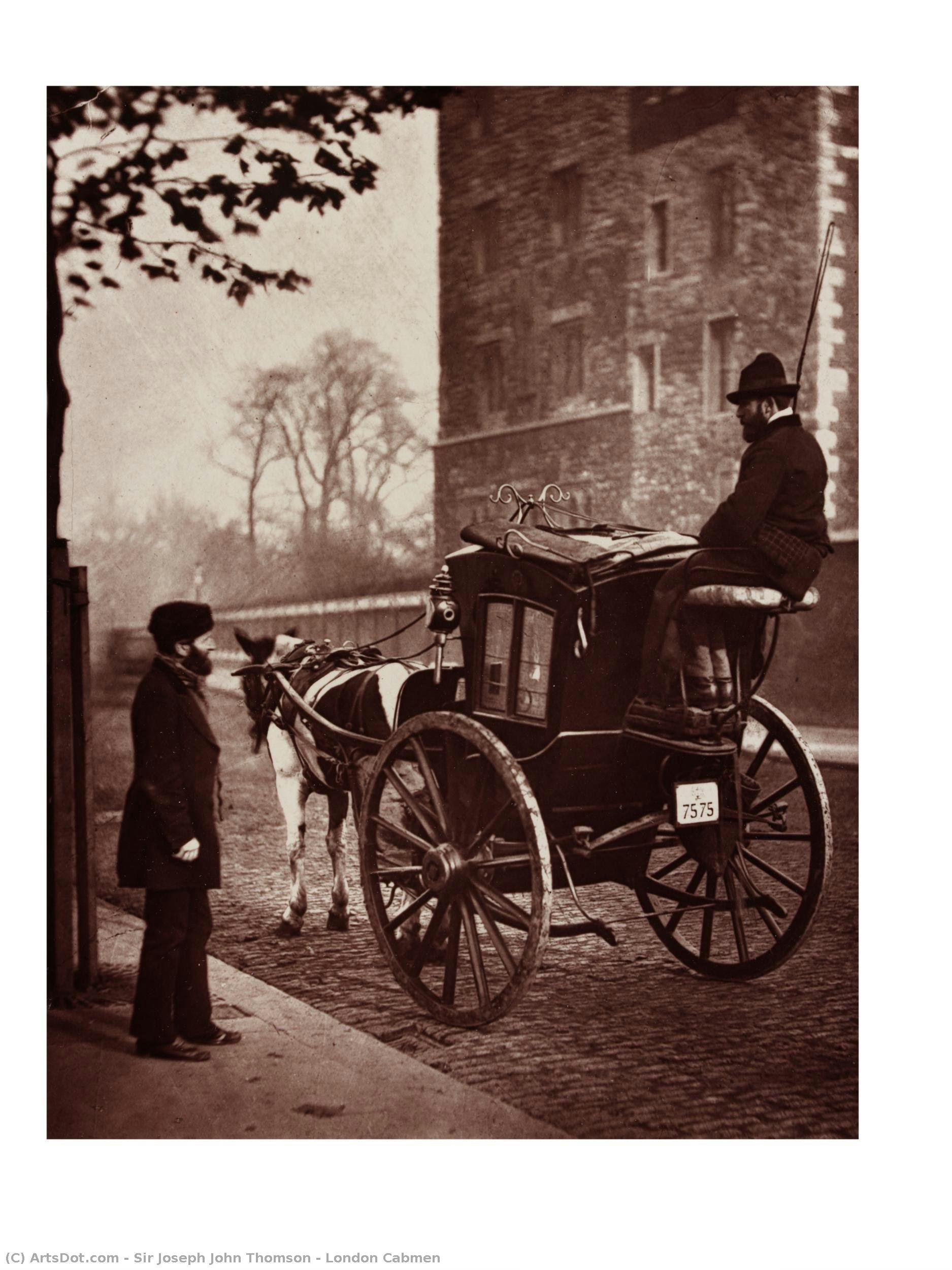
A poignant window into Victorian grit, this Woodburytype photograph by Sir Joseph John Thomson captures a London cabman with remarkable clarity, inviting you to explore this rare piece of historical social documentary.
London Cabmen: A Snapshot of Victorian Grit
John Thomson’s “London Cabmen” is more than just a photograph; it's a window into the bustling, often grim realities of Victorian London life. Executed in 1877-1878 using the Woodburytype process—a pioneering technique that produced remarkably stable and richly colored images—the print captures a moment frozen in time: a cabman seated in his carriage alongside two horses. Thomson’s meticulous attention to detail elevates this seemingly simple scene into a powerful statement about social observation and artistic innovation.
- The Technique: The Woodburytype process involved coating paper with gelatin emulsion, applying pigment dispersions onto the surface, and then exposing it to ultraviolet light. This method yielded images of exceptional clarity and tonal range—a significant advancement over earlier photographic methods like calotypes—resulting in a distinctive purple-brown hue that remains characteristic of this era’s prints.
- Composition & Context: Thomson skillfully positioned his subjects within the carriage, creating an asymmetrical composition that draws the eye to the cabman's face and posture. The photograph was part of “Street Life in London,” a monumental project undertaken by Thomson and journalist Adolphe Smith Headingly aimed at documenting poverty and social conditions in East London during the Industrial Revolution.
- Symbolism & Emotion: Beyond its technical prowess, "London Cabmen" speaks to themes of urban life, labor, and societal stratification. The cabman’s dignified gaze conveys resilience amidst hardship—a visual embodiment of Victorian fortitude.
About John Thomson
Sir Joseph John Thomson (1837-1940) was a Scottish physicist and photographer who revolutionized the field of scientific imaging. Born in Edinburgh, he pursued his passion for science with unwavering dedication, earning degrees from St Andrews University and Trinity College Cambridge. His groundbreaking work on cathode rays—demonstrating that cathode rays were composed of previously unknown particles—earned him international acclaim and cemented his legacy as one of the fathers of modern physics. However, Thomson’s artistic vision extended beyond the laboratory; he recognized the transformative potential of photography to illuminate social issues and capture the beauty of the natural world.
Further Exploration
This remarkable print resides within Yale Center for British Art's collection, specifically housed in the Study Room (BAC: British Art Center copy bound in publisher’s original gilt- and blind-stamped pictorial green cloth, with gilt edges). Its provenance traces back to Mrs. D. Crisp, highlighting its significance as a treasured exemplar of Victorian photographic art. For more information about Thomson's life and work, consult scholarly resources such as Gernsheim, H. History of photography (1978) and Johnson, W. Nineteenth-century photography (1986). Examining these texts provides invaluable insight into the broader context of Thomson’s artistic endeavors and their enduring impact on photographic history.