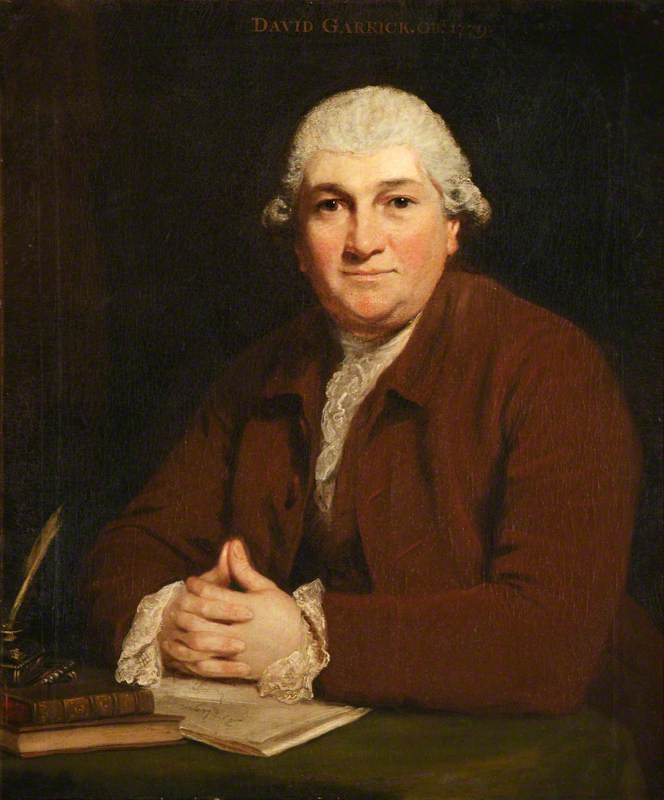
Admire Sir Joshua Reynolds' 'David Garrick,' a captivating portrait capturing the renowned actor in his prime. Witness masterful brushstrokes and a glimpse into 18th-century theatrical life.
Sir Joshua Reynolds (1723-1792): Leading British portrait painter of the 18th century & first Royal Academy President. Master of the 'Grand Style', he elegantly captured nobility and shaped British art.
Explore Knole House: A Palimpsest of English History! Discover stunning art, architecture & a vast deer park spanning centuries. Immerse yourself in royal legacies and British heritage at the National Trust.
The Prologue Portrait: A Window into Garrick’s Soul
Sir Joshua Reynolds' “David Garrick (1717–1779) ‘The Prologue Portrait’,” painted in 1776, is far more than a simple likeness of the celebrated actor. It’s a carefully constructed tableau vivant—a moment frozen in time that reveals not just Garrick’s outward appearance but also his inner character and the very essence of theatrical performance. The painting captures Garrick mid-sentence, poised to deliver a prologue, an introductory speech designed to ignite the audience's anticipation before a dramatic presentation. He sits at a richly appointed table, bathed in soft light that emphasizes the textures of his velvet coat, the delicate lace cuffs, and the worn pages of the books surrounding him – volumes of Shakespeare, Milton, and other literary giants. His posture is one of thoughtful concentration, yet there’s an undeniable magnetism about him; his gaze downward suggests both humility and a quiet confidence. Reynolds masterfully employs chiaroscuro—the dramatic contrast between light and shadow—to sculpt Garrick's form and draw the viewer into his world. The subtle play of light on his face hints at the emotions he would convey onstage, creating an immediate connection with the observer.
A Masterstroke of the Grand Style
Reynolds’s “Prologue Portrait” is a quintessential example of his renowned ‘Grand Style,’ a technique that dominated British portraiture in the late 18th century. Unlike earlier styles which focused on strict realism and meticulous detail, Reynolds sought to elevate portraiture to an art form by employing idealized forms, rich colors, and carefully orchestrated compositions. He wasn’t simply painting a likeness; he was crafting an image of virtue, intelligence, and social standing – qualities highly valued in the aristocratic circles that were his patrons. The use of warm, earthy tones—ochres, browns, and reds—creates a sense of gravitas and stability, while the inclusion of classical references—the books on the table, the elegant attire—underscores Garrick’s intellectual pursuits and his connection to the cultural heritage of Europe. Reynolds' skill in rendering fabric is particularly noteworthy; the velvet coat appears luxurious and weighty, the lace delicate yet substantial – details that contribute significantly to the painting’s overall sense of opulence and refinement.
The Actor’s World: Symbolism and Context
Beyond its technical brilliance, “The Prologue Portrait” is rich in symbolic meaning. The books represent Garrick's deep engagement with literature and his understanding of dramatic tradition. The quill pen suggests his role as a writer and adapter – Garrick was not merely an actor; he actively shaped the plays he performed, often rewriting them to suit his own style and the tastes of his audiences. The table itself is laden with props—a folio titled “Prologue,” a writing desk, and various books—all reinforcing the idea that Garrick is preparing for a significant artistic undertaking. The very act of delivering a prologue speaks volumes about the theatrical world – it’s an invitation to enter a realm of illusion, imagination, and heightened emotion. The painting can be interpreted as a meditation on the power of performance, the blurring of boundaries between reality and artifice, and the role of the actor in shaping public perception.
A Legacy Preserved: Garrick and Reynolds
The relationship between Sir Joshua Reynolds and David Garrick was one of mutual admiration and artistic collaboration. Reynolds considered Garrick his most important subject, dedicating numerous portraits to him throughout his career. This particular painting—created in 1776, a pivotal year for Garrick as he prepared to retire from the stage—captures the actor at the height of his fame and influence. It’s a testament to their shared vision – Reynolds sought to elevate portraiture to an art form, while Garrick embodied the ideals of theatrical excellence and social grace. The “Prologue Portrait” remains one of the most iconic images of the 18th century, offering a rare glimpse into the world of a brilliant actor and the artistic genius who immortalized him on canvas. It’s a painting that continues to resonate with viewers today, inviting us to contemplate the enduring power of performance and the complexities of human character.