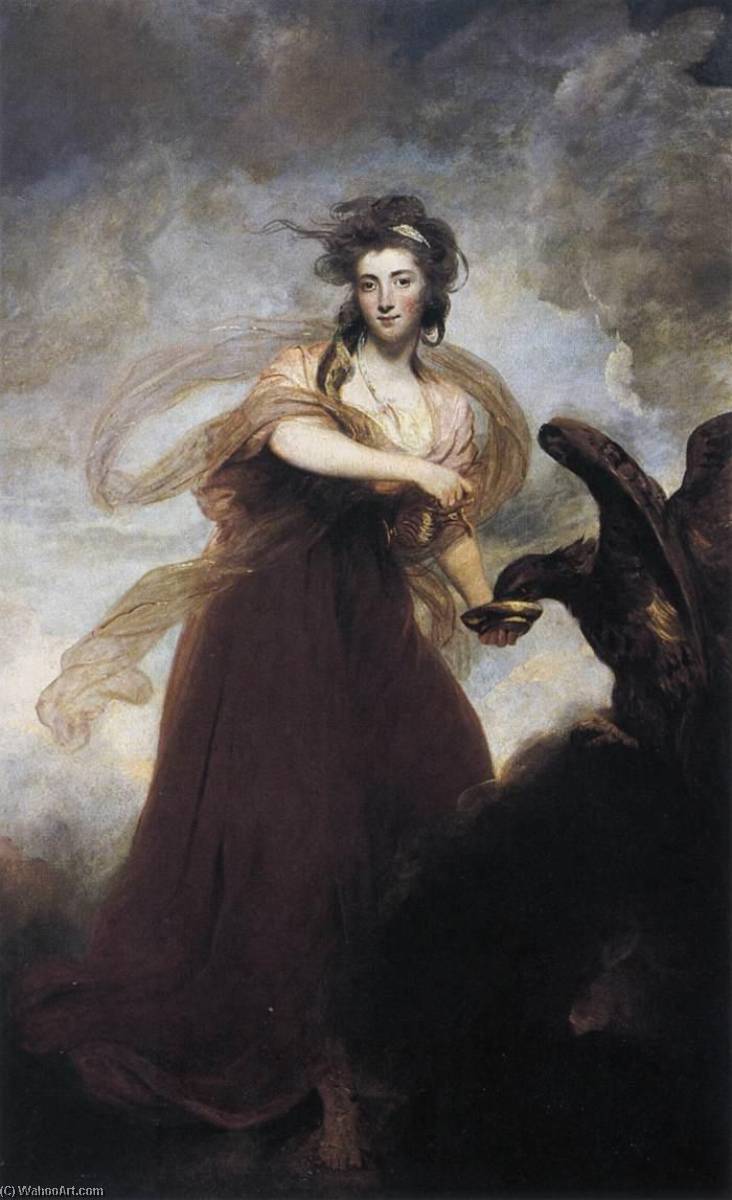
A Portrait Steeped in Myth and Mastery: Exploring Sir Joshua Reynolds’ Mrs. Musters as Hebe
Sir Joshua Reynolds (1723–1792), arguably the most celebrated portrait painter of his era, possessed an unparalleled ability to capture not merely likeness but also character—a feat achieved through meticulous observation and a masterful command of technique. His masterpiece, “Mrs. Sophia (née Heywood) Musters as Hebe,” completed in 1782, exemplifies this artistic philosophy and stands as a testament to the burgeoning neoclassical aesthetic that dominated British art during the Enlightenment.
The painting depicts Mrs. Sophia Heywood—a prominent social figure known for her beauty and grace—represented as Hebe, the Greek goddess of youth and springtime. Reynolds skillfully employed the conventions of classical mythology to elevate his subject beyond mere portraiture, transforming her image into a symbol of virtue and idealized femininity.
- Composition & Style: Reynolds’ approach harkens back to the grandeur of Guido Reni's “Aurora,” utilizing pyramidal composition—a technique favored by Renaissance artists—to create stability and visual harmony. The painting adheres strictly to neoclassical principles, prioritizing clarity, balance, and idealized beauty.
- Technique: Reynolds utilized mezzotint on moderately thick canvas, a printing process known for its tonal richness and ability to reproduce subtle nuances of light and shadow. This meticulous layering of ink allowed him to achieve an astonishing level of realism—capturing the delicate contours of Mrs. Musters’ face and drapery with remarkable precision.
- Symbolism: The inclusion of a bird, specifically an eagle, symbolizes freedom and strength – attributes traditionally associated with Hebe and reflecting Reynolds' belief in elevating his subject to divine status. Similarly, the bowl held by Mrs. Musters represents offerings or gifts, reinforcing the painting’s thematic exploration of grace and generosity.
- Color Palette: The artist skillfully employed a muted color palette dominated by earthy tones—browns and beiges for Mrs. Musters' gown—contrasting against the cool blues and whites of the dramatic sky backdrop. This deliberate use of light and shadow enhances the three-dimensional form of the figure, creating an immersive experience for the viewer.
- Historical Context: Reynolds’ work reflects the broader cultural currents of the Enlightenment, characterized by a renewed interest in classical antiquity and a desire to emulate its ideals of reason and beauty. “Mrs. Musters as Hebe” embodies this spirit, presenting Mrs. Heywood as an embodiment of feminine virtue—a figure worthy of admiration and emulation within the aristocratic circles of London.
Ultimately, Reynolds’ “Mrs. Musters as Hebe” transcends its formal conventions to deliver a profoundly emotive portrayal of beauty and grace. It remains a captivating example of neoclassical art—a timeless masterpiece that continues to inspire awe and admiration centuries after its creation.