A Portrait Steeped in Sentiment: Exploring Joshua Reynolds’s “Mrs. Stephen Payne-Gallwey and Her Son Charles”
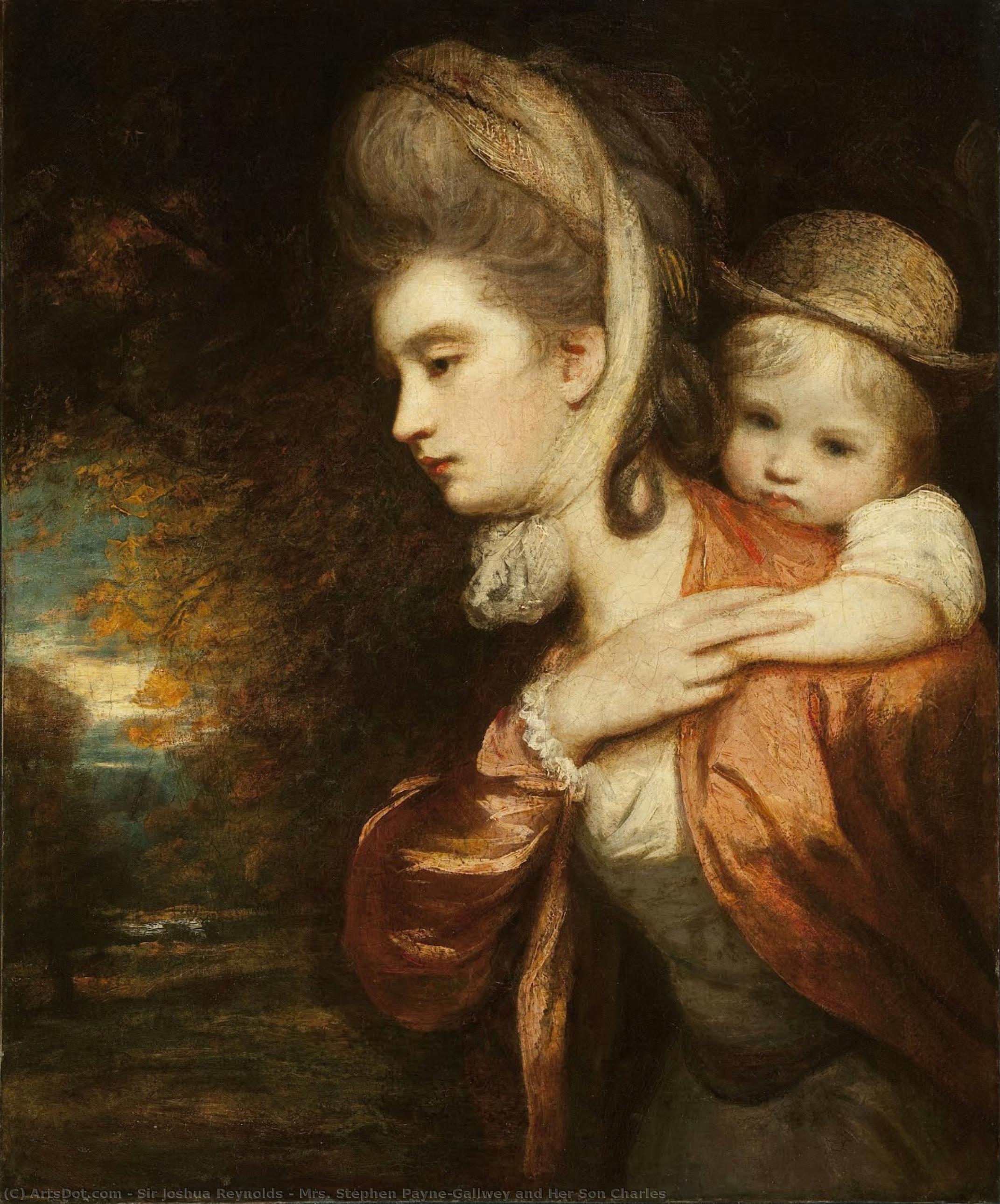
Sir Joshua Reynolds's "Mrs. Stephen Payne-Gallwey and Her Son Charles," completed in 1779, transcends mere likeness; it embodies the burgeoning Romantic sensibility of its time—a fascination with emotion and domestic tranquility amidst the intellectual fervor of the Enlightenment. Painted on canvas measuring 76 x 63 cm, this intimate portrait captures a moment of profound tenderness between Stephen Payne-Gallwey and his young son, offering viewers a glimpse into the idealized vision of family life prevalent in Georgian England. Reynolds skillfully employs chiaroscuro—the dramatic interplay of light and shadow—to sculpt the figures’ forms with remarkable precision, highlighting their delicate musculature and conveying an aura of serene contemplation.
- Style: Neoclassical – Reynolds adhered to the principles championed by Jacques-Louis David and Nicolas Poussin, prioritizing clarity of form and idealized beauty over expressive gesture or dramatic narrative.
- Technique: Reynolds’s mastery lay in his ability to achieve a luminous surface finish through meticulous layering of thin glazes—a technique that allowed him to capture subtle tonal variations and imbue the painting with an ethereal glow.
- Composition: The pyramidal arrangement lends stability to the scene, directing the viewer's gaze towards Mrs. Payne-Gallwey’s face, which dominates the canvas and exudes quiet dignity.
The subject matter itself speaks volumes about societal values during Reynolds’s era. Stephen Payne-Gallwey was a prominent figure in British society—a landowner, philanthropist, and advocate for progressive child rearing practices. Reynolds deliberately depicted Mrs. Payne-Gallwey cradling her son, emphasizing the importance of maternal care and nurturing – a concept that resonated deeply with contemporary audiences grappling with anxieties about societal change. The inclusion of two additional figures—presumably attendants—further reinforces this theme of domestic harmony and reinforces the idealized notion of aristocratic family life.
Symbolism: Reynolds’s use of color is restrained yet purposeful, favoring muted reds and creams that contribute to the painting's overall sense of calm. The pearl necklace adorning Mrs. Payne-Gallwey symbolizes purity and virtue—attributes highly valued in Georgian society. Furthermore, the gaze of both mother and son towards a distant horizon suggests aspiration and contemplation – hinting at the broader philosophical concerns of the Enlightenment regarding human potential and moral responsibility.
Historical Context: Reynolds’s work emerged during a period marked by significant social upheaval—the American Revolution, the Industrial Revolution, and growing skepticism toward established institutions. However, “Mrs. Stephen Payne-Gallwey and Her Son Charles” represents a deliberate retreat from these turbulent currents, presenting instead an image of domestic serenity and familial devotion—a testament to Reynolds’s ability to capture the spirit of his time while simultaneously elevating it to timeless beauty. The painting resides in the Taft Museum of Art, Cincinnati, Ohio, where it continues to captivate viewers with its exquisite craftsmanship and poignant portrayal of human emotion.