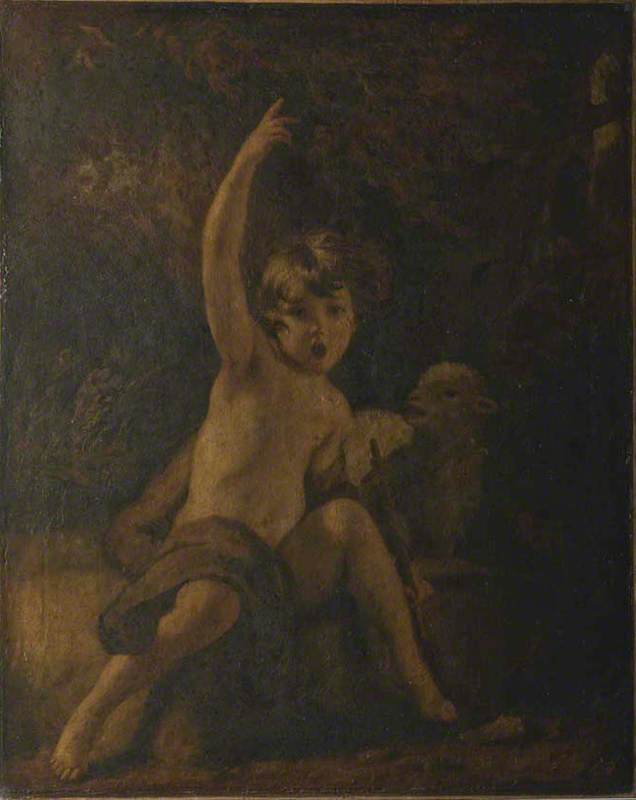
Discover Sir Joshua Reynolds’ "Saint John the Baptist in the Wilderness." A dramatic Romantic oil painting of a boy & sheep, showcasing rich texture & evocative lighting. Explore this captivating 1776 artwork.
Sir Joshua Reynolds (1723-1792): Leading British portrait painter of the 18th century & first Royal Academy President. Master of the 'Grand Style', he elegantly captured nobility and shaped British art.
Step back to Georgian elegance at The Wallace Collection! Explore stunning French art, exquisite furniture & arms in a historic townhouse – a jewel box of 18th-century London.
Saint John the Baptist in the Wilderness: A Romantic Vision of Innocence and Divine Presence
Sir Joshua Reynolds’s “Saint John the Baptist in the Wilderness,” completed around 1776, stands as a cornerstone of British Romanticism—a movement that championed emotion, imagination, and the sublime beauty of nature. More than just a portrait of a biblical figure, this painting embodies the era's fascination with spirituality and its yearning for transcendence, skillfully rendered through Reynolds’s masterful technique and compositional choices. The artwork captures a pivotal moment in Christian lore: John the Baptist’s solitary vigil before Jesus’s baptism, symbolizing vulnerability amidst grandeur and invoking contemplation on themes of faith and divine revelation.
Composition and Technique: Echoes of Raphael
Reynolds meticulously studied the works of Raphael—particularly his depiction of St John the Baptist—and sought to emulate his luminous style. The painting's dark palette—dominated by deep browns and greens—creates an atmosphere of brooding mystery, mirroring the shadowy woodland setting where John stands alone. Reynolds employed a loose brushstroke technique, prioritizing expressive texture over precise detail, particularly evident in the depiction of the rough bark of the trees and the folds of John’s garment. Impasto – thick application of paint – contributes to this textural richness, subtly enhancing the painting's dramatic impact. Notably, Reynolds incorporated experimental pigments that unfortunately led to deterioration over time, highlighting the challenges faced by conservators in preserving artworks from this period. The flattened perspective reinforces the feeling of being enveloped within the wilderness, emphasizing John’s isolation and vulnerability.
Symbolism: Lamb and Voice – Representations of Faith
Beyond its aesthetic qualities, “Saint John the Baptist in the Wilderness” is laden with symbolic significance. The central figure—a young boy—points upwards towards a crucifix held in his other hand, representing Christ's sacrifice and embodying Christian faith. Simultaneously, he gazes intently at a lamb—the Agnus Dei—symbolizing innocence, meekness, and divine compassion. Reynolds’s deliberate inclusion of this emblem underscores the painting’s spiritual core: John’s gesture signifies a plea for salvation, mirroring the Gospels’ portrayal of Jesus as the Lamb of God who redeems humanity. The scripture inscribed on the crucifix – “I am the voice of one calling in the wilderness” – directly quotes Psalm 23:1 and encapsulates John's prophetic role—a messenger proclaiming God’s mercy amidst a desolate landscape.
Historical Context and Influence
Painted during the Enlightenment, Reynolds’s work reflects the intellectual currents of his time—a period marked by scientific inquiry alongside a renewed interest in religious contemplation. The painting aligns with Romantic ideals that prioritized emotion over reason, celebrating the sublime power of nature as a conduit for spiritual experience. Its popularity resonated deeply within aristocratic circles and contributed to establishing Reynolds as one of Britain’s most celebrated portraitists. Furthermore, “Saint John the Baptist in the Wilderness” served as inspiration for subsequent artists, demonstrating Reynolds's enduring legacy as a pioneer of Romantic painting—a testament to his ability to capture both visual beauty and profound emotional resonance.
A Legacy of Luminosity: The Wallace Collection Reproduction
The Wallace Collection proudly houses a remarkable reproduction of this iconic artwork. Produced with meticulous attention to detail using archival pigments on canvas, this print faithfully recreates Reynolds’s original vision—allowing viewers to appreciate the painting's textural richness and evocative lighting. It stands as an exceptional choice for interior designers seeking to infuse their spaces with artistic grandeur and spiritual contemplation.