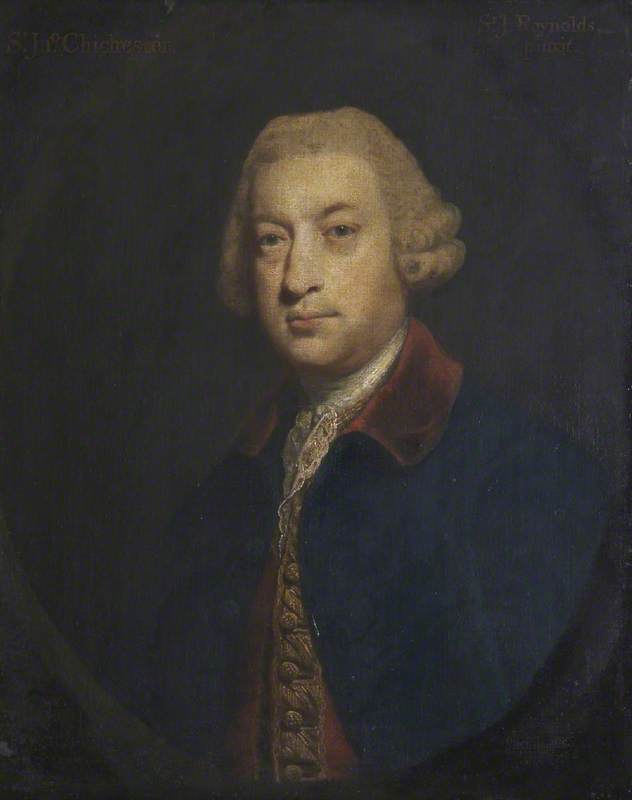
A Portrait of Aristocratic Grace: Sir John Chichester by Sir Joshua Reynolds
Sir Joshua Reynolds’s captivating portrait of Sir John Chichester, painted in 1767, offers a rare glimpse into the world of 18th-century English aristocracy. This meticulously rendered depiction transcends mere likeness; it's an embodiment of the ‘Grand Style’ that defined Reynolds’s career and established him as a leading figure in British art. The painting immediately draws the eye to Sir John Chichester himself, a man radiating confidence and bearing – qualities carefully cultivated through Reynolds’s masterful technique.
The subject is presented in a formal yet approachable manner. Dressed in the rich fabrics of the era—a vibrant red coat over a deep blue jacket, accented by elegant gold buttons—Chichester embodies the wealth and status associated with his title. The crisp white shirt beneath speaks to an attention to detail that was paramount for Reynolds’s aristocratic clientele. His carefully styled wig, a ubiquitous feature of the period, adds to the overall impression of polished sophistication. Notably, Chichester's direct gaze engages the viewer, creating a sense of intimacy and inviting us into his world.
The Grand Style: Technique and Composition
Reynolds’s signature ‘Grand Style’ is powerfully evident in this portrait. He employed a complex layering technique, building up the image through numerous glazes – thin layers of translucent paint applied over dry underpaintings. This created an astonishing depth and luminosity, particularly noticeable in the textures of the fabrics and the subtle play of light on Chichester's face. The artist’s use of chiaroscuro—the dramatic contrast between light and shadow—further enhances the three-dimensionality of the figure, imbuing him with a palpable presence.
The composition itself is carefully balanced, adhering to classical principles of proportion and harmony. Chichester occupies a central position within a relatively shallow space, drawing our attention directly to his face and posture. The background is deliberately muted, allowing the subject to command the entire visual field. Reynolds’s skill lies not just in replicating appearance but also in conveying character and status through subtle gestures and expressions.
Historical Context: A Portrait of Power
To fully appreciate this portrait, it's essential to understand its historical context. Sir John Chichester was a prominent figure within the landed gentry of Sussex, holding the title of 5th Baronet. Portraits like this were not simply decorative; they served as powerful statements of social standing and familial lineage. Commissioning such an artwork was a significant investment, reflecting the patron’s wealth and influence.
Painted during the Enlightenment, this portrait reflects the era's fascination with classical ideals of beauty and virtue. Reynolds himself drew heavily from Renaissance masters like Raphael and Titian, incorporating their principles into his own style. The emphasis on idealized form and dignified bearing aligns perfectly with the values championed by the elite of the time.
Symbolism and Emotional Impact
Beyond its technical brilliance, the portrait holds subtle symbolic weight. The formality of Chichester’s attire and pose speaks to the rigid social conventions of the era, while his direct gaze suggests a certain self-assurance and perhaps even a touch of pride. The red coat, often associated with military honor, subtly hints at Chichester's potential involvement in public life or service.
Ultimately, Sir John Chichester by Sir Joshua Reynolds is more than just a likeness; it’s a carefully constructed representation of power, status, and the ideals of the 18th century. A reproduction captures this exquisite detail and historical significance, offering a beautiful addition to any collection or a striking focal point for interior design – bringing a touch of aristocratic elegance to your space.