The Dignified Portrait of a Family’s Heart
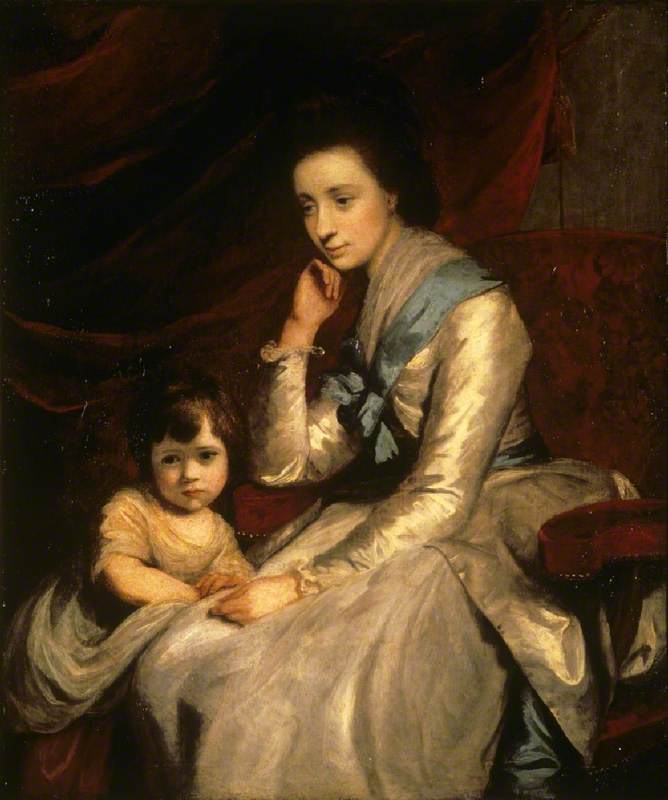
Sir Joshua Reynolds' “The Honourable Theresa Robinson (1744–1775), Mrs Parker, and Her Son, John Parker III (1772–1840), Later 1st Earl of Morley” is more than just a portrait; it’s a window into the refined world of Georgian England, capturing a tender moment of familial connection amidst societal expectations. Painted in 1775, this exquisite work exemplifies Reynolds' mastery of depicting character and atmosphere – a hallmark of his “Grand Style,” which prioritized idealized beauty and psychological insight over mere likeness. The scene unfolds within a subtly luxurious setting: a crimson curtain serves as a dramatic backdrop, hinting at the wealth and status of the Parker family, while the muted tones of the interior create an intimate, almost confidential mood.
At the heart of the composition sits Theresa Robinson, Mrs. Parker, presented in profile against a warm, inviting light. Her posture is graceful yet relaxed, her gaze direct and intelligent. Reynolds’ skill lies not just in capturing her physical features – the delicate curve of her neck, the subtle expression of serenity – but also in conveying her inner life. The blue ribbon around her neck isn't merely decorative; it subtly elevates her status, a small flourish that speaks volumes about her position within society. Her son, John Parker III, nestled securely in her lap, embodies youthful innocence and trust. The careful arrangement of their bodies – the mother’s protective embrace, the child’s contented repose – immediately establishes a powerful bond, one of love, security, and familial devotion.
Reynolds' Grand Style: A Study in Light and Form
Reynolds was a pioneer in portraiture, moving beyond simple likeness to create works that explored the sitter’s personality and social standing. “The Honourable Theresa Robinson” is a prime example of this approach. He employed his signature technique of using light to sculpt form, creating a sense of volume and depth within the figures. Note how the light catches the folds of her dress, highlighting its texture and elegance, while simultaneously softening the shadows that define her face. The use of chiaroscuro – the dramatic contrast between light and dark – not only adds visual interest but also serves to draw the viewer’s eye to key elements of the composition, such as Theresa's face and John’s youthful features.
The painting’s palette is restrained yet sophisticated, dominated by warm earth tones—ochres, browns, and reds—that evoke a sense of comfort and stability. The crimson curtain isn’t just a backdrop; it’s an integral part of the scene, adding warmth and richness to the overall composition. Reynolds' meticulous attention to detail extends to the rendering of fabrics – the velvet of the curtain, the silk of Theresa’s dress—each element contributing to the painting’s luxurious atmosphere.
Historical Context: A Portrait of a Family in Transition
To fully appreciate “The Honourable Theresa Robinson,” it's important to consider the historical context in which it was created. The late 18th century was a period of significant social and political change in England, marked by the rise of the landed gentry and the growing influence of the aristocracy. Portraits were not merely representations of individuals; they were carefully constructed statements about family lineage, wealth, and status. Theresa Robinson’s title – “The Honourable” – reflects her elevated position within society, while her marriage to John Parker III signaled a strategic alliance between two prominent families.
Furthermore, the painting was created during a time of personal tragedy for the family. Theresa died shortly after the portrait's completion, adding a poignant layer of melancholy to the scene. The tender intimacy captured in the image becomes all the more significant given this context, serving as a testament to the enduring power of familial love and connection. The fact that she was pregnant at the time of her death adds another layer of complexity to the portrait – a symbol of hope and potential lost.
Symbolism and Emotional Resonance
Beyond its technical brilliance, “The Honourable Theresa Robinson” is rich in symbolism. The mother’s hand gently resting on her son's lap speaks volumes about protection, nurture, and the passing down of values. The child’s contented expression suggests a sense of security and well-being – a reflection of the stability and prosperity enjoyed by the Parker family. The crimson curtain, often associated with royalty and wealth, reinforces this impression.
Ultimately, Reynolds' masterpiece is a deeply moving portrait that transcends its historical context. It captures not just the likeness of a woman and her child but also the essence of their relationship – a bond built on love, trust, and mutual affection. It’s a timeless depiction of family life, rendered with exquisite skill and profound emotional resonance, making it a treasured work of art for generations to come.