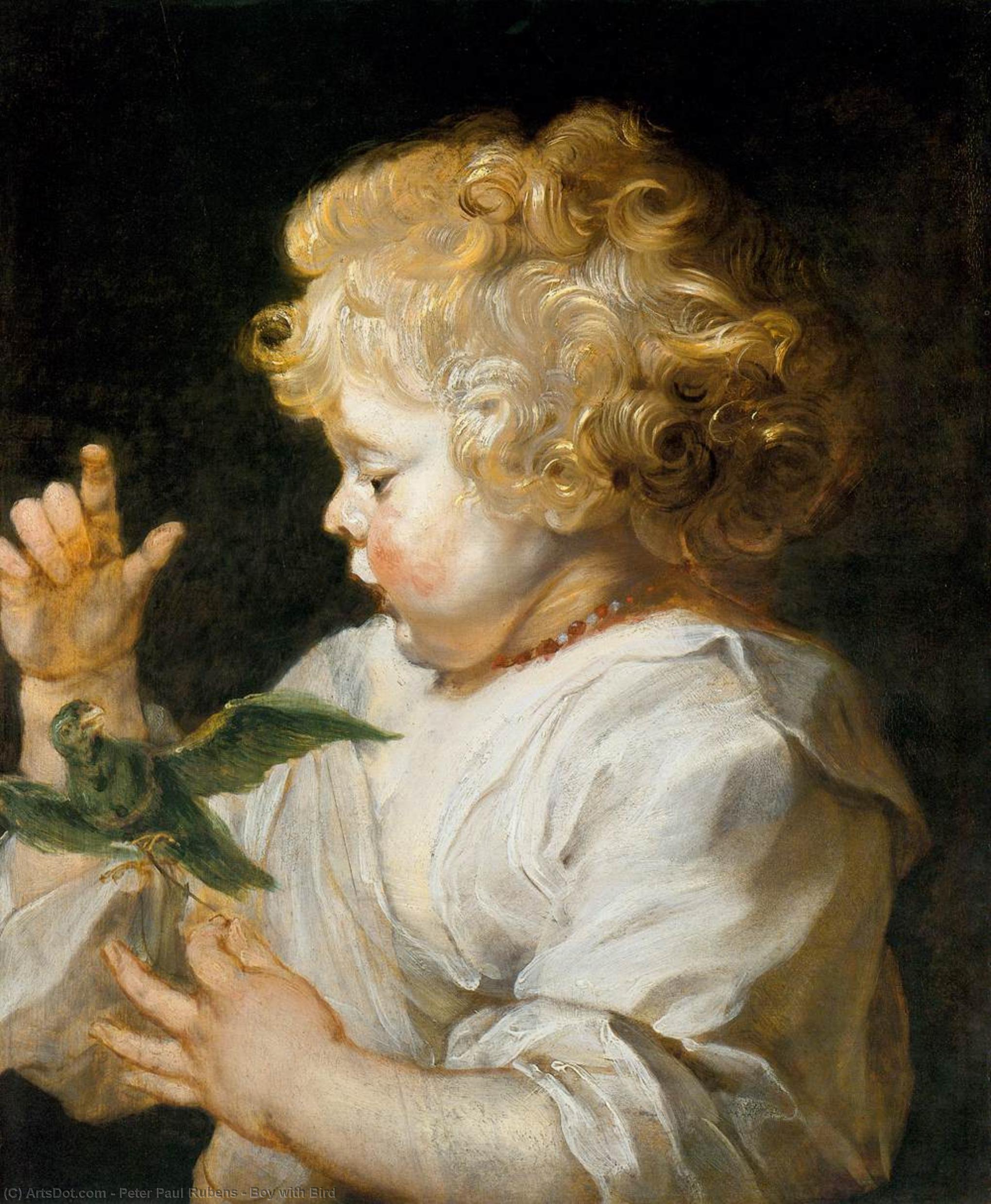
A Moment of Wonder: Peter Paul Rubens’ “Boy with Bird”
Peter Paul Rubens' "Boy with Bird," painted in 1616, is more than just a portrait; it’s a distillation of Baroque artistry—a vibrant tableau capturing the innocent joy of childhood and the quiet connection between humanity and nature. This intimate scene, housed within the Kunstsammlungen Graf von Schönborn Pommersfelden in Germany, reveals Rubens' masterful ability to infuse everyday moments with profound emotional depth and technical brilliance. Measuring just 49 x 40 cm on a panel, the painting’s scale belies its monumental impact, drawing the viewer into a world of light, color, and subtle interaction.
The central figure is a young boy, likely Rubens' own son Albert, presented in a pose of gentle curiosity. He wears simple white clothing, a stark contrast to the darker background that immediately draws attention to him. His gaze is fixed on a small bird held delicately in his hand – an avian companion seemingly engaged in a silent exchange with the child. The bird’s posture suggests a playful interaction, almost as if mirroring the boy's attentiveness. Rubens skillfully employs chiaroscuro—the dramatic contrast between light and dark—to heighten the sense of intimacy and focus. Light streams across the boy’s face and clothing, while the background recedes into shadow, creating a three-dimensional effect that anchors the scene within the viewer’s space.
Baroque Brilliance: Technique and Style
Rubens was a pioneer of the Baroque style, and “Boy with Bird” exemplifies his signature approach. The painting is executed in oil on panel, a technique he favored for its ability to capture rich colors and subtle textures. His use of color is particularly noteworthy—a symphony of warm reds, yellows, and blues creates an atmosphere of warmth and vitality. Rubens’ brushwork is loose and expressive, contributing to the painting's dynamic energy. Notice how he uses short, broken strokes to define form and create a sense of movement, especially in the bird’s feathers. The composition itself is carefully balanced, with the boy positioned slightly off-center, creating visual interest and preventing the scene from feeling static.
Furthermore, Rubens' background knowledge of classical art shines through. The arrangement of figures echoes principles found in Renaissance compositions, while the subject matter—a child interacting with nature—references ancient myths and allegories. The inclusion of two additional birds in the distance adds depth to the scene, suggesting a broader natural world beyond the immediate interaction between boy and bird. This layering of references elevates the painting from a simple portrait to a complex meditation on human connection and the beauty of the natural world.
A Window into Rubens’ World
"Boy with Bird" is not merely a charming depiction of childhood; it offers a glimpse into the life and artistic philosophy of Peter Paul Rubens. Born in Siegen, Germany, in 1577, Rubens spent formative years in Italy, where he was profoundly influenced by the works of Michelangelo and Caravaggio. This exposure to Italian art instilled in him a passion for dramatic realism and vibrant color—qualities that are abundantly evident in this painting. Rubens’ career spanned decades, during which he produced an astonishing volume of work, including grand historical paintings, religious scenes, portraits, and landscapes.
Beyond its aesthetic merits, “Boy with Bird” reflects Rubens' broader engagement with the Counter-Reformation. His art was commissioned by Catholic patrons throughout Europe, and his works often served to promote religious themes and values. However, this painting stands apart for its simplicity and directness—a departure from the elaborate allegories and mythological scenes that characterized much of his other work. It’s a moment of quiet contemplation, a celebration of innocence and wonder, and a testament to Rubens' enduring ability to capture the essence of human experience.
Collecting the Legacy: Reproductions and Further Exploration
Today, high-quality reproductions of “Boy with Bird” are readily available through platforms like ArtsDot.com, allowing art enthusiasts worldwide to appreciate this masterpiece. For those seeking a deeper understanding of Rubens’ life and work, we encourage you to explore the extensive resources available online, including Wikipedia (https://en.wikipedia.org/wiki/Peter_Paul_Rubens) and the Web Gallery of Art (https://www.wga.hu/html_m/r/rubens/41portra/11boybir.html). Additionally, the Kunstsammlungen Graf von Schönborn Pommersfelden (/art/list/?Filter=kunstsammlungen+graf+von+schönborn+pommersfelden,kunstsammlungen,graf,schönborn,pommersfelden,germany&) offers a fascinating glimpse into the museum’s collection and the history of this remarkable artwork.