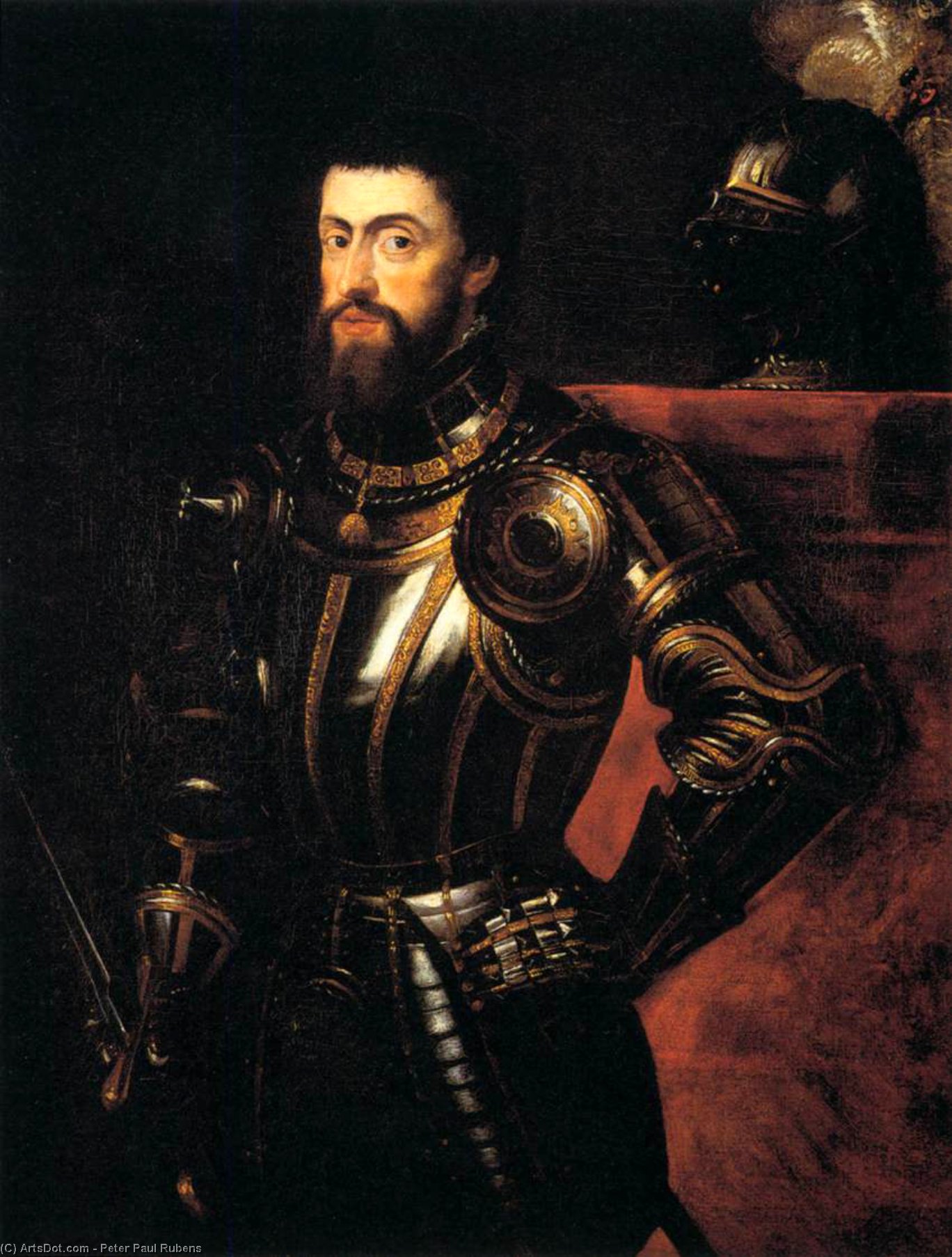
Charles V in Armour
Peter Paul Rubens’s “Charles V in Armour” stands as a monumental achievement of Baroque art, capturing not merely the likeness of Holy Roman Emperor Charles V but also embodying the grandeur and authority of his reign. Created in 1603, this oil on canvas masterpiece—measuring 119 x 93 cm—immediately commands attention with its dramatic composition and masterful execution.
The Subject: Charles V
The painting depicts Charles V, a figure pivotal to European history who reigned from 1508 until his death in 1558. He was renowned for ambitious military campaigns aimed at consolidating Habsburg dominion and implementing significant political reforms designed to strengthen the empire’s stability. Rubens' portrayal is characterized by an imposing presence; Charles V is depicted wearing full armour, conveying strength and resilience, with a stern expression reflecting the burdens of leadership.
Composition and Symbolism
Rubens skillfully arranges elements within the canvas to reinforce its thematic significance. Charles V occupies the central position, dominating the visual space. Surrounding him are two figures positioned in the background—likely intended as attendants or symbolic representations—adding depth and complexity to the scene. Notably, a sword rests at the lower left corner, serving as a potent emblem of martial prowess and royal power. The overall arrangement contributes to an atmosphere suggestive of both military grandeur and solemn contemplation.
Artistic Style
Rubens’s artistic style exemplifies the Baroque aesthetic—characterized by vibrant color palettes and dynamic brushwork—creating a palpable sense of movement and theatricality. The armour itself is rendered with meticulous detail, reflecting Rubens's unparalleled mastery of texture and realism. Light plays a crucial role in shaping the scene, highlighting Charles V’s form and casting shadows that heighten dramatic tension. This technique aligns perfectly with the Baroque tradition’s desire to evoke emotion and inspire awe.
Historical Context
Charles V’s reign coincided with transformative events in European history, including the rise of Protestantism and the Habsburg dynasty's expansion across Europe. Rubens’s depiction captures the essence of Charles V as a formidable ruler—a man who commanded respect and wielded considerable influence on the political landscape of his time. The painting serves as a testament to Rubens’s ability to translate historical narratives into compelling visual representations.
Relevance to Modern Art
"Cultural depictions of Maximilian I, Holy Roman Emperor" https://en.wikipedia.org/wiki/Cultural_depictions_of_Maximilian_I,_Holy_Roman_Emperor highlights the enduring legacy of Habsburg rulers in art and history, mirroring Rubens’s masterful portrayal of Charles V. Similarly, “Charles V in Armour” continues to fascinate art enthusiasts with its blend of historical accuracy and artistic brilliance—a timeless masterpiece that embodies the spirit of Baroque grandeur.
For those interested in exploring more artworks by Peter Paul Rubens, visit /art/list/?Filter=8XYQYS-Peter-Paul-Rubens-Charles-V-in-Armour and /art/list/?Filter=8XYQZ7-Peter-Paul-Rubens-Aeneas-And-His-Family-Departing-From-Troy.