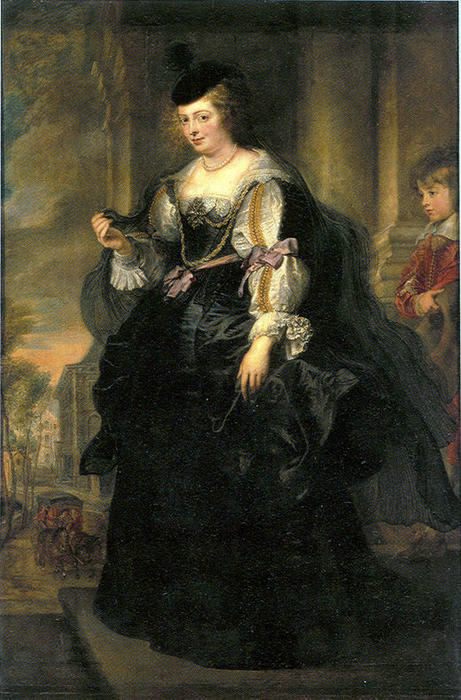
A Portrait of Grace and Power: Helena Fourment with Frans Rubens
Peter Paul Rubens’s “Helena Fourment with Frans Rubens,” housed within the hallowed halls of the Musée du Louvre, is more than simply a portrait; it's a carefully constructed tableau vivant—a snapshot of domestic life imbued with the grandeur and dynamism characteristic of the Flemish Baroque. Painted in 1639, during a pivotal period in Rubens’s career and personal life, this oil-on-panel masterpiece offers a rare glimpse into the world of a prominent artist and his family, revealing layers of elegance, ambition, and quiet intimacy.
The painting immediately commands attention with its masterful use of color and light. The figures are enveloped in deep, rich blacks – a deliberate choice that speaks to the formality and status of both Helena and Rubens. These dark tones are brilliantly offset by the subtle highlights on their clothing, particularly the delicate white collar worn by Helena, drawing the eye to her face—a portrait of serene beauty framed by a simple yet sophisticated hat. The background, rendered with meticulous detail, isn’t merely decorative; it establishes a sense of space and depth, hinting at a formal garden or courtyard – a setting that speaks to wealth, refinement, and the cultivated life favored by Antwerp's elite.
Rubens: A Humanist at the Heart of Baroque
Peter Paul Rubens was an extraordinary figure, not just as an artist but also as a diplomat, scholar, and humanist. His education in classical literature and philosophy profoundly influenced his work, imbuing it with a sense of intellectual depth and a fascination with mythology and history. “Helena Fourment with Frans Rubens” exemplifies this; the composition subtly references classical ideals of beauty and harmony, while simultaneously capturing the immediacy of a family moment. Rubens’s ability to seamlessly blend these influences is what truly sets his work apart.
The inclusion of his son, Frans Rubens, beside his wife underscores the importance of lineage and legacy within the artist's world. It’s a visual statement of continuity—a future generation inheriting both artistic talent and social standing. Rubens himself, depicted in a pose of dignified authority, subtly directs the viewer’s gaze towards Helena, suggesting her central role within the family and his own admiration for her.
Symbolism and Intimacy
Beyond its formal beauty, the painting is rich with symbolic details. The object held delicately in Helena's hand—likely jewelry or a small token—represents wealth, status, and perhaps even affection. Her posture, graceful yet poised, conveys an air of quiet confidence and self-possession. The subtle interaction between Rubens and his wife – the gentle gesture of his hand, the direct gaze – hints at a deep connection built on mutual respect and admiration. It’s not a passionate embrace, but rather a portrait of a stable, loving partnership—a cornerstone of their lives.
Interestingly, Helena Fourment herself was a woman of considerable influence in her own right. She was the daughter of a wealthy silk merchant, bringing with her a certain social standing and financial security to Rubens’s life. Her presence within the painting elevates it beyond a simple portrait; it becomes a reflection of Antwerp's thriving mercantile society and the intersection of art, wealth, and family.
A Legacy in Oil and Panel
Rubens’s choice of oil on panel is significant. While canvas was increasingly favored for its flexibility and ability to accommodate large-scale works, Rubens continued to utilize panels, particularly for portraits, valuing their durability and the rich texture they could achieve. This technique lends a certain warmth and depth to the painting's surface, enhancing the sense of realism and capturing the subtle nuances of light and shadow.
“Helena Fourment with Frans Rubens” remains a testament to Peter Paul Rubens’s extraordinary talent—a captivating blend of technical skill, humanist ideals, and emotional resonance. It is a window into a bygone era, offering a glimpse into the life of an artist at the height of his powers and a poignant reminder of the enduring beauty and complexity of the Flemish Baroque.