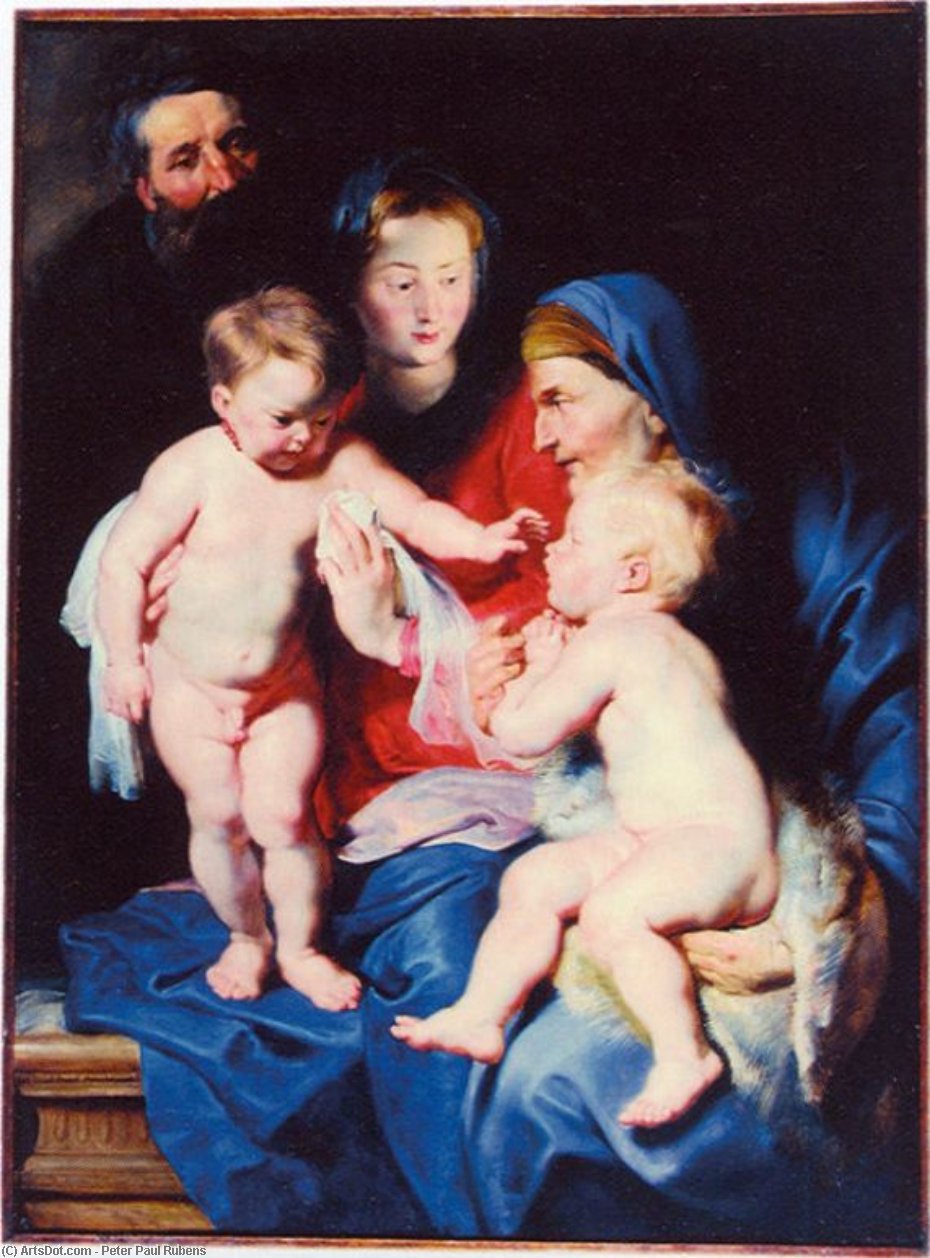
Holy Family with St Elizabeth and St John the Baptist
Peter Paul Rubens’ “Holy Family with St Elizabeth and St John the Baptist,” completed in 1614, stands as an emblem of Baroque grandeur and humanist compassion—a testament to Rubens' mastery of color, composition, and psychological depth. Currently residing at the Wallace Collection in London, this monumental oil on panel painting transcends mere depiction; it embodies a profound meditation on familial piety and divine grace. Measuring 138 x 102 cm, the artwork immediately captivates with its vibrant palette—deep reds, blues, and golds dominate, reflecting the opulent tastes of Rubens’ aristocratic patrons and mirroring the spiritual fervor of the era.
The painting's central focus is a serene tableau featuring Mary, Joseph, Jesus Christ, and St Elizabeth, accompanied by St John the Baptist. Rubens skillfully employs pyramidal composition to stabilize the scene, drawing the viewer’s eye upwards towards Mary—the Virgin Mother—who cradles her infant son Jesus in her lap. This positioning underscores Mary's centrality within Christian iconography as a symbol of purity and maternal devotion. The artist’s meticulous attention to detail extends beyond mere anatomical accuracy; he imbues each figure with palpable emotion, conveying tenderness, serenity, and unwavering faith. Joseph stands beside Mary, radiating quiet dignity and strength—a deliberate contrast to the youthful exuberance of St John the Baptist who leans towards Jesus, eager to initiate him into his prophetic mission.
Rubens’ artistic influences are discernible in several key stylistic elements. Like Parmigianino before him, Rubens subtly incorporates Mannerist techniques—particularly in Mary's face—creating an expression of melancholic beauty that anticipates Caravaggio’s dramatic chiaroscuro style. The artist’s masterful brushwork—characterized by loose, swirling strokes—generates a sense of movement and dynamism, capturing the palpable warmth emanating from the figures. Rubens’ use of color is equally remarkable; he employs bold hues to heighten emotional impact and create an immersive visual experience for the viewer. Furthermore, the painting's historical context illuminates its significance within the broader artistic landscape of the period—a time marked by papal patronage and a fervent desire to express religious piety through art.
The Wallace Collection’s acquisition of this masterpiece solidified its place in art history as one of Rubens’ most celebrated works. Alongside “The Descent from the Cross” (1612–1614) and “Madonna of the Basket” (around 1615), "Holy Family with St Elizabeth and St John the Baptist" exemplifies Rubens' ability to synthesize classical ideals—such as balance and harmony—with Christian spirituality. It continues to inspire admiration for its artistic brilliance and serves as a poignant reminder of the enduring power of art to convey profound human emotions and spiritual truths.
- Artist: Peter Paul Rubens
- Birth Year: 1577
- Death Year: 1640
- Birth City: Siegen
- Birth Country: Germany
Additional Research
*
Holy Family with St Elizabeth and St John the Baptist by Peter Paul Rubens
The Holy Family with Saints Elizabeth and John the Baptiste by The Art Institute of Chicago
The Descent from the Cross (Rubens, 1612–1614)
Marian art in the Catholic Church
Size
* 138 x 102 cm
Date
* 1614
Artist Information
Rubens’ artistic journey began in Cologne, where he honed his skills under the tutelage of Adam van Noort. His formative years in Italy exposed him to the revolutionary techniques of Caravaggio and Michelangelo—influences that profoundly shaped his distinctive Baroque style. Rubens' prolific output spanned genres including altarpieces, portraits, landscapes, and mythological subjects, establishing him as one of the foremost artists of his time. He served as court painter for Philip IV of Spain and Charles I of England, cementing his reputation as a diplomat and cultural statesman. His legacy continues to resonate through generations of artists—a testament to his unparalleled mastery of color, composition, and psychological realism.