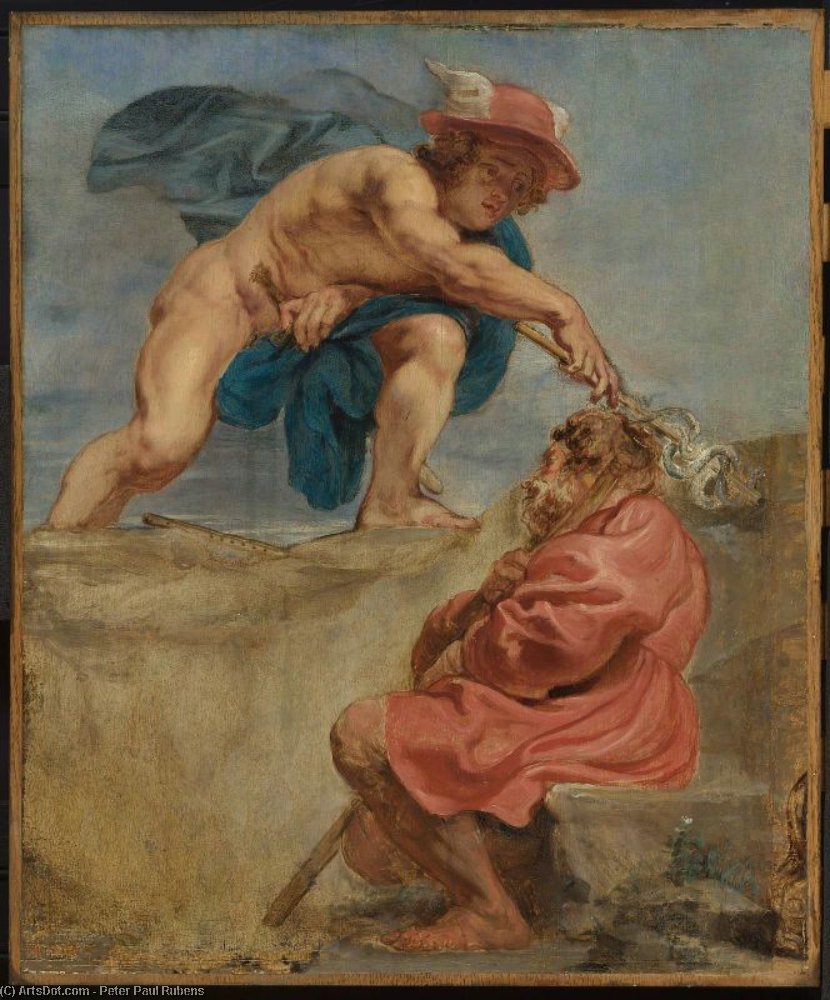
Mercury and a Sleeping Herdsman: A Baroque Masterpiece
- Title: Mercury and a Sleeping Herdsman
- Artist: Peter Paul Rubens
- Date: 1633
- Medium: Oil on panel
- Dimensions: 64 x 53 cm
- Location: Museum of Fine Arts, Boston
Subject and Composition
Peter Paul Rubens' "Mercury and a Sleeping Herdsman" presents a captivating scene steeped in classical mythology. The painting depicts the Roman god Mercury, identifiable by his winged sandals and caduceus (a staff entwined with serpents), attending to a sleeping herdsman. A third figure is subtly present in the background, adding depth and intrigue to the composition. Rubens masterfully utilizes dramatic lighting – characteristic of the Baroque period – to highlight the central figures and create a sense of dynamism. The red robe worn by Mercury provides a striking contrast against the muted tones of the landscape, drawing the viewer's eye directly to his presence.
Baroque Style and Technique
This artwork exemplifies the hallmarks of the Baroque style, championed by Rubens himself. The painting is characterized by its energetic brushwork, rich color palette, and a sense of movement that seems to animate the scene. Rubens’s technique involved layering paint to achieve depth and luminosity. He skillfully employed *chiaroscuro*, the dramatic contrast between light and shadow, to sculpt the figures and enhance their three-dimensionality. The composition is not static; it conveys a narrative moment – Mercury's watchful guardianship over the sleeping herdsman – with palpable emotion.
Historical Context and Symbolism
Created in 1633, "Mercury and a Sleeping Herdsman" reflects the artistic climate of the Counter-Reformation. Rubens, as a leading artist of the Flemish Baroque, was commissioned to create works that celebrated classical themes while subtly reinforcing Catholic values. Mercury, representing communication, trade, and protection, embodies qualities valued by both secular rulers and religious institutions. The sleeping herdsman could symbolize peace and tranquility under divine guidance. The painting’s commission likely stemmed from a desire for opulent decoration within aristocratic circles, showcasing the patron's refined taste and appreciation for classical mythology.
Emotional Impact and Artistic Significance
Beyond its technical brilliance and historical context, "Mercury and a Sleeping Herdsman" evokes a sense of quiet contemplation. The contrast between Mercury’s alertness and the herdsman’s peaceful slumber creates a subtle tension that engages the viewer's imagination. Rubens’s ability to capture human emotion – even in mythological figures – is remarkable. This painting stands as a testament to his artistic genius, solidifying his place as one of the most influential artists of the Baroque era. It continues to inspire awe and admiration for its beauty, complexity, and enduring power.