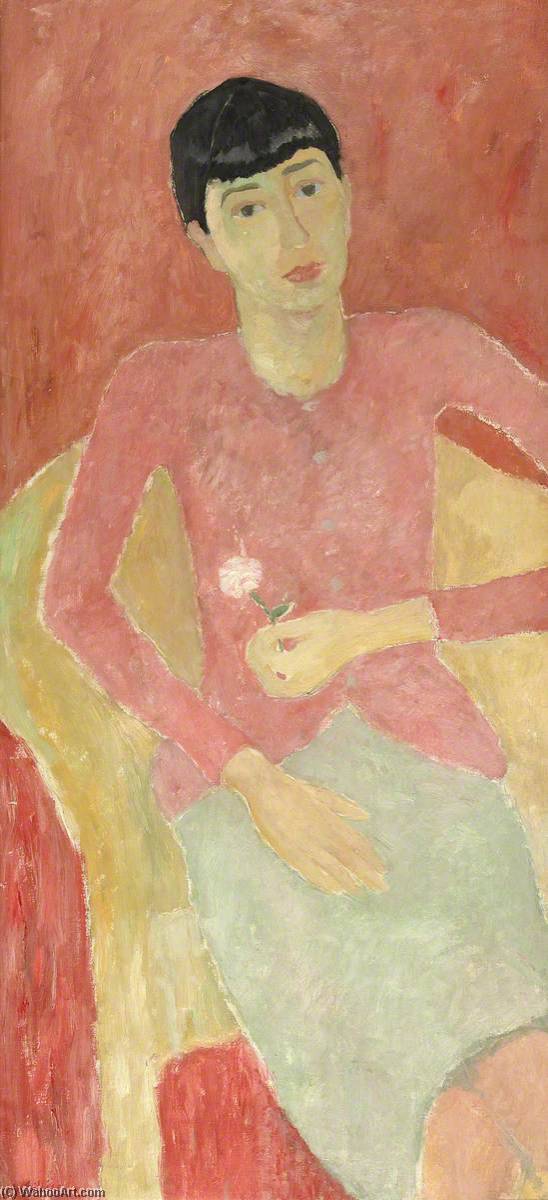
Marjory Porter (1): A Portrait of Quiet Elegance
Sir William George Gillies’ “Marjory Porter” is more than just a depiction of a young woman; it's an embodiment of the Scottish Impressionist movement’s fascination with capturing fleeting moments and conveying subtle emotional resonance. Painted circa 1934, this oil on canvas piece exemplifies Gillies’ distinctive approach to portraiture – one characterized by understated color palettes and a deliberate simplification of form.
The artwork centers around Marjory Porter seated in an armchair, bathed in diffused natural light. Gillies skillfully employs soft brushstrokes to create a sense of stillness and tranquility, reflecting the contemplative gaze of his subject. The muted tones of beige and cream dominate the background, minimizing distractions and allowing Porter’s figure—dressed in pale grey—to command attention.
Gillies' stylistic influences are palpable throughout “Marjory Porter.” He absorbed lessons from Paul Cézanne and André Lhote during his Parisian studies in 1923-24, adopting Cézanne’s pyramidal compositions and Picasso’s restrained color harmonies. However, the profound impact of Klee—particularly Klee's exploration of childlike spontaneity and vibrant hues—is evident in Gillies’ use of color. The delicate pink blossom held by Porter serves as a poignant symbol – representing beauty, fragility, perhaps even innocence – subtly enhancing the portrait’s emotional depth.
Technically, Gillies achieved his luminous effect through meticulous layering of paint, utilizing thin glazes to build up tonal variations and create subtle gradations of color. The canvas surface retains visible brushstrokes, contributing to the artwork's textural richness and conveying a sense of immediacy. This technique aligns with the broader artistic ethos of the period, prioritizing expressive gesture alongside careful observation.
“Marjory Porter” resides within the larger context of Scottish art during Gillies’ lifetime – a time marked by experimentation and a desire to forge new visual languages. It stands as a testament to Gillies' ability to distill complex emotions into deceptively simple forms, securing its place as an enduring masterpiece of Impressionist portraiture.
- Artist: Sir William George Gillies
- Year Painted: Circa 1934
- Medium: Oil on Canvas
- Dimensions: 129 x 59 cm
Further research suggests that Gillies’ formative years were shaped by his involvement in World War I with the Royal Engineers, providing him with invaluable experience and fostering a disciplined artistic sensibility. His dedication to teaching at Edinburgh College of Art cemented his legacy as a pivotal figure in Scottish art education.