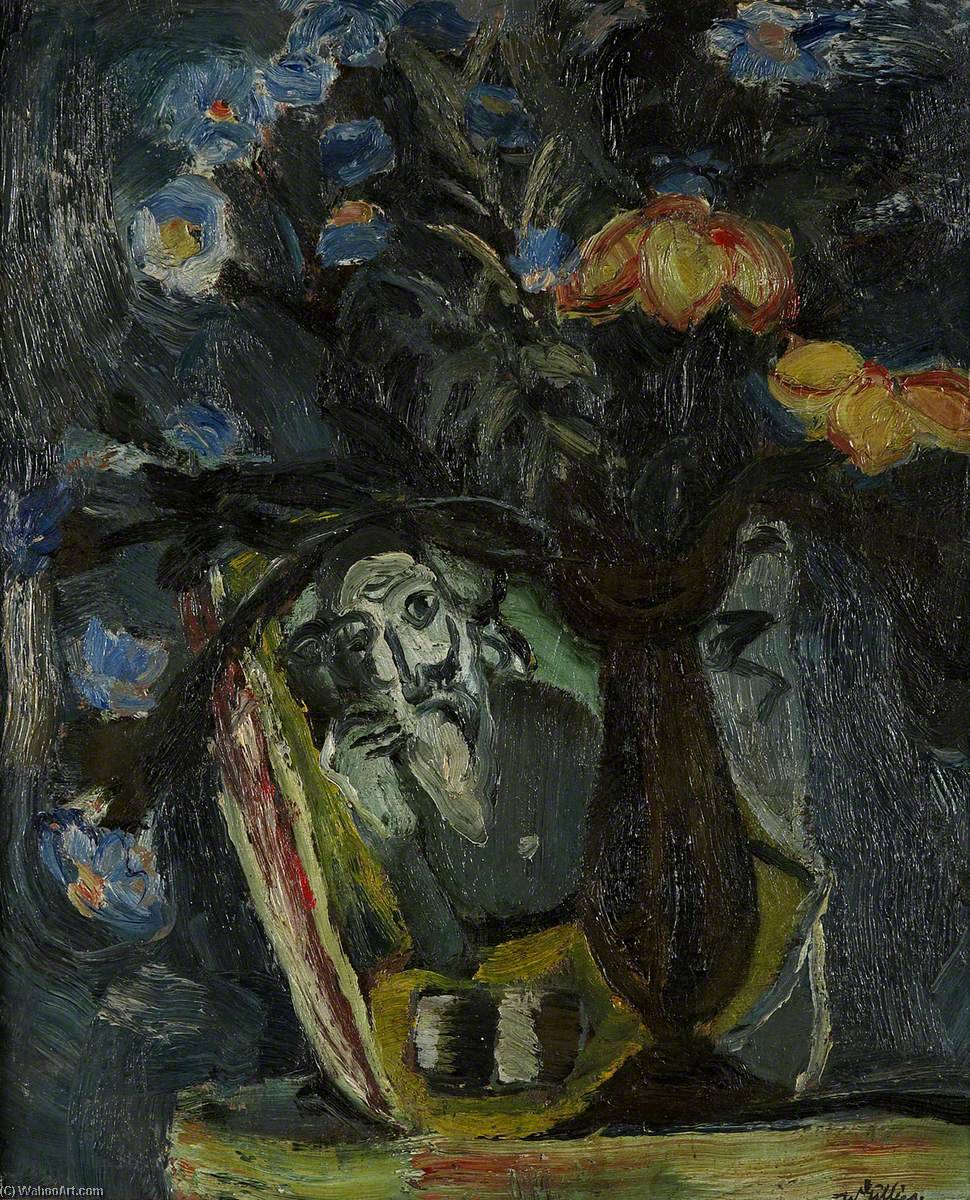
Explore Gillies' 'Still Life with Chagall Print,' a moody 1933 oil painting blending botanical beauty with symbolic depth. Experience Expressionist brushwork & evocative imagery.
Explore W.G. Gillies' Scottish landscapes & still lifes. Discover his Cubist influences, 1922 Group ties, Edinburgh College of Art legacy & profound impact on 20th-century art.
Explore Scotland's artistic heritage at the Royal Scottish Academy – Edinburgh’s national academy of art showcasing contemporary and historic masterpieces, fostering creativity & celebrating architectural excellence.
A Haunting Still Life: "Still Life with Chagall Print" by Sir William Gillies
This evocative artwork, created in 1933, presents a compelling still life imbued with an atmosphere of quiet melancholy and introspection. Dominated by a palette of dark blues and yellows, the composition features a vibrant yet slightly unsettling arrangement of flowers spilling from a vase alongside a striking figure – an elderly man cloaked and hatted, his face etched with weariness. The overall impression is one of profound contemplation, hinting at themes of aging, mortality, and perhaps even judgment, all rendered through Gillies’ distinctive Expressionistic style.
Style and Technique: Echoes of Modernism
Gillies' artistic journey was deeply influenced by the modernist movements of his time. Initially exploring Cubism under André Lhote in Paris, as evidenced by earlier works like "Two Pots, Saucer and Fruit" (1933), he later embraced the expressive freedom found in Paul Klee’s work. This painting exemplifies that evolution. The loose brushstrokes, distorted forms, and flattened perspective are hallmarks of Expressionism, prioritizing emotional impact over strict realism. The heavy impasto technique – a thick application of paint – adds significant texture, creating a tactile quality that draws the viewer into the scene. Notice how the directional lighting casts dramatic shadows, further enhancing the sense of unease and mystery within the composition.
Symbolism and Narrative
Beyond its visual appeal, "Still Life with Chagall Print" invites deeper interpretation. The vibrant flowers, typically symbols of life and beauty, are juxtaposed against the somber presence of the old man, creating a poignant contrast. The inclusion of a Chagall print in the background (though details remain obscured) adds another layer of complexity – perhaps referencing themes of memory, displacement, or the enduring power of art amidst personal reflection. The figure’s contemplative expression and posture suggest a sense of weariness and acceptance, prompting viewers to consider their own mortality and the passage of time.
Historical Context and Gillies' Artistic Development
Created during the interwar period, this painting reflects a broader cultural mood characterized by uncertainty and introspection following World War I. Gillies’ career spanned over four decades, marked by his dedication to both artistic practice and education at Edinburgh College of Art. His ability to synthesize diverse influences – from Cubism to Klee – resulted in a unique visual language that resonated with audiences throughout Scotland and beyond. This still life demonstrates Gillies' mastery of capturing not just the appearance of objects but also their underlying emotional weight, solidifying his place as a significant figure in Scottish art.