A Moment on Hampstead Heath: William Nicholson’s Evocative Vision
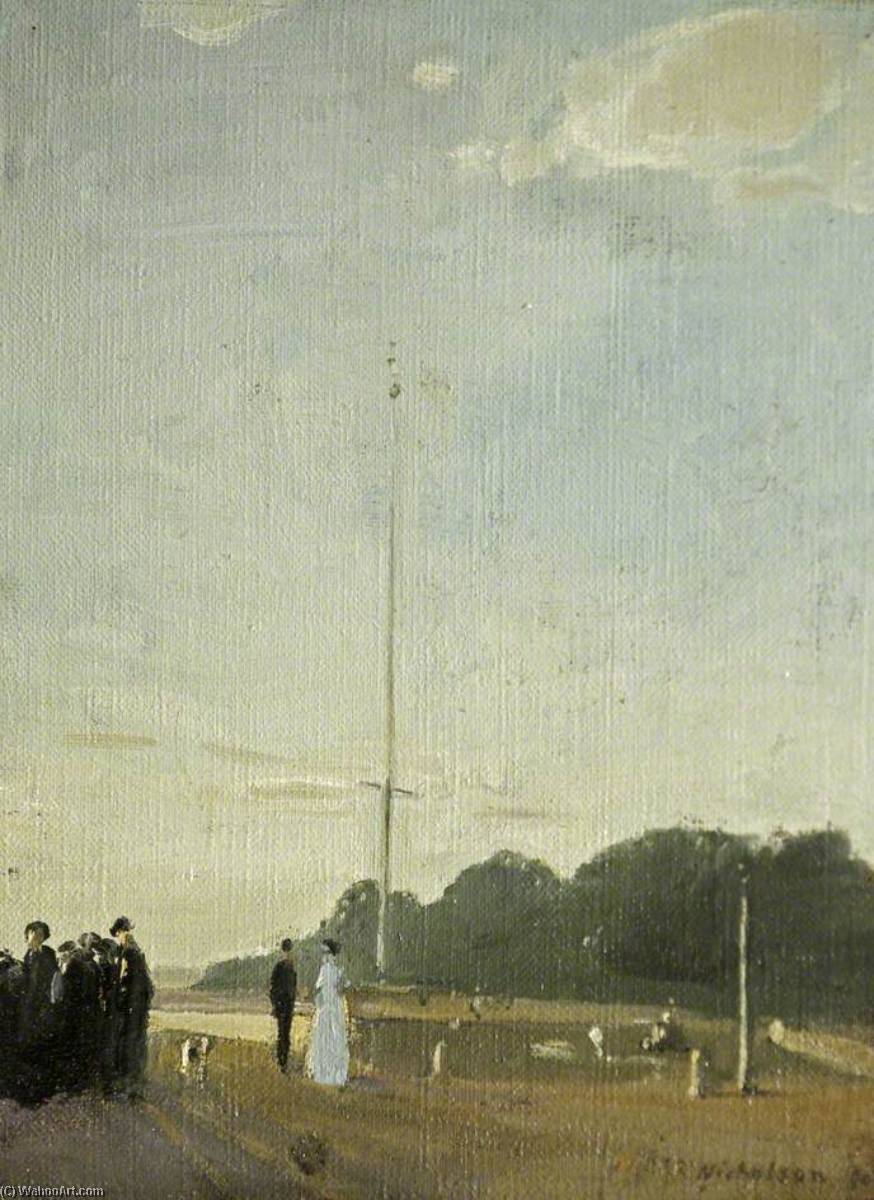
William Nicholson's "Hampstead Heath, Flagstaff," painted in 1908, isn’t merely a depiction of a London landscape; it’s a carefully constructed tableau brimming with quiet observation and subtle emotional resonance. The painting captures a fleeting moment on the sprawling heath, a gathering of figures clustered around a prominent flagpole – a focal point that immediately draws the eye and subtly anchors the scene within a broader narrative of community and national identity. Nicholson, a pivotal figure in British art at the turn of the 20th century, masterfully employs the tenets of Impressionism and Post-Impressionism to create an atmosphere both familiar and imbued with a delicate sense of melancholy. The muted palette – dominated by browns, greens, and greys punctuated by hints of white in the clouds – immediately establishes a mood of diffused light and contemplative stillness, reminiscent of a late afternoon on a cool autumn day.
Composition and Technique: A Study in Atmospheric Perspective
Nicholson’s compositional choices are deliberate and effective. The flagpole, rendered with a slight vertical emphasis, acts as a visual axis, guiding the viewer's eye through the scene towards the figures in the foreground. These individuals – a small group of men and women – are depicted with a remarkable degree of naturalism, yet their forms are softened by the atmospheric perspective Nicholson skillfully utilizes. Notice how they gradually diminish in size and detail as they recede into the background, creating an illusion of depth that seamlessly blends with the rolling expanse of the heath. The artist’s brushwork is loose and expressive, characteristic of his style, conveying a sense of immediacy and capturing the fleeting quality of light and shadow. He employs visible strokes, layering colors to build up form and texture – particularly evident in the depiction of foliage and the billowing clouds – without resorting to sharp outlines or precise detail. This technique contributes significantly to the painting’s overall atmospheric effect.
Symbolism and Context: National Identity and Everyday Life
The presence of the flagpole is crucial to understanding the painting's deeper significance. In 1908, Hampstead Heath was a popular destination for Londoners seeking respite from the city’s bustle, and flagstaffs were frequently erected on prominent locations like this one to serve as markers or symbols of civic pride. Nicholson subtly elevates this everyday scene into something more profound by suggesting a gathering of individuals united by a shared connection to their community and perhaps even to national identity. The figures are engaged in conversation, seemingly lost in contemplation – they represent the ordinary people of London, enjoying a moment of leisure amidst the grandeur of the heath. The painting subtly invites us to consider the relationship between public spaces, social gatherings, and the collective consciousness.
Emotional Resonance: A Quiet Sense of Nostalgia
Beyond its technical merits and symbolic layers, “Hampstead Heath, Flagstaff” possesses a powerful emotional resonance. There’s an undeniable sense of nostalgia woven into the scene – a longing for simpler times, for connection with nature, and perhaps even for a lost sense of community. The muted colors, the diffused light, and the quiet demeanor of the figures all contribute to this feeling. It's not a vibrant, celebratory depiction; rather, it’s a quietly contemplative one, inviting us to pause and reflect on the beauty and serenity of the natural world. Nicholson’s masterful ability to capture such subtle emotional nuances is what elevates this painting beyond a mere landscape view – it becomes a poignant meditation on the human experience.
Further Exploration
To delve deeper into William Nicholson's artistic journey, consider exploring his early collaborations with James Pryde, particularly their Beggarstaff prints. His work at the Sir William Dunn School of Pathology also offers insights into his diverse interests and creative spirit. For a more detailed examination of this specific painting, you can visit Art UK for further information and related resources.