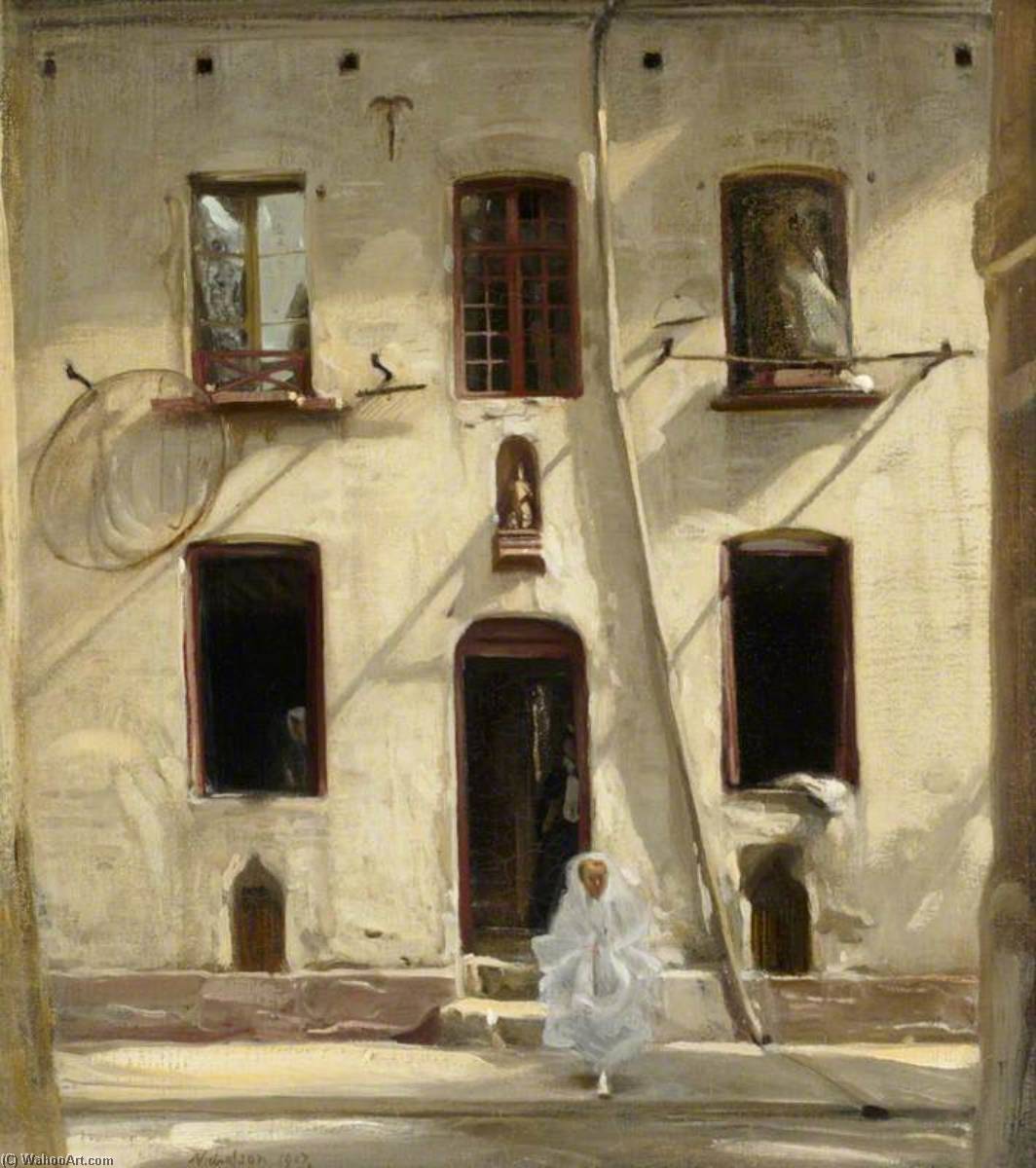
A Moment Frozen in Time: Sir William Nicholson’s “The First Communion”
Sir William Nicholson's "The First Communion," painted in 1907, isn’t merely a depiction of a religious ceremony; it’s a poignant snapshot of Victorian England imbued with a delicate blend of realism and sentimentalism. The painting captures a young girl, poised on the steps of an unassuming building – likely a church or community hall – as she prepares to receive her First Communion. Her posture, slightly hesitant yet undeniably hopeful, immediately draws the viewer in, establishing a quiet intimacy that transcends the formal setting. Nicholson masterfully utilizes light and shadow, bathing the scene in a soft, diffused glow that emphasizes the girl’s youthful face and the simple elegance of her white dress. The background, subtly rendered with a streetscape and a distant building, provides context without distracting from the central subject – a testament to Nicholson's skill in balancing detail and atmosphere.
The Beggarstaff Legacy and Artistic Influences
Understanding “The First Communion” requires acknowledging Sir William Nicholson’s place within the broader artistic landscape of his time. He was a key figure in the Beggarstaff partnership, alongside James Pryde, renowned for their groundbreaking graphic work – posters, illustrations, and designs that challenged Victorian conventions with their bold lines, dynamic compositions, and often satirical wit. This experience profoundly shaped Nicholson's approach to painting, instilling a keen eye for composition, color, and capturing fleeting moments of everyday life. The influence of the Pre-Raphaelites is also evident in the painting’s meticulous attention to detail and its focus on portraying human emotion with remarkable sensitivity. The careful rendering of textures – the fabric of the dress, the worn steps – speaks to a desire for realism tempered by an artistic vision.
Symbolism and Victorian Values
“The First Communion” is rich in symbolic meaning, deeply rooted in the values of the late 19th century. The girl’s white dress represents purity and innocence, a visual shorthand for her transition into adulthood and her acceptance within the Christian community. Her hesitant posture suggests both vulnerability and anticipation – she's on the cusp of a significant religious experience. The presence of other figures in the background—a man standing near the left side, another on the right, and two individuals closer to the center—adds a layer of social context, hinting at a community gathered to witness this important rite of passage. The clock mounted on the building’s exterior wall subtly references time and the passage of life, reinforcing the painting's theme of transition and growth. The bird flying above adds an element of lightness and hope, suggesting that this moment marks the beginning of a bright future.
A Window into Victorian Life and Nicholson’s Vision
Beyond its religious subject matter, “The First Communion” offers a valuable glimpse into Victorian society. The modest setting, the everyday attire of the figures, and the quiet dignity of the scene all speak to the values of restraint, piety, and community that were prevalent at the time. Nicholson’s ability to capture this atmosphere with such sensitivity is remarkable. He doesn't simply depict a religious ceremony; he creates a compelling portrait of a moment in time—a moment filled with hope, innocence, and the quiet beauty of human connection. The painting remains a powerful testament to Nicholson’s artistic talent and his profound understanding of the human condition. Reproductions of this evocative work continue to resonate with viewers today, offering a timeless reflection on faith, childhood, and the enduring power of art.