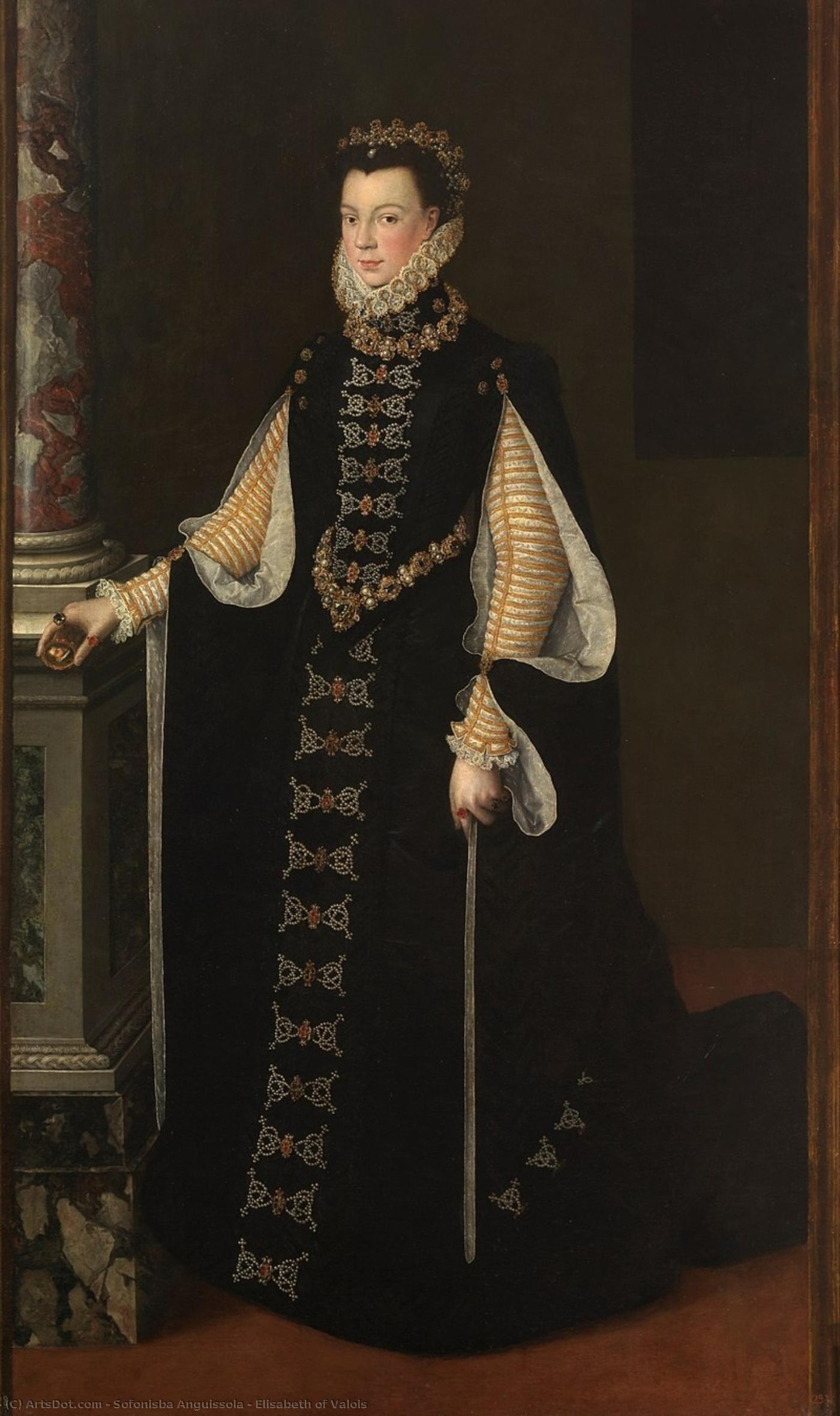
Sofonisba Anguissola's *Elisabeth of Valois* (1565) captivates with its symmetrical composition, dark palette accented by gold, and masterful depiction of the Spanish Queen’s poise and attire. Explore this iconic Renaissance artwork.
Elisabeth of Valois: A Renaissance Portrait Embodied in Elegance
The artwork “Elisabeth of Valois” by Sofonisba Anguissola, completed around 1565, stands as a remarkable testament to the artistic achievements of the Italian Renaissance and, crucially, to the pioneering spirit of women artists during that era. Currently residing within the Museo del Prado in Madrid, Spain, this portrait transcends mere representation; it’s an immersive experience into the opulent world of Spanish royal court life and a poignant glimpse into the personal character of Elisabeth Stuart, daughter of Henry II and Catherine de' Medici—a woman who defied societal expectations to carve out her own legacy as Queen consort.
- Subject Matter & Context: The painting depicts Elisabeth of Valois in a formal pose against a blurred background, reflecting the conventions of Renaissance portraiture where dignity and status were paramount. Commissioned during Philip II’s reign—a period marked by religious fervor and imperial ambition—the portrait served not only as a visual record but also as a symbol of royal power and marital alliance. Elisabeth's role as Queen was fraught with political complexities, yet Anguissola skillfully captured her serene composure, conveying an aura of grace and resilience.
- Composition & Technique: Sofonisba Anguissola’s masterful technique is immediately apparent in the artwork’s balanced symmetry—Elisabeth occupies the central axis, drawing the viewer's eye directly to her gaze. The artist employed oil paint on canvas with exceptional precision, layering pigments to achieve subtle gradations of light and shadow that imbue the figure with palpable volume. Note the careful rendering of textures: the smooth skin contrasts beautifully with the intricate embroidery adorning Elisabeth’s gown—a deliberate choice designed to emphasize both wealth and refinement.
- Color Palette & Symbolism: The dominant color palette is characterized by deep browns and blacks, punctuated by flashes of gold, cream, and muted reds – colors that speak volumes about the aristocratic milieu in which Elisabeth resided. The subdued hues underscore the solemnity of the occasion while highlighting the luminosity of her jewelry—particularly a magnificent golden necklace studded with pearls and emeralds. Furthermore, the drapery’s folds are rendered with meticulous detail, mirroring the stylistic influences of Titian's portraits and subtly referencing classical ideals of beauty.
- Stylistic Influences & Artistic Legacy: Anguissola’s work aligns seamlessly with the broader artistic currents of the Renaissance, inheriting elements from Mannerism—particularly in the stylized pose and expressive gaze—yet grounding itself firmly in realism. Her achievement is particularly noteworthy considering the limitations imposed upon women artists during her time; Sofonisba defied societal norms by pursuing a career dedicated to visual art, establishing herself as one of the foremost female painters of her generation.
- Emotional Impact & Interpretation: “Elisabeth of Valois” transcends mere depiction—it invites contemplation on themes of femininity, nobility, and resilience. The portrait’s serene expression conveys an inner strength that belies the turbulent political landscape of Elisabeth's life. It serves as a poignant reminder of Sofonisba Anguissola’s artistic brilliance and her courageous determination to assert herself in a male-dominated world—a legacy that continues to inspire artists and collectors alike.