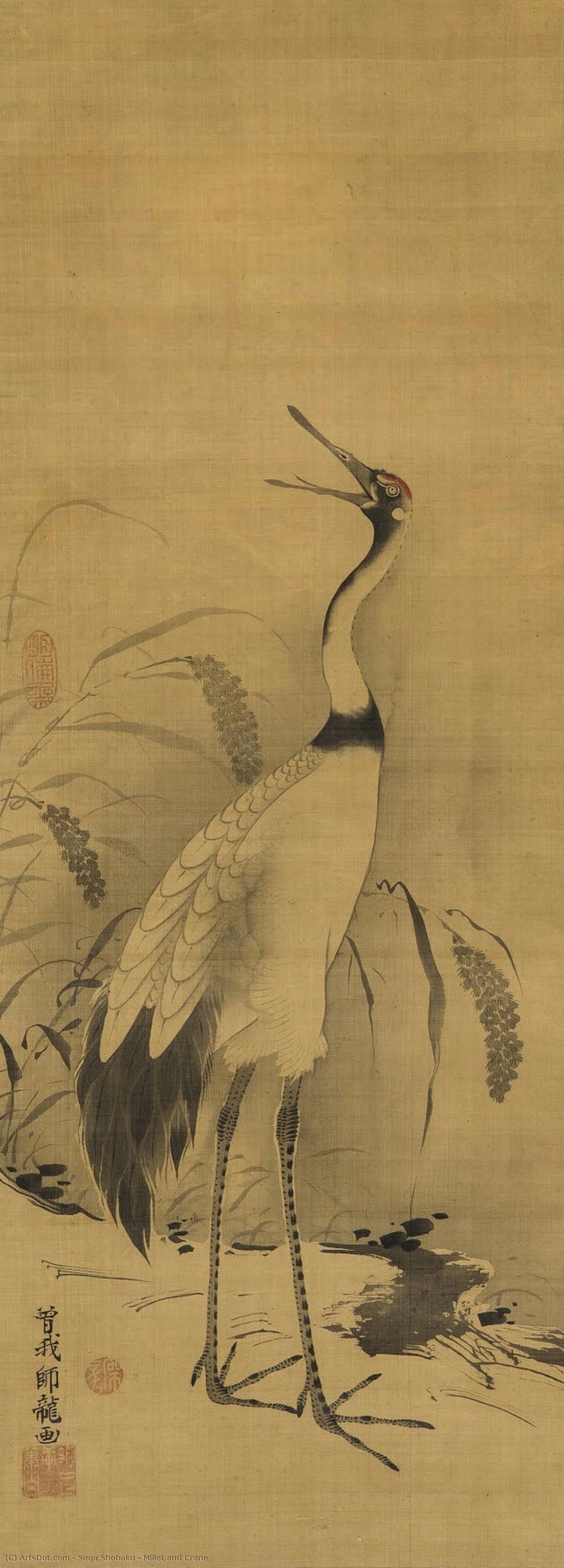
Millet and Crane

Soga Shohaku’s ‘Millet & Crane’ – a stunning Edo-period ink painting of a solitary crane amidst vibrant millet. Explore its unique style, symbolism & serene beauty.


soga shohaku (1730 - 1781)

Explore the unconventional world of Soga Shōhaku (1730-1781), a Japanese Edo period painter known for his bold, Muromachi-style brushwork & eccentric depictions of Zen Buddhist themes and folklore. Discover his unique grotesquerie!

Fukuda Art Museum (Kyoto, Japan)

Experience tranquility & beauty at Fukuda Art Museum in Kyoto! Explore Japanese realism with stunning prints inspired by masters like Uemura Tsune & Murai Sadakatsu – find serenity & artistic inspiration.

The crane turns, stretches its neck, opens its mouth wide, and shouts. Though Japanese-style paintings typically feature a pair of male and female cranes, only one crane is shown in this picture, seemingly attempting to call its counterpart. The millet leaves and ears behind the crane fully utilize shades of ink to adeptly create an impression of depth. Millet is frequently portrayed with quails, making Shohaku’s decision to use a crane quite daring. In addition, the millet ears are extraordinarily large in comparison to the crane. The combination of motifs and unbalanced scale lend a mysterious air to the painting, signaling intent on the part of the artist. Soga Shohaku (1730-1781) is a painter who hailed from Kyoto during the mid-Edo Period.