A Botanical Symphony in Ink
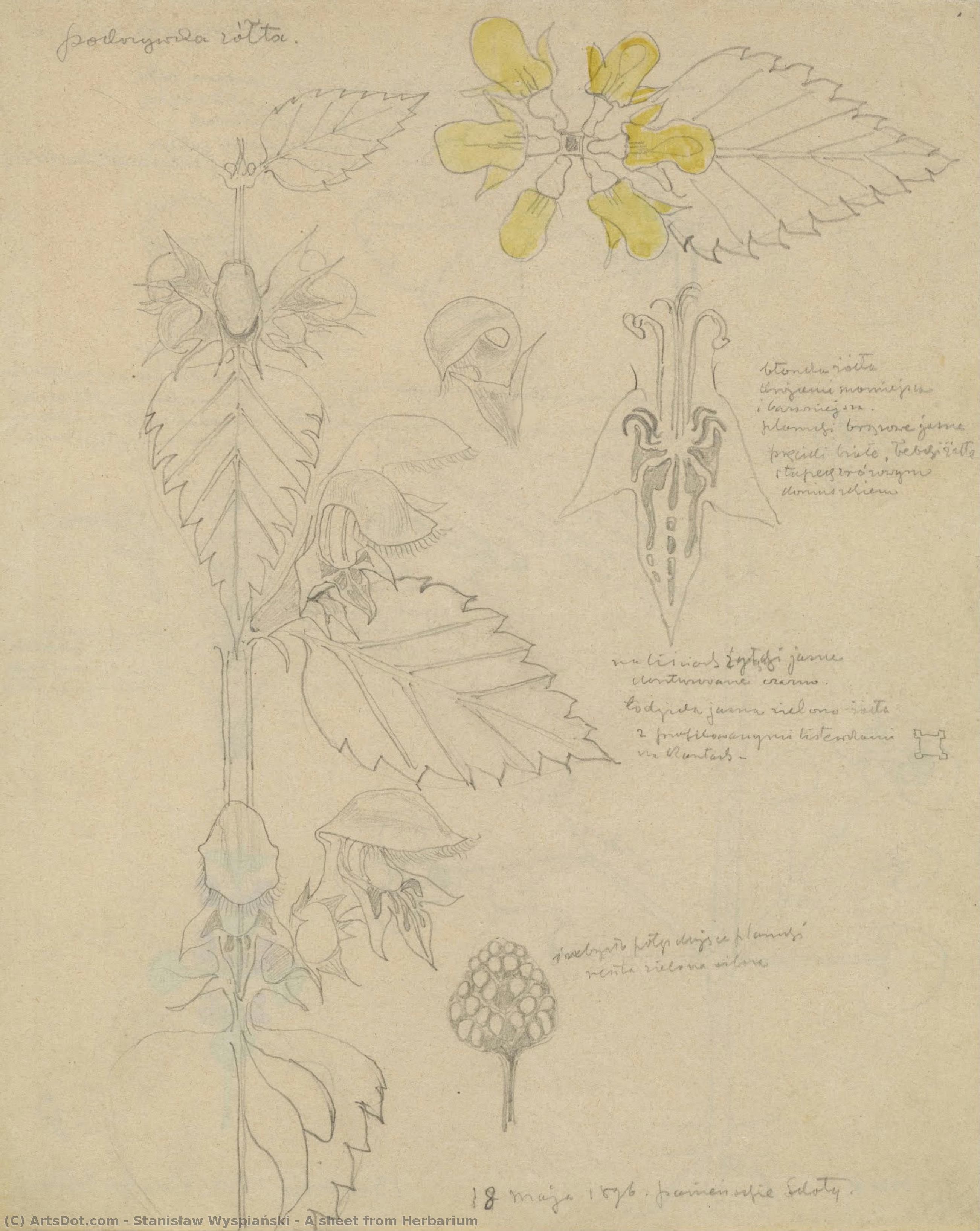
In the delicate intersection of scientific inquiry and poetic expression lies "A sheet from Herbarium," a mesmerizing work by the Polish master Stanisław Wyspiański. Created in 1896, this piece serves as a profound window into the artist's meticulous observation of the natural world. At first glance, the drawing presents itself as a botanical study, capturing the intricate anatomy of flora with an almost clinical precision. A leaf, bisected to reveal its hidden internal structures, invites the viewer to peer into the very lifeblood of the plant, while blossoms are positioned across the composition like notes on a musical staff. Yet, beneath this surface of biological documentation lies the unmistakable soul of the Young Poland movement, where every line carries an emotional weight and every botanical detail whispers of the ephemeral beauty of life.
The technique employed in this sheet is nothing short of masterful, showcasing Wyspiański’s ability to blend the clarity of illustration with the fluidity of fine art. The artist utilizes a delicate hand to trace the veins of leaves and the soft curves of petals, creating a sense of depth and texture that transcends the two-dimensional plane. The inclusion of a small bird, perched quietly in the upper corner, breaks the botanical focus to introduce a narrative element of companionship and ecosystem, suggesting a world that is breathing, moving, and interconnected. This interplay between the static specimen and the living creature creates a rhythmic tension that keeps the eye wandering through the composition, discovering new details with every glance.
Symbolism and the Spirit of Modernism
To understand this work, one must look toward the historical context of Kraków at the turn of the century. As a pivotal figure in Polish Symbolism, Wyspiański often used natural motifs to represent deeper national and spiritual themes. In "A sheet from Herbarium," the botanical elements act as metaphors for growth, decay, and the cyclical nature of existence. The meticulous labeling of plant parts suggests a desire to categorize and understand the universe, yet the artistic flourishes remind us that nature remains an untamable, mystical force. For the collector or art enthusiast, this piece offers more than just aesthetic pleasure; it provides a meditative experience, urging a slower, more intentional way of seeing the world.
For interior designers and connoisseurs of fine art reproductions, this work offers unparalleled versatility. Its organic lines and muted, naturalistic tones make it an exquisite centerpiece for spaces that celebrate Art Nouveau elegance or contemporary botanical themes. Whether placed in a sun-drenched study to inspire scientific curiosity or integrated into a sophisticated gallery wall to provide a moment of quiet reflection, the piece commands attention through its subtlety. Owning a reproduction of this caliber allows one to bring the timeless, soulful essence of Wyspiański’s vision into the modern home, fostering an environment of intellectual depth and organic beauty.