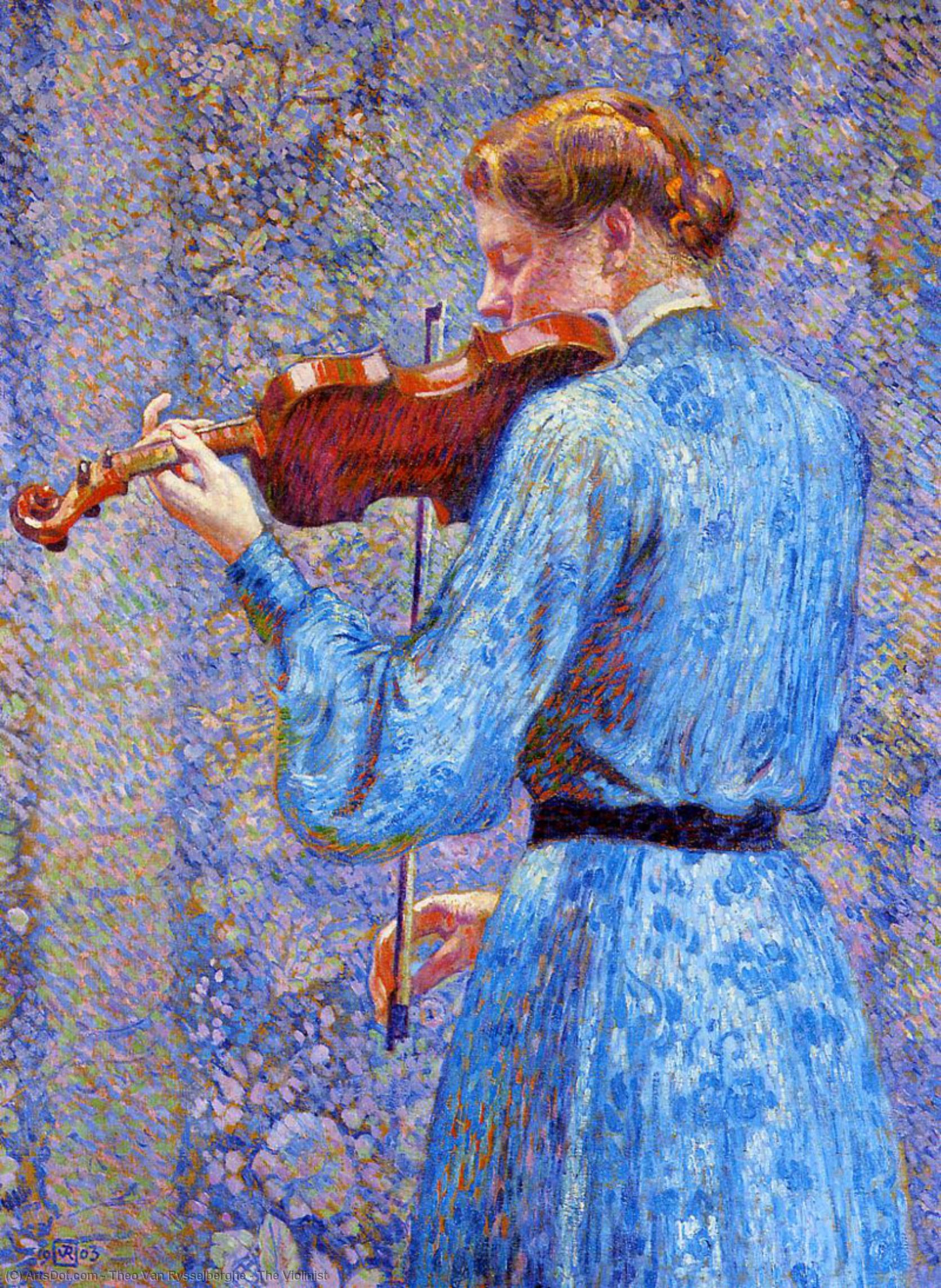
The Violinist by Theo van Rysselberghe: A Pointillist Reverie
Theo van Rysselberghe’s “The Violinist,” painted in 1903, is more than just a depiction of a woman playing an instrument; it's a meticulously crafted meditation on light, sound, and the quiet contemplation of artistic expression. This oil-on-canvas work, measuring 100 x 73 cm, offers a profound glimpse into the burgeoning world of Pointillism, a technique championed by van Rysselberghe himself, and reveals his deep engagement with capturing fleeting moments of beauty.
The Dance of Color: Pointillist Technique
Van Rysselberghe’s mastery of Pointillism is immediately apparent. Rather than blending colors directly on the canvas, he employed thousands of tiny dots – meticulously placed and layered – to create an illusion of tone and form. This technique, popularized by Georges Seurat and Paul Signac, demanded immense patience and precision. The resulting image shimmers with a vibrant energy, as individual points of color coalesce to define the woman’s figure, her blue dress, and the surrounding objects. The careful arrangement of these dots creates an almost tactile quality, inviting the viewer to actively participate in constructing the image's depth and luminosity. It is a testament to his dedication to scientific approach to painting.
A Portrait of Introspection: Subject and Composition
The central figure, a woman lost in her music, embodies a sense of serene introspection. Her posture, the focused gaze, and the simple elegance of her attire suggest a moment of profound concentration. The inclusion of subtle details – the blue dress, the bun hairstyle, and the carefully positioned bowl – adds to the painting’s realism while simultaneously elevating it beyond a mere portrait. The background elements—two birds seemingly observing the scene—introduce an element of nature and perhaps symbolize freedom or inspiration. This careful composition draws the viewer into the violinist's world, inviting us to share in her quiet moment.
Historical Context: Bridging Impressionism and Neo-Impressionism
"The Violinist" reflects van Rysselberghe’s pivotal role within the artistic landscape of early 20th century Belgium. Born in Ghent in 1862, he initially trained in traditional realism but was profoundly influenced by the Impressionists and later embraced Neo-Impressionism, a movement that sought to scientifically analyze color and light. This painting represents a culmination of these influences, demonstrating his ability to synthesize traditional artistic principles with innovative techniques. His work aligns him within a period of significant artistic experimentation, marking a transition between the subjective explorations of Impressionism and the more structured approach of Neo-Impressionism.
Collecting the Moment: Value and Significance
This exceptional reproduction captures not only the visual beauty of “The Violinist” but also its historical importance. Painted in 1903, it stands as a prime example of Theo van Rysselberghe’s artistic genius and his pioneering work with Pointillism. A hand-painted reproduction offers an unparalleled opportunity to own a piece of art history, bringing this captivating scene into your home or office. Its intricate detail and evocative atmosphere make it a compelling addition to any collection, appealing to both seasoned art enthusiasts and those seeking to infuse their spaces with beauty and contemplation.