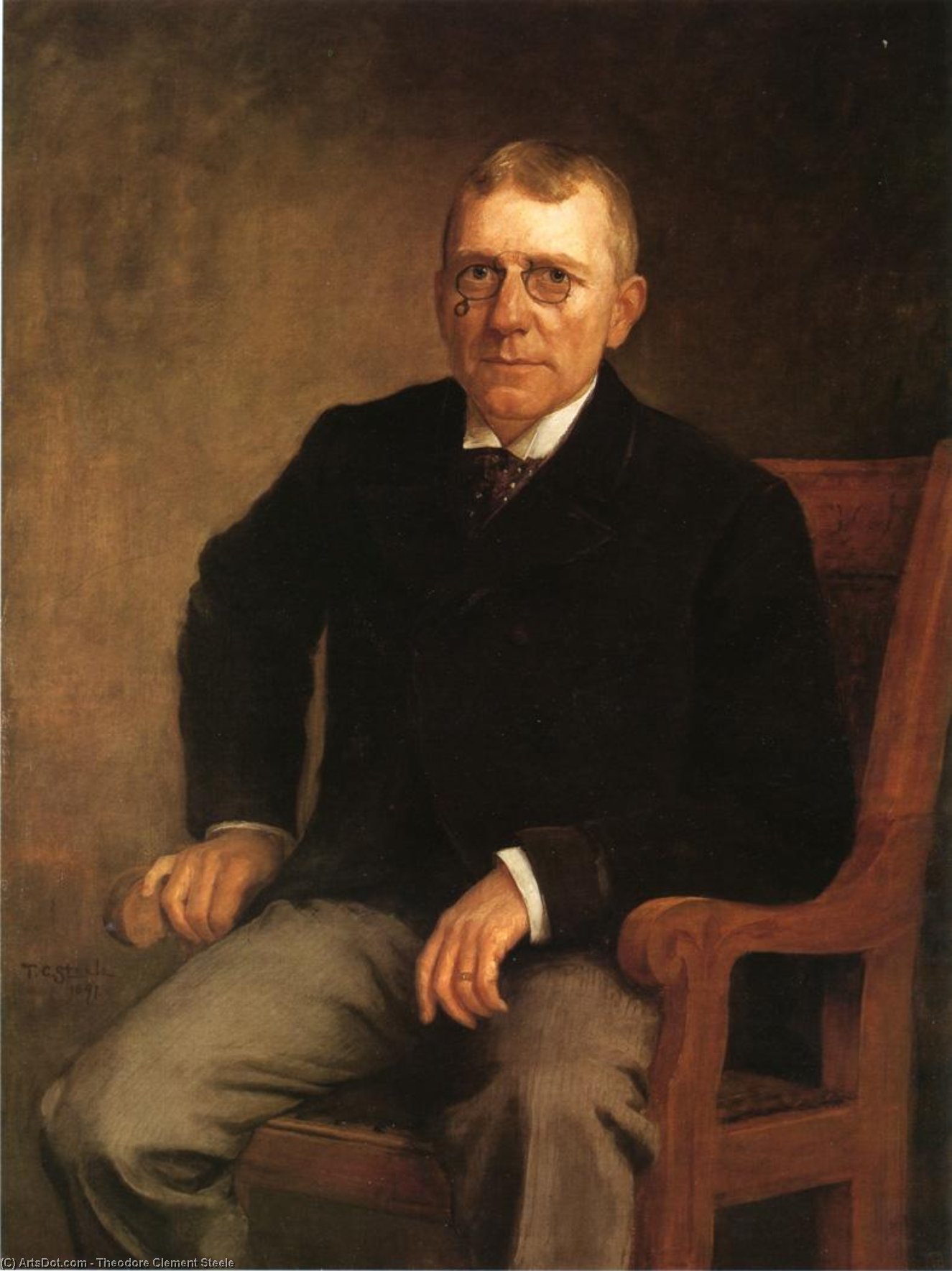
Admire 'Portrait of James Whitcomb Riley' by T.C. Steele! This captivating Impressionist painting showcases the renowned poet in a serene setting, reflecting Hoosier beauty and artistic mastery.
Discover Theodore Clement Steele (1847-1926), a leading American Impressionist painter renowned for luminous Indiana landscapes & capturing serene beauty. Explore his blend of European techniques and American themes.
Discover Newfields in Indianapolis! Explore 54,000+ artworks from African, Asian & European collections, stunning gardens, historic homes & nature parks. Enjoy exhibitions, tours & events for all ages.
Portrait of James Whitcomb Riley – A Hoosier Soul Captured in Light
The year is 1891. Indianapolis, Indiana, a burgeoning Midwestern city brimming with ambition and the spirit of westward expansion, finds itself captivated by the poetry of James Whitcomb Riley. It’s within this vibrant context that Theodore Clement Steele, a young artist deeply rooted in the landscape of his native state, immortalizes the poet in oil on canvas – a portrait not merely of a man, but of an era and a distinctly American voice. This is more than just a likeness; it's a distillation of Riley’s character, his gentle wisdom, and the quiet dignity that defined his enduring legacy. Steele, having spent formative years studying in Munich’s prestigious Academy, brought back with him a refined understanding of Impressionistic techniques, yet he skillfully adapted them to capture the unique qualities of the American Midwest. The painting isn't rendered with photographic precision; instead, it’s imbued with a palpable sense of warmth and intimacy, achieved through subtle shifts in light and color – a hallmark of Steele’s distinctive style.
The Palette of the Heartland
Steele’s masterful use of color is central to the portrait’s power. He employs a muted palette dominated by earthy browns, soft greens, and gentle blues, reflecting the natural hues of Indiana's rolling hills and expansive skies. Notice how the light catches the folds of Riley’s suit, creating a delicate interplay of shadows that lend depth and texture to the fabric. The background is deliberately indistinct, suggesting not a specific location but rather the broader landscape of Riley’s life – the familiar comforts and enduring beauty of his home state. The artist avoids harsh contrasts, favoring instead a harmonious blend of tones that evoke a sense of tranquility and understated elegance. This careful attention to color demonstrates Steele's commitment to capturing the essence of his subject, rather than simply creating a realistic representation.
A Window into a Poet’s Soul
Riley himself is depicted in a pose of quiet contemplation, seated comfortably in a chair. His spectacles, perched on his nose, suggest an intellectual curiosity and a deep engagement with the world around him. The slight furrow of his brow hints at the thoughtful process behind his poetic craft. Steele doesn't attempt to portray Riley as a grand figure or a heroic hero; instead, he presents him as a relatable human being – a man of simple pleasures, honest observations, and profound empathy. The artist’s focus is on capturing the poet’s inner life—his gentle spirit, his connection to the land, and the quiet wisdom gleaned from a lifetime spent observing and reflecting. The portrait invites us to step into Riley's world and share in his contemplative gaze.
Symbolism of Place and Identity
The choice of setting – a simple chair within an undefined interior – is laden with symbolic meaning. It speaks to Riley’s rootedness in the Midwest, his connection to the land, and his identification with the common people of Indiana. The portrait becomes a visual embodiment of the “Hoosier” identity—a region defined by its agricultural heritage, its strong sense of community, and its rich literary tradition. Steele's decision to paint Riley in a familiar setting reinforces this theme, suggesting that the poet’s voice is inextricably linked to the landscape and culture of his home state. The portrait isn’t just a representation of an individual; it’s a celebration of a place and a people.
A Legacy of Light and Sentiment
“Portrait of James Whitcomb Riley” remains a powerful testament to Steele's artistic vision and his deep appreciation for the American Midwest. It is a painting that transcends mere portraiture, offering viewers a glimpse into the soul of a poet and the spirit of an era. Reproductions of this iconic work continue to resonate with audiences today, evoking a sense of nostalgia for a bygone time and reminding us of the enduring power of poetry to capture the human experience. It’s a piece that speaks volumes about the beauty of simplicity, the importance of connection to place, and the timeless appeal of a gentle, thoughtful spirit.