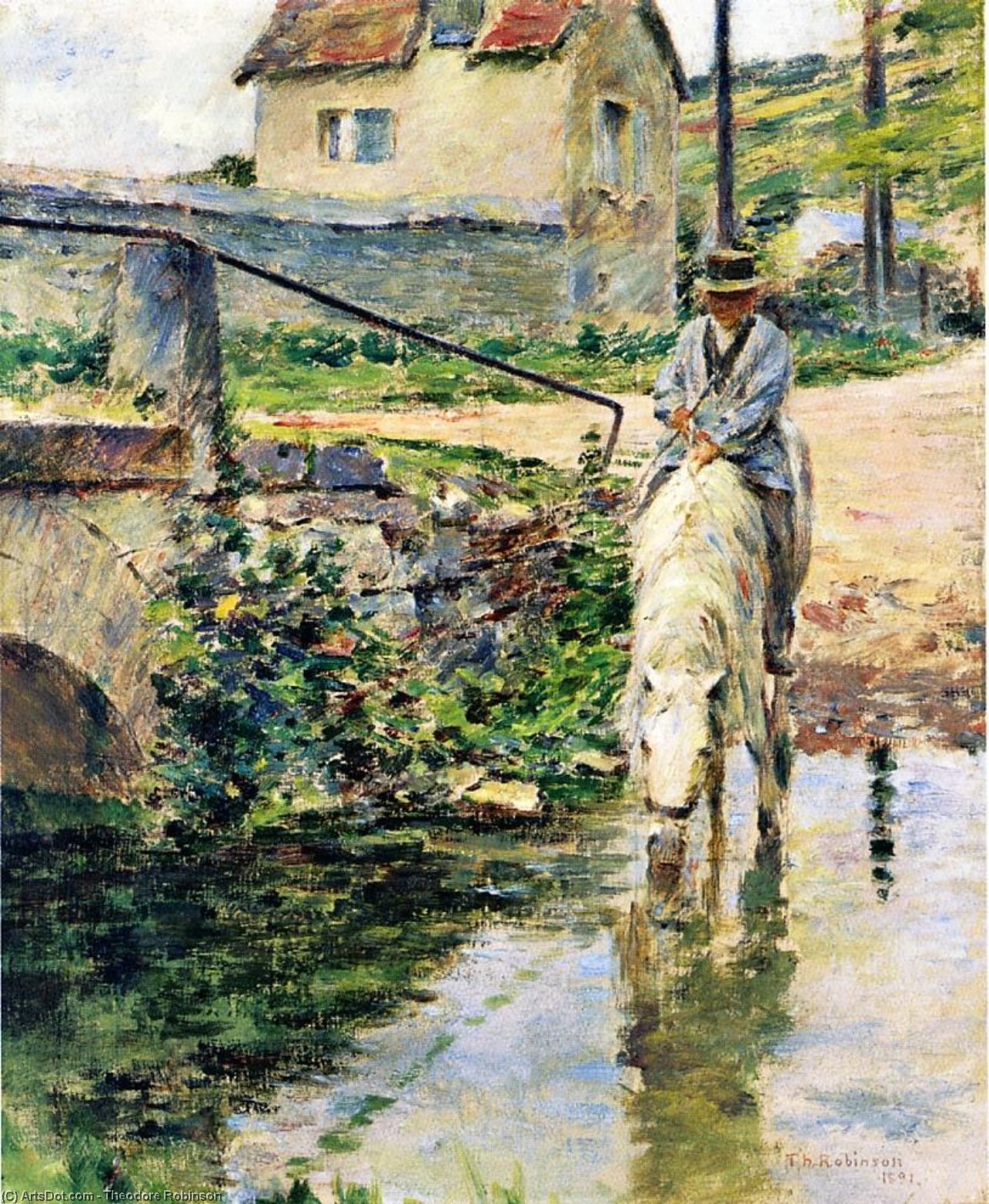
The Watering Place: A Vision of Rural Tranquility by Theodore Robinson
Theodore Robinson’s “The Watering Place,” painted in 1891, isn't merely a depiction of a rural scene; it’s an immersion into a carefully constructed world of quiet contemplation and the profound beauty of the natural world. This oil on canvas, currently residing within the Baltimore Museum of Art, offers a glimpse into the heart of American Impressionism – a movement Robinson helped pioneer by embracing the shimmering light and broken color techniques he encountered during his transformative years in France.
At first glance, the painting presents a deceptively simple tableau: a man on horseback traversing a dirt road leading to a modest farmhouse nestled amidst rolling hills. A second horse stands patiently nearby, suggesting a moment of respite or perhaps the anticipation of another journey. However, beneath this surface tranquility lies a complex layering of artistic influences and personal reflection. Robinson’s early training in traditional academic styles is evident in the meticulous rendering of the landscape – the precise detail of the foliage, the subtle gradations of color in the sky, and the carefully constructed perspective of the buildings. Yet, he skillfully infuses this foundation with the Impressionistic principles he absorbed from Monet and other French masters, particularly their focus on capturing fleeting moments of light and atmosphere.
Impressionist Techniques and a Harmonious Palette
Robinson’s masterful use of brushstrokes is immediately striking. Rather than striving for sharp outlines or photographic realism, he employs loose, expressive strokes that create a sense of movement and immediacy. Notice how the sunlight seems to dance across the fields, rendered with delicate washes of color – pale blues and greens mingling with hints of gold and ochre. This technique isn’t simply about replicating what the eye sees; it's about conveying the *feeling* of being present in that moment, experiencing the warmth of the sun and the freshness of the air.
The composition itself is carefully balanced, drawing the viewer’s eye along the winding road towards the distant farmhouse. The muted color palette – dominated by earthy tones and soft pastels – contributes to a sense of serenity and timelessness. Robinson's deliberate choice of colors evokes a feeling of nostalgia, as if recalling a simpler, more harmonious time. The painting is not about grand drama or heroic figures; it’s about the quiet dignity of rural life and the restorative power of nature.
A Reflection of Robinson’s Journey
Understanding “The Watering Place” requires considering Theodore Robinson's own personal journey as an artist. Born in Vermont, he spent his early years moving across the United States before embarking on a pivotal trip to Europe in 1884. It was during this time that he became deeply influenced by Impressionism and developed a close friendship with Claude Monet at Giverny. Robinson’s work began to reflect these new influences, shifting from more traditional landscapes to paintings characterized by vibrant color, broken brushstrokes, and an emphasis on capturing the ephemeral qualities of light and atmosphere.
The painting can be interpreted as a distillation of Robinson's experiences – a longing for the tranquility he found in nature after years of restless travel. The man on horseback represents a journey, both literal and metaphorical, while the watering place itself symbolizes a moment of respite and renewal. It’s a scene imbued with a sense of peace and contentment, suggesting that true beauty can be found in the simplest of things.
Collecting a Legacy: Reproductions and Beyond
Today, “The Watering Place” stands as a testament to Robinson's artistic vision and his significant contribution to American art. High-quality reproductions, such as those available at ArtsDot.com, allow art lovers to experience the painting’s beauty and tranquility in their own homes. These meticulously crafted prints capture the essence of Robinson's original work, offering a tangible connection to this remarkable piece of American artistic heritage. For those seeking to delve deeper into Robinson’s life and work, resources like the Baltimore Museum of Art’s website (Wikipedia) and online artist databases provide valuable insights.