The Soul Beneath the Surface: Eakins’s Mastery of Realism
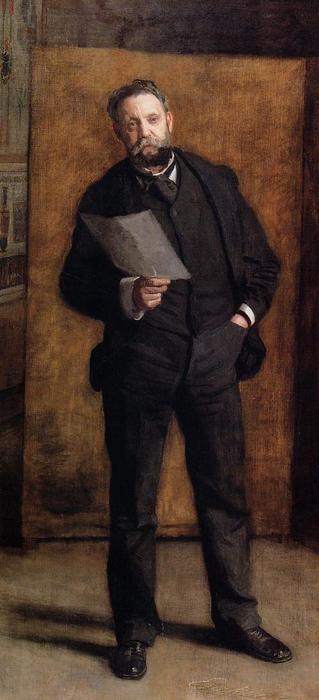
In the quiet, commanding presence of Thomas Eakins’s Portrait of Leslie W. Miller, one finds more than a mere likeness of a man; one encounters a profound meditation on character and intellect. Completed in 1901, this masterpiece serves as a cornerstone of American Realism, capturing the essence of Professor Leslie William Miller with an unflinching honesty that was Eakins’s unmistakable hallmark. The painting does not rely on the superficial flourishes of high society or the idealized glow of Romanticism. Instead, it presents a study in psychological depth, where every line of the subject's posture and every subtle shift in light serves to reveal the inner life of a man dedicated to the pursuit of knowledge.
Eakins, a painter whose scientific rigor was informed by his deep fascination with anatomy, approaches the canvas with the precision of a surgeon and the soul of a poet. The subject, Miller—the esteemed principal of the Pennsylvania Museum and School of Industrial Art—is depicted in an arresting pose that suggests a moment of paused contemplation. As his gaze drifts upward toward a manuscript held in his hand, the viewer is invited into a shared space of intellectual engagement. There is a palpable sense of purpose in his stance, a weightiness to his presence that commands respect and evokes a sense of timeless dignity.
A Symphony of Technique and Texture
To behold this work is to witness the pinnacle of oil painting technique. Eakins utilized a sophisticated method of layering thin, translucent glazes over a meticulously prepared tonal underpainting. This painstaking process allows light to penetrate the various strata of pigment, creating a luminous quality that breathes life into the skin tones and fabric of the sitter. The texture of the canvas becomes a playground for light and shadow, where the heavy folds of a formal suit meet the delicate, paper-like quality of the manuscript.
The artist’s commitment to anatomical accuracy is evident in the way he renders the musculature and skeletal structure beneath Miller's skin. This scientific approach does not strip the portrait of its humanity; rather, it anchors the subject in reality, making his presence feel undeniably physical and present. For the collector or the interior designer, this technical mastery translates into a piece of profound visual interest, capable of anchoring a room with its sophisticated interplay of light, shadow, and substance.
Historical Resonance and Timeless Elegance
Beyond its individual brilliance, the Portrait of Leslie W. Miller acts as a window into the spirit of late Victorian Philadelphia. It captures a period of burgeoning industrialization and scientific advancement, where the intellectual elite were shaping the cultural landscape of a growing nation. The painting embodies the values of that era—discipline, observation, and a profound respect for the empirical truth. By documenting figures like Miller, Eakins created a visual record of the very architects of American institutional progress.
For those seeking to adorn a space with art that inspires thought and conversation, this reproduction offers an unparalleled opportunity. It is a piece that transcends the trends of modern decor, providing a sense of historical continuity and intellectual gravity. Whether placed in a private library, a professional study, or a curated gallery setting, Eakins’s portrait brings with it an atmosphere of seriousness, importance, and an enduring, quiet beauty that continues to captivate the modern eye.