The Unflinching Gaze: Capturing Introspection in Eakins' Portrait of Maud Cook
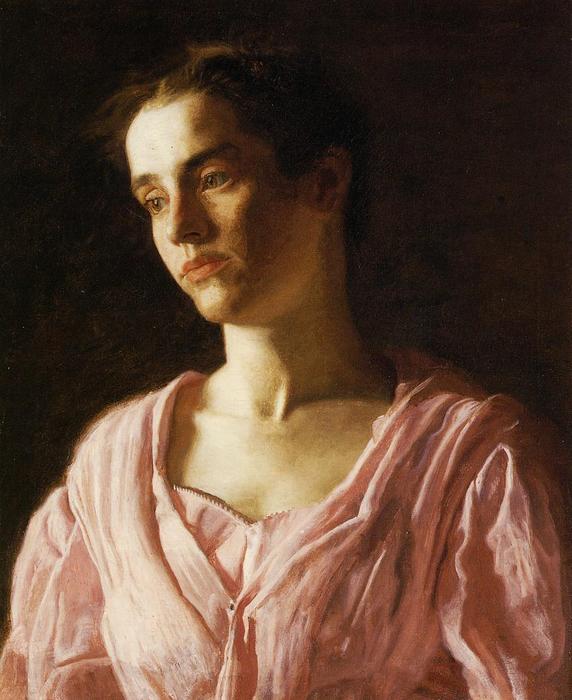
To stand before Thomas Eakins’ Portrait of Maud Cook is not merely to observe a likeness; it is to encounter a moment of profound, quiet contemplation. Painted in 1895, this oil on canvas transcends the simple act of portraiture, offering instead an intimate window into the psychological landscape of its sitter. Eakins, the master of American realism, possessed an almost scientific dedication to truth, and here, that commitment shines through every meticulously rendered strand of hair and every subtle nuance in Maud Cook’s expression. The composition immediately draws the viewer in with the subject's direct, yet deeply thoughtful gaze—a look that seems to acknowledge not just the artist, but the very act of being observed.
Technique and Material Mastery
Eakins’ technical prowess is evident in the handling of light and shadow. The way the illumination catches the folds of her pink shawl and highlights the delicate structure beneath her jaw speaks to a masterful understanding of oil paint on canvas. Notice the subtle dimensionality achieved through chiaroscuro; it gives the figure a tangible presence, pulling her forward from the background plane. Her attire—the modest dress reaching to her knees, complemented by that soft pink wrap—is rendered with an attention to texture that is breathtaking. The artist did not just paint fabric; he captured its weight, its drape, and how it interacts with the ambient light of the studio.
Symbolism in Simplicity
The symbolism within Portrait of Maud Cook resides in its restraint. The pulled-back bun and the simple necklace suggest a contained elegance, a quiet dignity that speaks volumes without uttering a word. The pink clothing itself often carries connotations of femininity and tenderness, yet it is juxtaposed against her serious, almost resolute expression. This tension—between the softness suggested by the color and the intellectual depth conveyed by her eyes—is where the painting finds its enduring resonance. It invites us to question what lies beneath the surface calm.
A Window into Late 19th-Century American Life
Historically, this work situates itself within a period of intense artistic evolution in America. Eakins was deeply committed to realism, moving away from romantic idealism toward an unflinching depiction of contemporary life and character. This portrait is a testament to that dedication—a refusal to prettify reality for mere aesthetic pleasure. For the collector or designer seeking art with genuine historical weight, this piece offers more than decoration; it offers a tangible connection to the rigorous artistic standards of the late Victorian era.
Bringing Introspection Home
For those considering acquiring a high-quality reproduction of this masterpiece for your home or gallery, know that you are bringing home an object imbued with narrative power. The emotional impact of Portrait of Maud Cook is one of quiet contemplation; it encourages the viewer to pause, to look deeper, and to consider their own inner narratives. It is a sophisticated piece that complements environments demanding both beauty and intellectual depth.