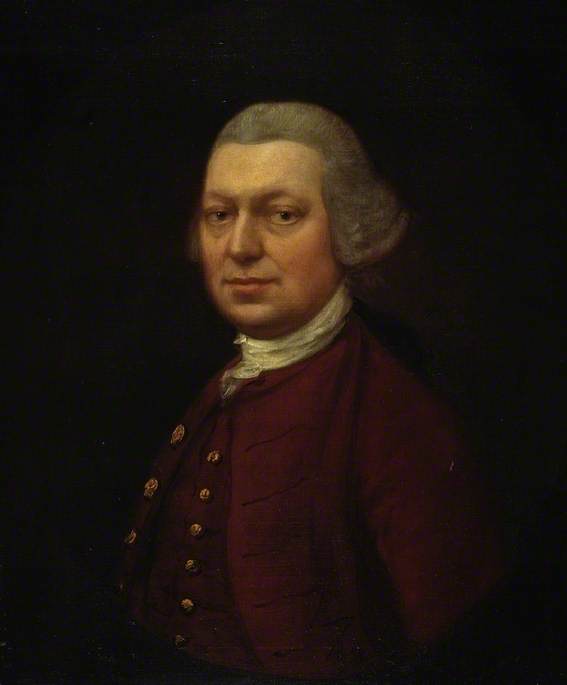
A Portrait of Quiet Dignity: Joshua Kirby by Thomas Gainsborough
Thomas Gainsborough’s “Joshua Kirby,” painted in 1764, is more than just a likeness; it's a carefully constructed tableau of Georgian society and the artist’s evolving mastery. This captivating portrait, rendered in a masterful blend of black and white, immediately draws the viewer into a scene of understated elegance and quiet contemplation. The subject, Joshua Kirby himself – a painter, author, and printmaker – stands as a testament to Gainsborough's ability to capture not just physical appearance but also the very essence of his sitter’s character.
The painting immediately establishes a sense of formality through Kirby’s attire: a rich red coat, meticulously trimmed with white, speaks to his social standing. The wig, a fashionable accessory of the era, adds another layer of visual interest and subtly hints at the artificiality often present in portraits of this period. Yet, Gainsborough avoids a stiff or overly posed presentation. Kirby's gaze, directed squarely at the viewer, is imbued with an air of gentle curiosity – he isn’t merely presenting himself; he’s engaging in a silent conversation.
The Suffolk Landscape and Artistic Roots
Understanding “Joshua Kirby” requires acknowledging Gainsborough’s formative years in Sudbury, Suffolk. As our research reveals, the artist's early life was deeply rooted in the rural landscape – a stark contrast to the burgeoning urban centers of London. This connection profoundly influenced his artistic vision, imbuing his work with a sensitivity to light, texture, and the subtle nuances of nature. The dark background, deliberately chosen by Gainsborough, serves not as an absence of detail but rather as a powerful amplifier for Kirby’s features, emphasizing his face and creating a sense of intimacy.
The painting's monochromatic palette—a hallmark of Gainsborough’s style—further enhances this effect. He skillfully manipulates light and shadow to sculpt Kirby’s form, lending the portrait an almost sculptural quality. The absence of color allows the viewer to focus entirely on the intricacies of his expression and the subtle details of his clothing.
A Study in Georgian Character
Beyond a simple depiction of a man, “Joshua Kirby” offers a glimpse into the social dynamics of 18th-century England. The portrait reflects the values of the era – respect for tradition, an appreciation for refined manners, and a fascination with appearances. However, Gainsborough subtly subverts these expectations by imbuing Kirby with a quiet dignity that transcends mere social convention.
The painting’s composition—the direct gaze, the carefully arranged clothing, and the restrained expression—suggests a man of intellect and refinement, yet also one who possesses an inner reserve. It's this delicate balance between outward composure and hidden depth that makes “Joshua Kirby” such a compelling and enduring work of art.
Symbolism and Artistic Legacy
Interestingly, the portrait’s creation coincided with Gainsborough’s exploration of his own artistic identity. He was grappling with the shift from landscape painting to portraiture, seeking to capture not just likeness but also personality. “Joshua Kirby” exemplifies this transition, showcasing Gainsborough's growing confidence in portraying human subjects and his ability to imbue them with a sense of life.
Furthermore, the painting’s popularity contributed to the rise of portraiture as a significant genre within British art. It demonstrates Gainsborough’s skill in capturing not just physical likeness but also the character and social standing of his subjects. The work's influence can be seen in the subsequent portraits created by imitators of Gainsborough, solidifying his place as one of Britain’s most celebrated artists.