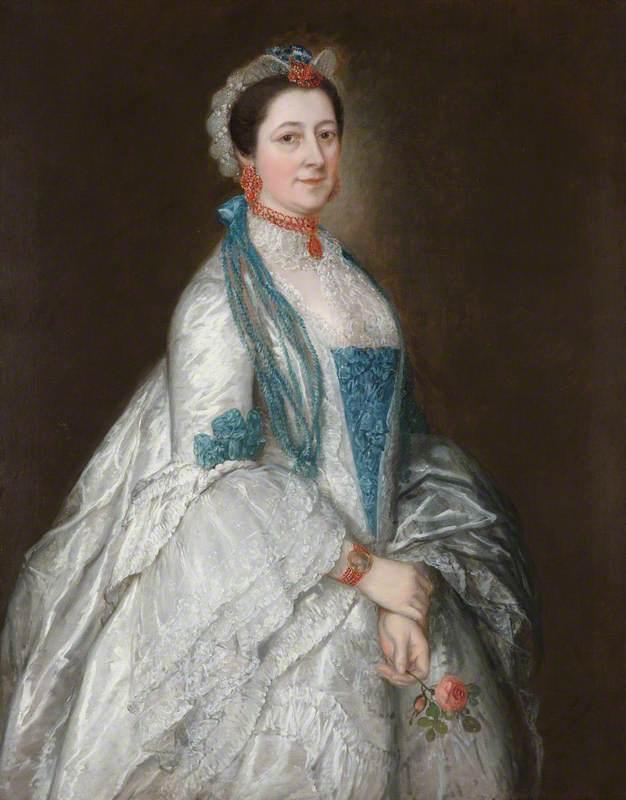
Lady Margaret Downing by Thomas Gainsborough captures elegance and quiet dignity with soft whites, subtle blues, and diffused natural lighting—a quintessential Romantic portrait reflecting wealth and refined taste.
Lady Margaret Downing: An Ode to Refinement in Gainsborough’s Brushstrokes
Thomas Gainsborough, born in 1727 amidst the pastoral beauty of Sudbury, Suffolk, stands as a cornerstone of British Romanticism. His artistic journey began not within the hallowed halls of academia but in his father's wool workshop—a formative experience that instilled in him an appreciation for observation and detail, skills he would later translate into canvases brimming with luminous color and masterful draughtsmanship. Unlike many of his contemporaries who pursued formal training, Gainsborough cultivated his talent independently, honing his craft through tireless practice and a profound connection to the English countryside. This dedication resulted in a distinctive style characterized by serene landscapes interwoven with exquisitely rendered portraits—a stylistic fusion that cemented his legacy as one of Britain’s most beloved artists.
- Subject Matter: The portrait depicts Lady Margaret Downing, wife of Sir Jacob Downing, a prominent figure in British politics during the Georgian era. Gainsborough skillfully captures her likeness, presenting her with dignified poise and conveying an aura of quiet composure.
- Style: Gainsborough’s oeuvre embodies the Romantic aesthetic—a movement prioritizing emotion and imagination alongside meticulous realism. He eschewed theatrical poses and dramatic lighting favored by earlier portraitists, opting instead for a naturalistic approach that aimed to portray his subjects as individuals inhabiting their surroundings.
Technique & Material Considerations: Layers of Light and Texture
Gainsborough’s technique exemplifies the meticulous craftsmanship demanded by the era. Employing oil paint on canvas—a medium known for its ability to achieve unparalleled luminosity—he utilized a layering process termed “glazing.” Thin, translucent washes of pigment were applied successively upon each other, building up tonal depth and creating subtle gradations that mimic the effects of natural light. This technique allowed Gainsborough to capture the nuances of skin tone and fabric texture with remarkable accuracy, imbuing his paintings with an ethereal quality. The pigments themselves—derived from minerals and plants—were carefully mixed with linseed oil, ensuring optimal adhesion and blending capabilities.
- Color Palette: Dominating the canvas is a palette of muted whites and creams, accented by delicate blues and hints of pink and brown. Gainsborough’s masterful use of color contributes to the painting's overall mood—one of serenity and understated elegance.
- Composition & Line Work: The three-quarter view pose emphasizes Lady Downing’s gracefulness while subtly off-centering her figure creates visual interest. Lines are extensively utilized to delineate drapery folds and facial contours, conveying a sense of fluidity and movement despite the stillness of the scene.
Symbolism & Context: Wealth, Status, and Domestic Tranquility
Beyond its aesthetic merits, “Lady Margaret Downing” speaks volumes about the social conventions of Georgian Britain. The woman’s attire—a gown adorned with shimmering silk or satin—symbolizes wealth and aristocratic status. Similarly, the bouquet of flowers presented by Lady Downing represents beauty, purity, and domestic tranquility—values highly esteemed within the Victorian ideal of femininity. Situated against a blurred brown background, this deliberate lack of detail underscores the subject's importance and reinforces the intimacy of the portrait genre.
Emotional Resonance: Dignity & Quiet Grace
Ultimately, Gainsborough’s masterpiece transcends mere representation; it communicates profound emotional resonance. Lady Margaret Downing embodies dignity and quiet grace—qualities prized in portraits intended to commemorate individuals of distinction. The painting's subdued palette and masterful technique combine to evoke a sense of contemplative beauty, inviting viewers to contemplate the virtues of composure and refinement. It remains an enduring testament to Gainsborough’s artistic genius and his ability to capture the essence of human character within the framework of a timeless landscape.