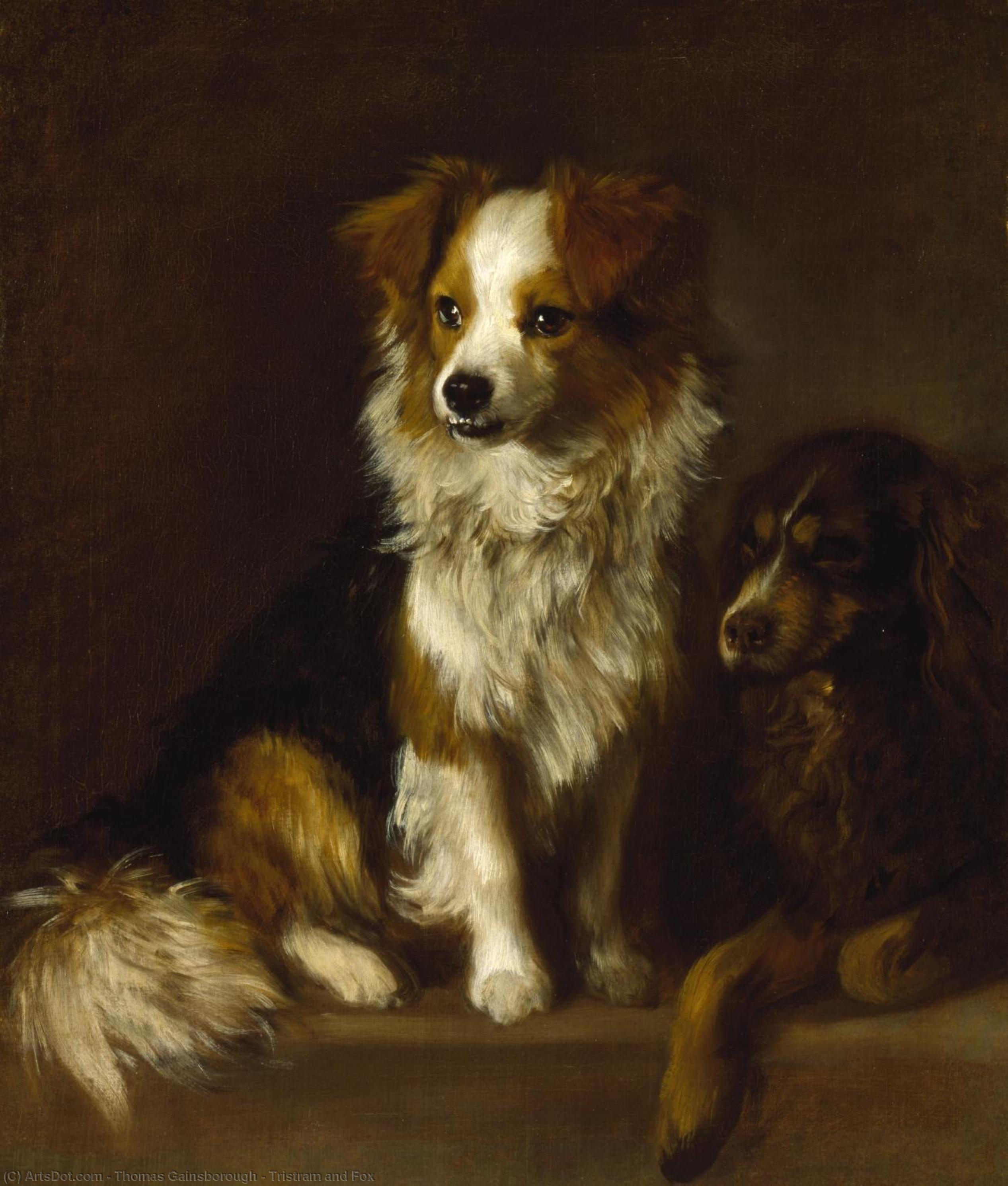
Thomas Gainsborough’s "Tristram and Fox," painted in 1775, captures a charming portrait of two dogs alongside their human companions, showcasing the artist's signature style and idyllic British countryside scenes – discover this exquisite hand-painted reproduction.
A Moment of Canine Contemplation: Gainsborough's "Tristram and Fox"
Thomas Gainsborough’s “Tristram and Fox,” painted in 1775, is more than just a charming depiction of two dogs; it’s a window into the burgeoning artistic sensibilities of a young man shaped by the Suffolk countryside. This intimate portrait, measuring 61 x 51 cm, captures a fleeting moment of quiet observation, inviting us to consider the subjects' intentions and the subtle interplay between animal and human presence. The painting’s immediate appeal lies in its deceptively simple composition – two dogs, one on either side of a table, their gazes fixed on an unseen point. Yet, within this apparent stillness resides a wealth of artistic and historical significance.
The Artist's Suffolk Roots and Early Influences
- Thomas Gainsborough’s journey to becoming one of Britain’s most celebrated artists began not in the hallowed halls of London, but in the rural tranquility of Sudbury, Suffolk. Born in 1727, he was the youngest son of a wool merchant, yet from a remarkably young age, his passion lay with drawing and painting.
- His father recognized this innate talent and fostered it, providing him with materials and encouraging his artistic pursuits – a deliberate divergence from the family trade that ultimately shaped Gainsborough’s distinctive style.
- The Suffolk landscape itself became his initial muse, imbuing his early works with a characteristic sensitivity to light and atmosphere, qualities that would define his later masterpieces.
A Study in Composition and Technique – Gainsborough's Approach
Gainsborough’s technique in “Tristram and Fox” exemplifies his mastery of tonal modeling and atmospheric perspective. Notice the subtle gradations of light and shadow that define the dogs’ fur, creating a remarkable sense of volume and texture. The loose brushwork, characteristic of Gainsborough's later style, contributes to the painting’s relaxed and naturalistic feel. The use of warm earth tones – browns, ochres, and muted greens – reflects the Suffolk countryside, grounding the scene in its immediate surroundings. The inclusion of two figures observing the dogs adds a layer of narrative complexity, prompting questions about their relationship and motivations.
Symbolism and Emotional Resonance
While seemingly straightforward, “Tristram and Fox” is rich with symbolic potential. Dogs have long been associated with loyalty, companionship, and the pastoral life – themes frequently explored in Gainsborough’s work. The dogs' focused gazes suggest a moment of intense concentration or perhaps an anticipation of something unseen. The presence of the human figures adds to this ambiguity, inviting us to interpret their roles as observers, companions, or even participants in the scene. The painting evokes a sense of quiet contemplation and peacefulness, capturing a timeless moment of connection between humans and animals.
A Timeless Masterpiece – Reproduction Possibilities
ArtsDot offers meticulously crafted hand-painted reproductions of Gainsborough’s “Tristram and Fox,” ensuring that you experience the full beauty and emotional depth of this iconic artwork. Each reproduction is created using traditional oil painting techniques, faithfully replicating Gainsborough's masterful brushwork and nuanced color palette. Whether for your home, office, or as a unique gift, our reproductions provide an authentic connection to one of Britain’s greatest artistic treasures.