A Vision of Regency Elegance
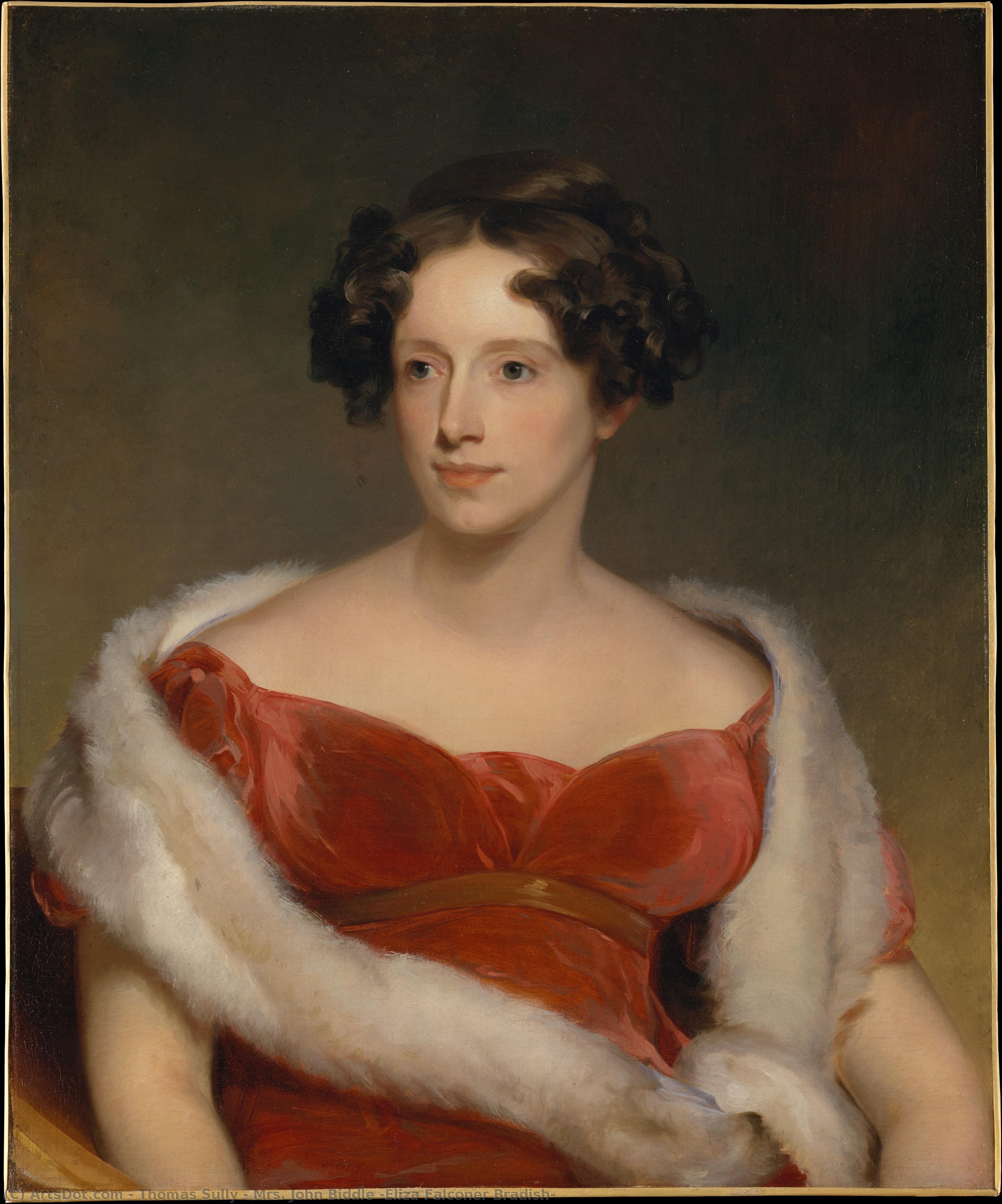
In the soft, luminous glow of Thomas Sully’s 1818 masterpiece, Mrs. John Biddle (Eliza Falconer Bradish), we encounter more than just a portrait; we step into the refined atmosphere of early nineteenth-century American high society. This exquisite oil on canvas serves as a breathtaking window into an era defined by grace, social aspiration, and the burgeoning Romantic movement. As the eye meets the subject, one is immediately struck by the profound sense of poise held by Eliza Falconer Bradisch. She does not sit with the rigid, unyielding posture often found in earlier aristocratic portraiture; instead, Sully captures her in a moment of relaxed sophistication, an informal pose that suggests a quiet intimacy and a burgeoning ideal of domestic tranquility.
The painting is a masterclass in texture and light, where every brushstroke contributes to a sensory experience. The deep, rich crimson of her velvet gown commands the viewer's attention, its heavy folds rendered with such precision that one can almost feel the weight of the luxurious fabric. Draped across her shoulders, a plush fur stole adds a layer of tactile opulence, contrasting beautifully with the delicate shimmer of the pearls encircling her neck. Sully’s technique, heavily influenced by the British master Thomas Lawrence, utilizes subtle tonal gradations and luminous layering to create a skin tone that appears to radiate from within, imbuing the portrait with a lifelike, breathing quality that is rare in works of this period.
Symbolism and the Romantic Spirit
Beyond the mere depiction of a prominent socialite, the composition is rich with the subtle language of the Romantic era. The interplay between the dramatic flourish of her attire and the soft, focused rendering of her face creates a captivating visual tension. While the opulent drapery speaks to the wealth and status of the Biddle family—a lineage deeply woven into the cultural fabric of Philadelphia—the subject's expression hints at a deeper, more psychological narrative. There is an air of romantic uncertainty beneath the surface, a characteristic hallmark of Sully’s ability to capture the fleeting nuances of human emotion.
The choice of color also plays a pivotal role in the painting's emotional resonance. By diverging from the color palettes used in his earlier portraits of her husband, Major John Biddle, Sully creates a visual dialogue that scholars suggest reflects the complex layers of identity and marital harmony. For the discerning collector or interior designer, this piece offers a profound sense of historical continuity and timeless beauty. It is an artwork that does not merely decorate a space but transforms it, providing a focal point of intellectual depth and aesthetic splendor.
An Inspiration for the Modern Interior
For those seeking to curate a collection that speaks of heritage and refined taste, a high-quality reproduction of Mrs. John Biddle offers an unparalleled opportunity. The painting’s balanced yet dynamic composition makes it an ideal centerpiece for a variety of sophisticated settings, from a classic study lined with leather-bound books to a contemporary living space seeking a touch of historical grandeur. Its ability to evoke feelings of warmth, luxury, and quiet contemplation ensures that it remains a conversation piece for generations.
Integrating such a masterful work into an interior design scheme allows for the introduction of rich textures and a storied past. Whether placed in a gallery-style hallway or as a commanding presence above a mantle, this portrait brings with it the spirit of the American Renaissance—a period where art and identity were inextricably linked. To possess a reproduction of this caliber is to hold a fragment of history, rendered with the meticulous care required to honor Sully’s enduring legacy.