A Moment Suspended in Light
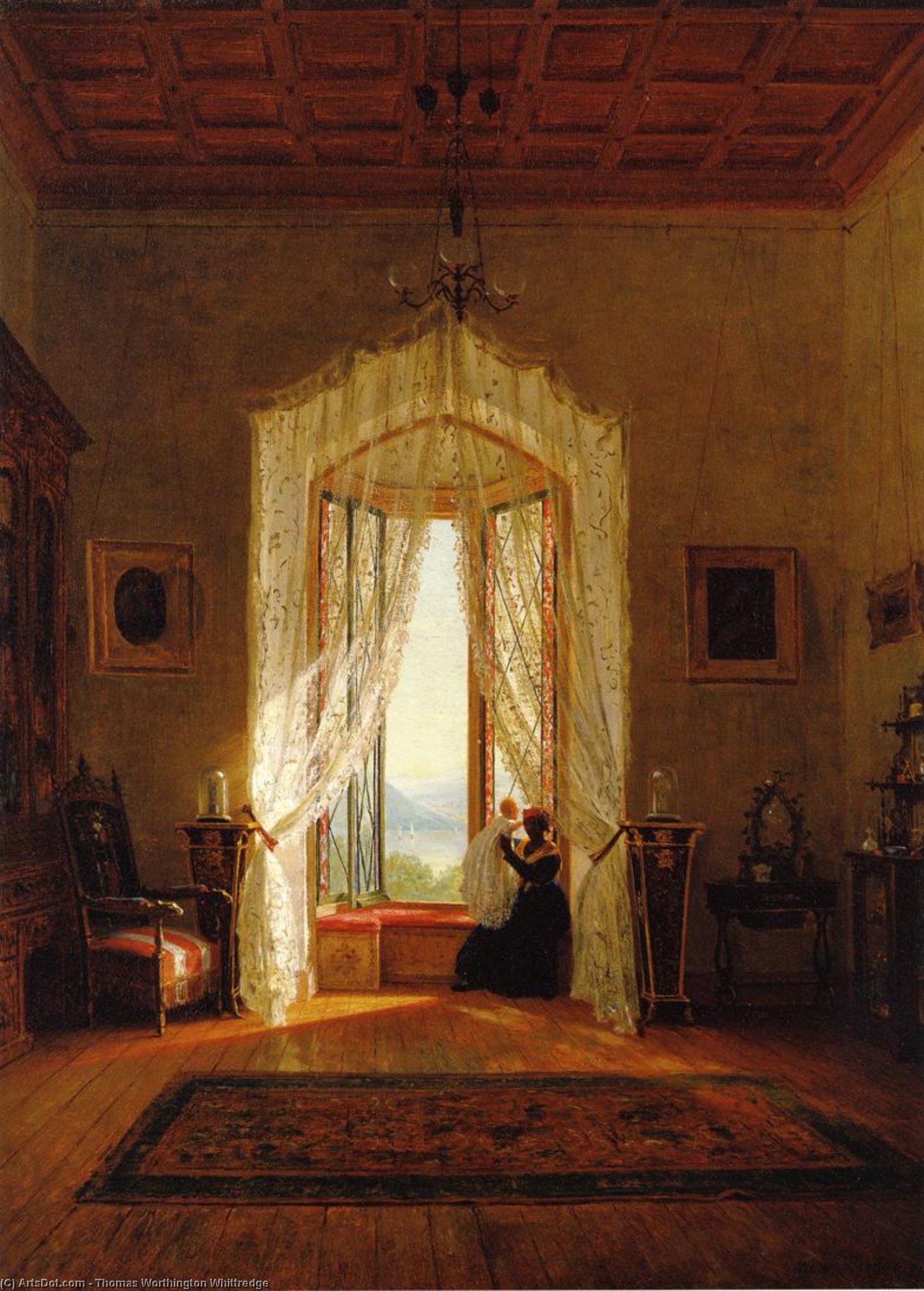
In the quietude of 1863, Thomas Worthington Whittredge captured more than just a domestic scene; he captured a profound sense of longing and stillness. A Window, House on the Hudson River invites the viewer into an intimate interior where the boundary between the private sanctuary of the home and the vast, untamed beauty of the American landscape begins to blur. At the heart of this composition sits a woman, her figure draped in a long, flowing dress that anchors the scene with a sense of grounded grace. She gazes through a window framed by soft curtains, her posture suggesting a contemplative state—perhaps she is lost in thought, or perhaps she is waiting for a traveler to emerge from the horizon. The light filtering through the glass does not merely illuminate the room; it breathes life into the textures of the fabric and the subtle shadows of the interior, creating an atmosphere that feels both heavy with memory and light with hope.
The technique employed by Whittredge, a master of the second generation of the Hudson River School, is nothing short of luminous. His ability to manipulate atmospheric effects allows the viewer to sense the humidity in the air and the gentle shift of daylight. Through meticulous brushwork on canvas, he renders the dining table in the background, the delicate bowl, and the rhythmic presence of a wall clock with such factual precision that the room feels inhabited. This mastery of light and shadow—a hallmark of his training at the Düsseldorf Academy—serves to elevate a simple domestic moment into a poetic meditation on time and presence. For the collector or interior designer, this piece offers a sophisticated interplay of texture and tone, making it an ideal centerpiece for spaces that value tranquility and classical elegance.
The Harmony of Interior and Exterior
Beyond the immediate visual charm, the painting serves as a symbolic bridge between the civilized world and the natural wilderness. While the foreground is defined by the comforts of home—the chairs, the vases, and the structured arrangement of a dining space—the window acts as a portal to the infinite. This duality was central to the Hudson River School's philosophy, reflecting the mid-19th-century American fascination with the sublime power of nature contrasted against the burgeoning stability of domestic life. The presence of the clock on the wall adds a layer of temporal depth, reminding us that while the seasons and the light outside are in constant flux, the human spirit seeks moments of eternal stillness within the walls of our own making.
For those looking to bring this sense of historical grandeur into a modern residence, a high-quality oil reproduction of this work provides an unparalleled opportunity. The painting’s palette, rich with earthy tones and soft, diffused light, complements a wide variety of interior aesthetics, from traditional manor styles to contemporary minimalist settings. It is not merely a decoration but a window into a bygone era of American romanticism, offering any room a sense of narrative depth and an emotional resonance that lingers long after the first glance.